










Rail Vikas Nigam Limited secures 35- and 10-year maintenance periods
Key highlights
- RVNL’s Rs 8,640 crore Vande Bharat Sleeper share includes a 35-year O&M commitment.
- The Rs 13,236 crore BharatNet project covers 82,607 kilometres of fibre and a 10-year O&M lifecycle.
- BharatNet reached 10% physical progress in FY26 after its FY25 DBOM award.
- RVNL’s total order book stood at Rs 90,099 crore as of Q2FY27.
powered by IRIS
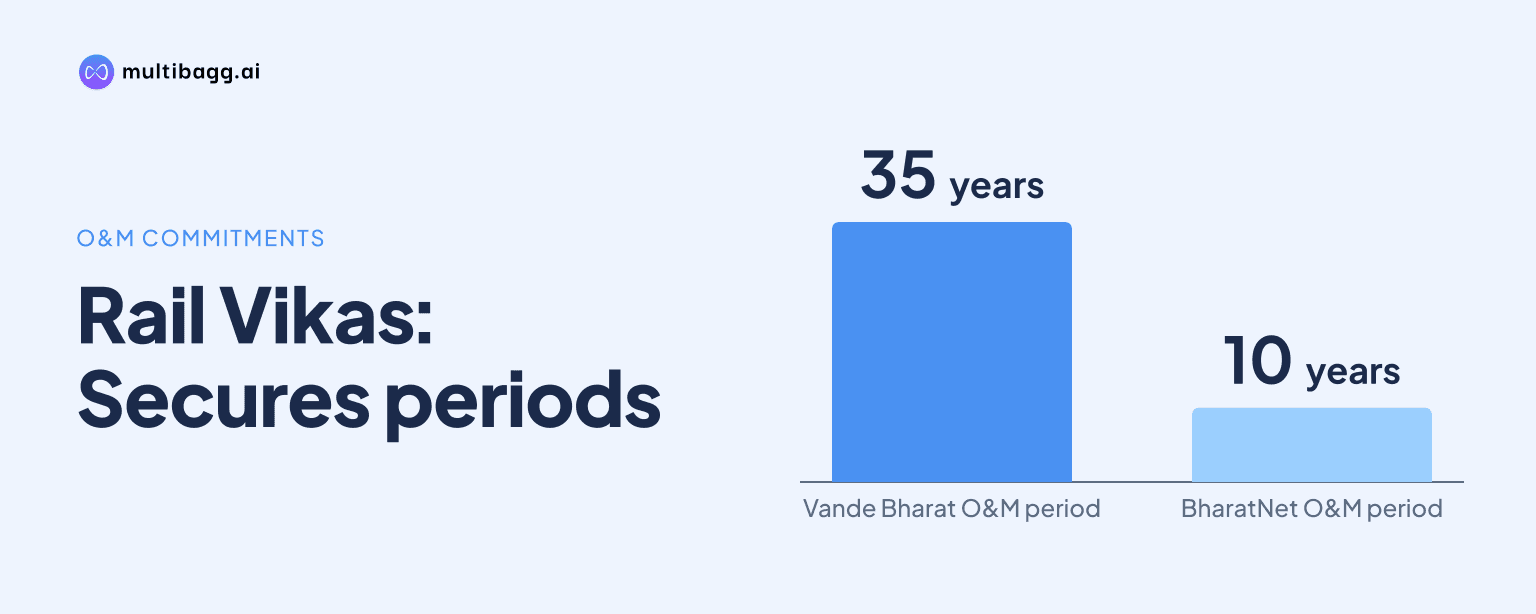
Rail Vikas Nigam Limited has disclosed a 35-year maintenance commitment for its Vande Bharat Sleeper programme and a 10-year lifecycle for BharatNet. The commitments attach to RVNL’s Rs 8,640 crore share of the Vande Bharat programme and the Rs 13,236 crore BharatNet Middle Mile project, extending responsibilities beyond construction and delivery.
Know Rail Vikas Nigam inside out
Results, valuation, peers and who's buying, in one view.
What maintenance commitments has RVNL secured?
RVNL has disclosed two long-duration operations and maintenance, or O&M, commitments: 35 years for the Vande Bharat Sleeper programme and 10 years for BharatNet Middle Mile in Uttar Pradesh East and West. The Vande Bharat programme covers 120 sleeper trainsets with a total value of Rs 14,400 crore, of which RVNL’s reported share is Rs 8,640 crore.
BharatNet has a project value of Rs 13,236 crore and covers 82,607 kilometres of optical fibre cable for Bharat Sanchar Nigam Limited’s Middle Mile network. RVNL says the design-build-operate-maintain, or DBOM, mandate was awarded in financial year 2025, or FY25, and physical progress was 10% in FY26.
The presentation describes the combined lifecycle income as recurring revenue that can offset cyclical project-based civil work. It does not disclose annual O&M revenue, maintenance margins, payment schedules or the portion of RVNL’s Rs 8,640 crore Vande Bharat share allocated between manufacturing and maintenance.
Why does Vande Bharat give RVNL a 35-year maintenance period?
Vande Bharat gives RVNL a 35-year maintenance period because the 120-train sleeper programme includes a 35-year O&M commitment alongside manufacturing and delivery. The first prototype is due in June 2027 at Latur through Kinet Railway Solutions Ltd, the joint-venture manufacturing platform formed with Russia’s TMH.
Trainset deliveries are scheduled over six years after approval, starting with 10 sets in Year 1 and rising to 25 sets in each of Years 5 and 6. The phased schedule means the maintenance obligation is linked to a delivery programme rather than to a single completion date for all 120 trainsets.
RVNL’s Rs 8,640 crore share is 60% of the Rs 14,400 crore programme value. The presentation identifies Kinet as the manufacturing platform, but does not state how revenue, costs or maintenance responsibilities are divided among RVNL, Kinet and TMH.
Got a follow-up? Ask IRIS
How does BharatNet give RVNL a 10-year lifecycle?
BharatNet gives RVNL a 10-year lifecycle because the FY25 DBOM mandate requires the company to build and maintain 82,607 kilometres of fibre for Bharat Sanchar Nigam Limited in UP East and West. With physical progress at 10% in FY26, the project remained in its implementation phase according to the presentation.
RVNL says it spent Rs 20 crore on consultancy and surveys before bidding for BharatNet. It describes the award as its first large mandate outside rail and says it won against established telecom firms, although the presentation does not identify the other bidders or provide an award date within FY25.
Management says the O&M phase requires less capital and offers steadier margins than engineering, procurement and construction, or EPC, work. This is the company’s stated rationale for the contract structure, rather than a reported financial outcome, because the presentation gives no BharatNet O&M margin, capital-spending amount or annuity payment figure.
How do the maintenance commitments compare with RVNL’s wider pipeline?
The Vande Bharat and BharatNet commitments sit within an order book of Rs 90,099 crore as of the second quarter of FY27, or Q2FY27, which RVNL says was about 4.1 times FY26 revenue. Their distinguishing feature is the 35-year and 10-year service periods, not only their reported contract values.
Railways was RVNL’s largest order-book segment at Rs 56,816 crore, followed by signalling at Rs 12,224 crore and building, port and other work at Rs 6,994 crore. BharatNet is RVNL’s largest non-railway order at Rs 13,236 crore, while the Vande Bharat programme adds a long-term maintenance obligation to a rail-linked manufacturing project.
RVNL reported Rs 7,132 crore of standalone order inflow in the first half of FY27 and a roughly 41:59 mix between nomination and competitive bidding. Its bid pipeline was Rs 37,400 crore at Q2FY27, and management said the existing order book represented about four years of work already won.
The presentation contrasts these maintenance-linked projects with the Rs 37,000 crore Rishikesh-Karnaprayag Rail Link, which was 79% complete and due for completion in December 2028. It does not disclose a similar long-term O&M commitment for that project, while it specifically identifies 35 years for Vande Bharat and 10 years for BharatNet.
Conclusion
RVNL is pairing selected construction and manufacturing mandates with defined post-delivery maintenance periods. Its Rs 8,640 crore Vande Bharat share carries a 35-year O&M commitment, while the Rs 13,236 crore BharatNet contract has a 10-year lifecycle, adding service obligations alongside a Rs 90,099 crore Q2FY27 order book.
The next disclosed milestones are the Vande Bharat prototype due in June 2027, deliveries beginning after approval, and BharatNet execution progress beyond the reported FY26 level of 10%. RVNL has not disclosed O&M revenue timing, margins, capital requirements or the allocation of responsibilities within Kinet, making those matters unresolved in the presentation.