










Ramkrishna Forgings says Europe reached 41% of export mix
Key highlights
- RKFL said Europe represented 41% of export mix, up from 28% two years earlier.
- Total exports rose to Rs 424 crore from Rs 277 crore in Q2 of FY26.
- North America represented around 58% of RKFL's geographical export mix.
- Shipping costs had a net Rs 8 crore to Rs 9 crore quarterly impact after partial customer pass-through.
powered by IRIS
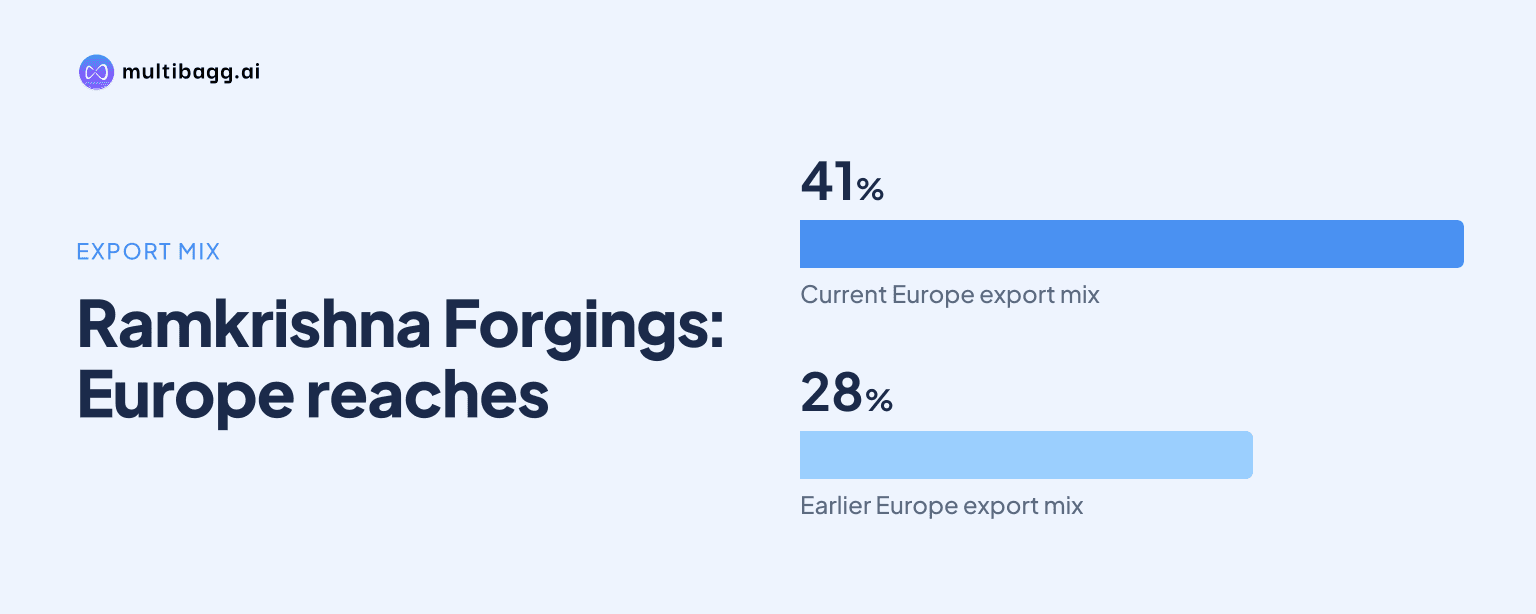
Ramkrishna Forgings said Europe accounted for 41% of its geographical export mix in the reported quarter, up from 28% two years earlier, while total exports increased to Rs 424 crore from Rs 277 crore in Q2 of FY26. Management said the regional mix reflected a broader European customer base rather than deterioration in Europe.
Know Ramkrishna Forgings inside out
Results, valuation, peers and who's buying, in one view.
Why does RKFL say Europe is 41% of exports?
RKFL said Europe accounted for about 41% of its total geographical export breakup, compared with 28% two years earlier. Management gave the figure while responding to an analyst who had characterised Europe as weak after North American revenue rose sharply. It said North America represented around 58% of the export mix.
The movement from 28% to 41% indicates that Europe has taken a larger place in RKFL’s export portfolio over two years. Management attributed that change to an increased customer base in Europe. The call did not provide a customer count, country-level sales or the value of European shipments, so the 41% figure is a geographic-mix measure rather than a separately disclosed regional revenue total.
Did RKFL's Europe revenue fall while exports grew?
RKFL said total exports rose to Rs 424 crore in the current Q2 from Rs 277 crore in Q2 of FY26, a Rs 147 crore increase, and maintained that its Europe numbers had also increased in the broader sales mix. The company therefore disputed the view that Europe was structurally weak, even though an analyst referred to a slight year-on-year decline in the quarter’s absolute European revenue.
Management later described the European movement as a “very marginal difference” that could be covered in the next quarter. It said the relevant comparison should include the overall export breakup, which it characterised as better than both the first quarter and the prior year’s Q2. However, RKFL did not disclose Europe-only revenue for either period, meaning the size of any quarter-on-quarter or year-on-year European change cannot be calculated from the call.
What shifted export volumes toward North America?
RKFL said North America had a V-curve recovery after a subdued prior year affected by tariff issues, creating an immediate increase in demand. Management said it gave North America more patronage, or supply priority, so customers could receive material during that recovery. That allocation was presented as the reason a marginal European difference appeared in the quarter, rather than as a loss of European business.
The company’s explanation points to production scheduling as the mechanism behind the mix change. RKFL said capacity and schedule lines can be adjusted according to demand from different regions, and that North America’s sudden recovery required more material. Management also said both North America and Europe remain the principal areas of focus for international growth, supported by order wins and capacity additions already made.
Europe’s 41% mix share shows that RKFL’s international business includes a substantial contribution outside North America’s stated 58% share. The company did not quantify the sales pipeline awaiting commencement in Europe or identify the European customers added. Its disclosed evidence is limited to the higher regional mix share from 28% two years ago and management’s statement that the customer base has expanded.
Got a follow-up? Ask IRIS
How could export growth affect RKFL's margins and costs?
RKFL said a higher export contribution would support margin expansion, but management declined to specify an expected percentage-point benefit because the outcome depends on product mix. It said margins had expanded by about 30 to 50 basis points each quarter in the past couple of quarters, where one basis point equals one-hundredth of a percentage point. Management’s aspiration is to exceed its prior peak margin, but it said this would not happen in the next quarter or the quarter after that.
Export growth also carries costs that can limit the benefit from a better geographic mix. RKFL said shipping costs had increased significantly versus Q2 of last year and caused a net Rs 8 crore to Rs 9 crore impact in the quarter after partial pass-through to customers. Management said customers were not prepared to bear the entire freight increase, so the company expects to continue sharing some of that cost if freight remains at the prevailing level.
Raw-material pricing was another pressure in the export business. Management said higher Indian steel prices had exceeded increases obtained from export customers, resulting in a negative carry of about Rs 6 crore to Rs 7 crore in the quarter. It said domestic steel-price increases are passed through quarterly, while export pass-through varies by contract and region, with North American and European steel markets not seeing the same price rise cited in India.
What supports RKFL's broader international growth plan?
RKFL said its existing order wins and capacity additions support continued international growth, with North America and Europe identified as the two main focus regions. Management did not quantify FY28 domestic or export growth, but said it saw strong market visibility for the next six months and would provide guidance after the full-year results. This is an outlook from management, not a numerical forecast.
A new casting order adds to the North American pipeline. Of Rs 447 crore of casting orders received, RKFL said Rs 272 crore relates to a North American light-vehicle application for a new customer and new product line. The company expects development, sampling and validation to take about six to nine months before regular supplies begin, reflecting the longer cycle for light-vehicle programmes.
Management said it currently has enough capacity for the new orders and would consider any further capital expenditure in the next financial year. It expects group capital expenditure of about Rs 550 crore in the current year, including value-addition investments in machining. The link to Europe is indirect: the planned additions are intended to support international growth generally, rather than being disclosed as Europe-specific capacity.
Conclusion
RKFL’s central point is that a marginal quarterly shift in European revenue should not be read as a weakening regional position. Total exports increased by Rs 147 crore from Q2 of FY26 to the current Q2, while Europe’s geographical share rose by 13 percentage points over two years to 41%. North America’s 58% share reflects a rapid demand recovery and management’s decision to allocate more supply there.
The next check is whether the marginal European difference is covered in the following quarter, as management said it could be, while the 41% European share is sustained. Investors can also watch the six-to-nine-month validation process for the Rs 272 crore North American light-vehicle casting order, freight costs that reduced quarterly results by Rs 8 crore to Rs 9 crore, and management’s guidance after the full-year results.