










Ramkrishna Forgings raises FY27 capex plan to Rs 550 crore
Key highlights
- RKFL expects FY27 group capex to end near Rs 550 crore, versus an earlier Rs 350 crore indication cited on the call.
- RKFL spent almost Rs 390 crore on capex through the first half and identified about Rs 160 crore of second-half machining investment.
- RKFL reported Rs 447 crore of casting orders, including Rs 272 crore for North American light-vehicle applications.
- RKFL maintained its FY27-end net-debt target of Rs 1,500 crore despite the increased capex plan.
powered by IRIS
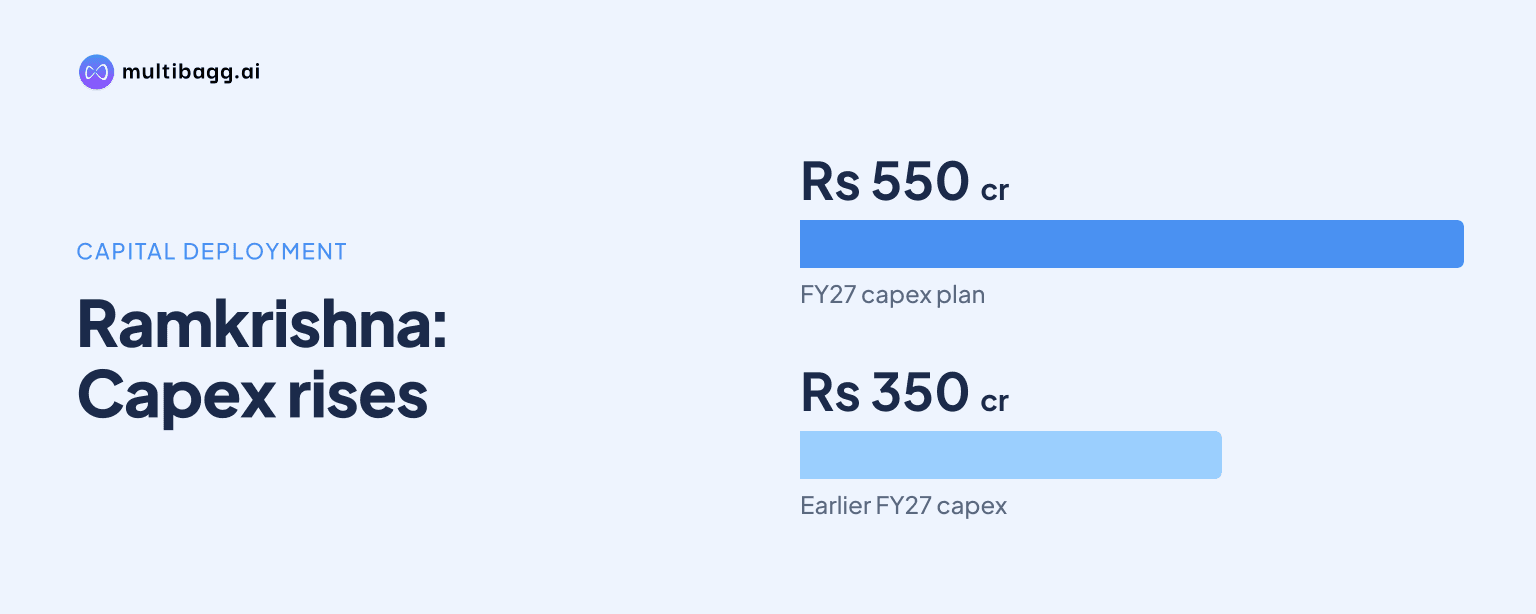
Ramkrishna Forgings (RKFL) expects FY27 group capital expenditure to reach about Rs 550 crore, after spending almost Rs 390 crore in the first half and planning roughly Rs 160 crore more, mainly for machining and value-added capacity, as management cited buoyant demand.
Know Ramkrishna Forgings inside out
Results, valuation, peers and who's buying, in one view.
Why has RKFL increased its FY27 capital-expenditure plan?
RKFL increased its expected FY27 capital expenditure because management said buoyant markets and opportunities across customer segments require continued investment in machining and other value-added capabilities. Management described the spending as an addition to forging-capacity augmentation already undertaken, rather than a fresh announcement of large basic forging capacity.
The revised expectation is materially above the Rs 350 crore FY27 capex indication cited by an analyst as having been given in the first quarter. By the first half, RKFL had spent almost Rs 390 crore on capex, which already exceeded that earlier full-year indication, while it had also invested Rs 40 crore in a joint venture. Management said total group capex should end the year close to Rs 550 crore.
The table shows why the plan changed: the almost Rs 390 crore spent through the first half was already above the earlier Rs 350 crore indication, and management subsequently outlined about Rs 160 crore for the second half. The Rs 550 crore total is management’s estimate for the entire group, not a separate amount limited to the parent operation.
Where will RKFL deploy the additional Rs 160 crore?
RKFL said the additional Rs 160 crore of capex for the second half will be directed primarily to the machining side. Management linked machining investment to its effort to increase value addition, supporting products that require more processing beyond the company’s existing forging capacity.
This allocation follows management’s statement that past forging-capacity augmentation had already been completed. The current programme is therefore aimed at machining and value-added operations, with the company responding to demand it described as coming from many areas. The transcript does not provide a plant-by-plant allocation, commissioning date or specific machining-capacity volume for the Rs 160 crore outlay.
The company’s product and order pipeline provides the operating context for this investment. RKFL reported Rs 447 crore of casting orders, including Rs 272 crore for North American light-vehicle applications, Rs 90 crore of farm-equipment orders, and interest in castings, aluminium forgings and higher-value-added products. Management also said oil-and-gas product demand remained strong.
For the Rs 272 crore North American light-vehicle casting order, management expects development and sample validation to take about six to nine months before regular supply begins. The balance of the Rs 447 crore casting orders is domestic, where management said development typically takes 12 to 14 weeks before approved samples lead to bulk supply. These timelines provide the stated context for investment in processing capacity before order volumes ramp up.
Got a follow-up? Ask IRIS
Does RKFL have capacity for its new casting orders?
RKFL said it currently has enough capacity to fulfil the new casting orders, although an analyst said casting utilisation was 88%. Management did not announce an immediate dedicated casting-capacity expansion and said decisions on any further capex would be considered in the next financial year.
The Rs 447 crore casting-order total includes Rs 272 crore for a North American light-vehicle programme and a domestic balance. The export programme has a longer launch cycle of six to nine months because of part development and validation, while domestic business can begin bulk supplies after the 12-to-14-week development process. RKFL gave no utilisation target after the orders start.
RKFL is also building utilisation in adjacent product lines. Management said aluminium forging and cold-forging utilisation was above 50%, and confirmed aluminium-forging capacity of 3,000 tonnes. It said it is adding customers in these lines, particularly for exports to North America, to raise utilisation from current levels.
Management described the casting order as opening an export-market opportunity for its casting business. The Rs 272 crore light-vehicle order is specifically for North America, while RKFL also said it is working with customers in North America and Europe and using its Mexico presence to explore additional opportunities. These commercial developments, rather than a disclosed casting expansion project, are the stated basis for its near-term capacity strategy.
How does the higher capex fit with RKFL’s debt-reduction target?
RKFL maintained its target to reduce net debt to Rs 1,500 crore by the end of FY27 while raising expected capex to about Rs 550 crore. Management said March debt was Rs 2,173 crore and was about Rs 2,000 crore after bill discounting, which underpins its guidance for a Rs 500 crore reduction.
At the gross-debt level, management indicated an FY27-end range of Rs 1,670 crore to Rs 1,700 crore. This means the company is presenting higher investment in machining alongside a debt-reduction plan, rather than postponing the debt objective. The transcript does not state projected operating cash flow, asset-sale proceeds or other detailed funding sources for both commitments.
The joint venture remains part of the capital commitments, but management said it is within the amount committed at inception. About Rs 50 crore to Rs 55 crore of joint-venture investment remains pending over the next year, with perhaps Rs 15 crore to Rs 20 crore expected in the next half and the remainder in the next financial year.
Management also gave a quantified estimate of the potential finance-cost effect of deleveraging. It said reducing the full Rs 500 crore of debt would lower annual finance cost by almost Rs 40 crore, based on an interest cost of about 8%. For the following financial year, management said it aims to reduce another Rs 300 crore to Rs 400 crore of debt.
Conclusion
RKFL’s revised Rs 550 crore FY27 capex expectation reflects a shift from broad forging-capacity augmentation toward machining and other value-added processing. The company has already spent almost Rs 390 crore in the first half, while management sees demand support in Rs 447 crore of casting orders, exports and products such as aluminium forgings, cold forgings and oil-and-gas components.
The next points to watch are the planned Rs 160 crore of second-half machining capex, the six-to-nine-month validation of the Rs 272 crore North American light-vehicle casting order, and progress toward Rs 1,500 crore of net debt by the end of FY27. Management also said it would provide further guidance after full-year results and has not quantified FY28 growth.