










Ramkrishna Forgings Limited Q2 Revenue Rises 54.9% to ₹1,405 Crore
Key highlights
- Ramkrishna Forgings reported Q2 FY27 revenue of ₹1,405 crore, up 54.9% year-on-year.
- Ramkrishna Forgings' EBITDA margin rose to 18.23% from 13.5% in Q2 FY26.
- Ramkrishna Forgings secured ₹673 crore of new orders with an approximate four-year programme life.
- Ramkrishna Forgings reduced debt by ₹126 crore in H1 FY27 and maintained ₹500 crore FY27 reduction guidance.
powered by IRIS
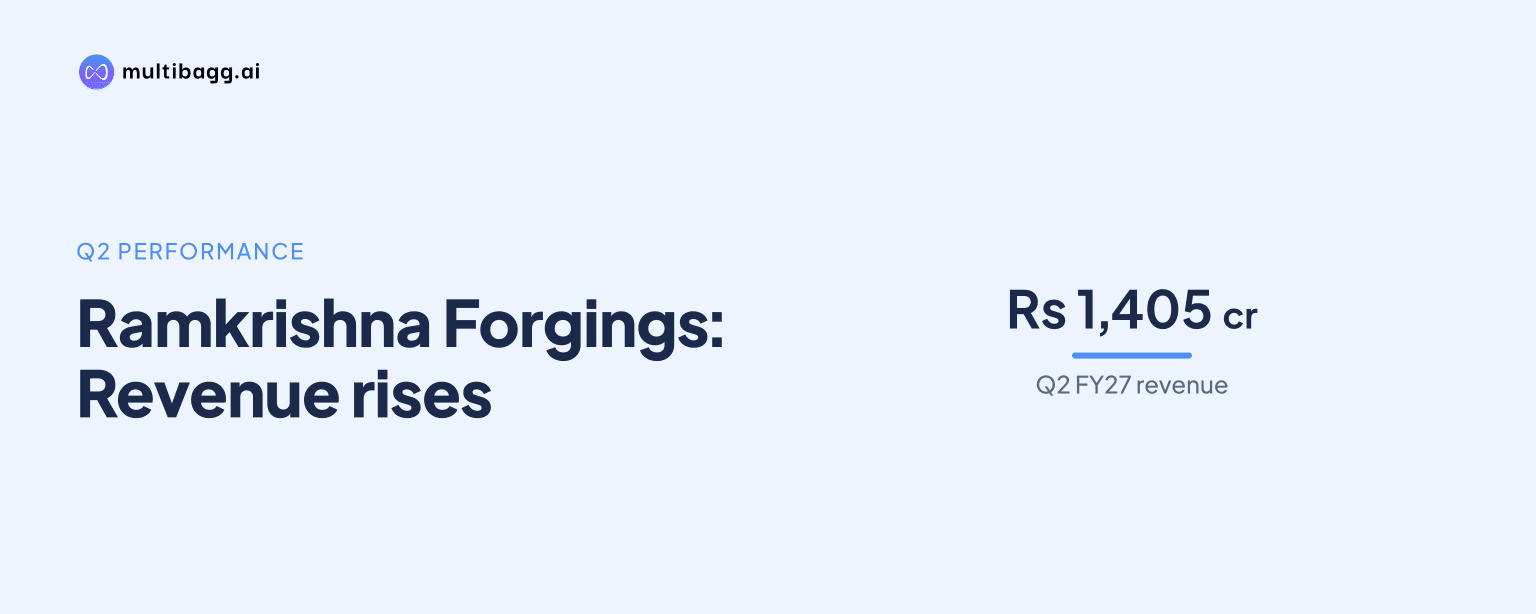
Ramkrishna Forgings Limited reported consolidated revenue of ₹1,405 crore in Q2 FY27, up 54.9% year-on-year, while its EBITDA margin rose to 18.23% from 13.5% a year earlier. The company also recorded ₹673 crore of new order wins and filed the transcript of its 30 October 2026 earnings call with stock exchanges on 6 November 2026.
Know Ramkrishna Forgings inside out
Results, valuation, peers and who's buying, in one view.
What did Ramkrishna Forgings report in Q2 FY27?
Ramkrishna Forgings reported a sharp increase in quarterly revenue and operating profit for the quarter ended September 2026. Consolidated revenue from operations rose to ₹1,405 crore from ₹908 crore in Q2 FY26. Revenue was also 15.5% higher than the ₹1,217 crore recorded in Q1 FY27.
Operating performance improved alongside revenue growth. EBITDA, excluding other income, stood at ₹256 crore, compared with ₹123 crore in the corresponding quarter a year earlier and ₹218 crore in the preceding quarter. The EBITDA margin increased to 18.23%, from 13.5% in Q2 FY26 and 17.96% in Q1 FY27.
The company reported profit before tax of ₹95 crore, against a loss before tax of ₹10 crore in Q2 FY26 and a profit before tax of ₹65 crore in Q1 FY27. Profit after tax was ₹71 crore, which management said was 47% higher on a sequential basis.
How did Ramkrishna Forgings improve its operating margin?
Ramkrishna Forgings attributed the margin improvement to higher capacity utilisation, a better product mix and operating efficiencies. These factors helped EBITDA grow faster than revenue during the quarter, lifting the margin by 4.73 percentage points from the year-earlier level.
The sequential movement was smaller but still positive. Revenue increased 15.5% from Q1 FY27, while EBITDA rose from ₹218 crore to ₹256 crore. The margin moved from 17.96% in the preceding quarter to 18.23% in Q2 FY27, indicating that the company retained a larger share of additional revenue as operating profit.
Management also referred to freight and input costs as continuing pressures. The earnings-call material did not quantify the cost impact or provide a separate outlook for these expenses. Therefore, the reported margin expansion reflects the quarter's stated operating leverage and mix improvement rather than a confirmed long-term cost trend.
What new orders and debt targets did Ramkrishna Forgings disclose?
Ramkrishna Forgings secured new orders worth ₹673 crore during Q2 FY27 across commercial vehicle, electric vehicle, light vehicle and farm-equipment segments. Management said these programmes have an approximate life of four years, providing visibility over a multi-year period rather than representing revenue for a single quarter.
About 48% of the order wins came from domestic markets and 52% from export markets. The company also referred to casting orders in its earnings-call discussion, though the supplied material does not provide a separate value for them. The order mix shows that both Indian and overseas customers contributed to the quarter's wins.
On the balance sheet, Ramkrishna Forgings said debt had reduced by ₹126 crore during the first half of FY27. It maintained its guidance to reduce total debt by ₹500 crore during FY27. The disclosure does not state the company's total outstanding debt or specify the timing and source of all planned reductions.
Got a follow-up? Ask IRIS
Why do the Q2 figures matter for investors and industry participants?
Ramkrishna Forgings' results matter because the company serves several vehicle and industrial equipment categories, including commercial vehicles, electric vehicles, light vehicles and farm equipment. Revenue growth across domestic and export business, together with the order wins, indicates that demand from multiple end markets contributed to the reported quarter.
For investors, the key disclosed financial change was the improvement in operating profitability. Revenue rose by 54.9% year-on-year, EBITDA increased to ₹256 crore and the company returned to a ₹95 crore profit before tax from a ₹10 crore loss a year earlier. These figures provide the basis for evaluating the company's stated target of 20% to 25% revenue growth in FY27.
The filing of the earnings-call transcript on 6 November 2026 also gives shareholders access to management's discussion of the Q2 and H1 FY27 performance. No share-price movement, revised capital-expenditure figure or updated earnings forecast was provided in the supplied disclosure, so those matters cannot be assessed from the transcript information alone.
What is Ramkrishna Forgings' stated outlook after Q2 FY27?
Ramkrishna Forgings said it expects strong growth momentum in domestic and export markets in FY28 and beyond, supported by its order pipeline and new customer wins. For FY27, management maintained a revenue-growth target of 20% to 25% and its ₹500 crore debt-reduction guidance.
Management also discussed an EBITDA-margin target of 18% to 20% for the railway wheels joint venture. It said it aims to improve margins steadily by 30 to 50 basis points each quarter and to move beyond prior peak levels. These are management targets, not reported financial results, and their achievement will depend on operating conditions, customer programmes and cost developments.
Conclusion
Ramkrishna Forgings delivered higher Q2 FY27 revenue, stronger operating margins and a return to profit before tax, supported by capacity utilisation, product mix and operating efficiencies. The ₹673 crore of new orders, divided between domestic and export markets, adds visibility across its automotive and farm-equipment customer segments.
The next disclosures to watch are progress toward the company's FY27 revenue-growth target of 20% to 25%, its plan to reduce debt by ₹500 crore, and the development of margins in the railway wheels joint venture. Freight and input costs remain identified pressures that could influence future operating performance.