










Rashi targets 20% enterprise mix, curbs AI data-centre bids
Key highlights
- Rashi targets enterprise at about 20% of total business next year.
- Management said more than Rs 20,000 crore of AI data-centre orders were placed in one recent quarter.
- Rashi has sustained about 50% growth for several quarters, management said.
- Price increases contributed 30% of first-half growth, versus a 10% to 15% expectation for the second half.
powered by IRIS
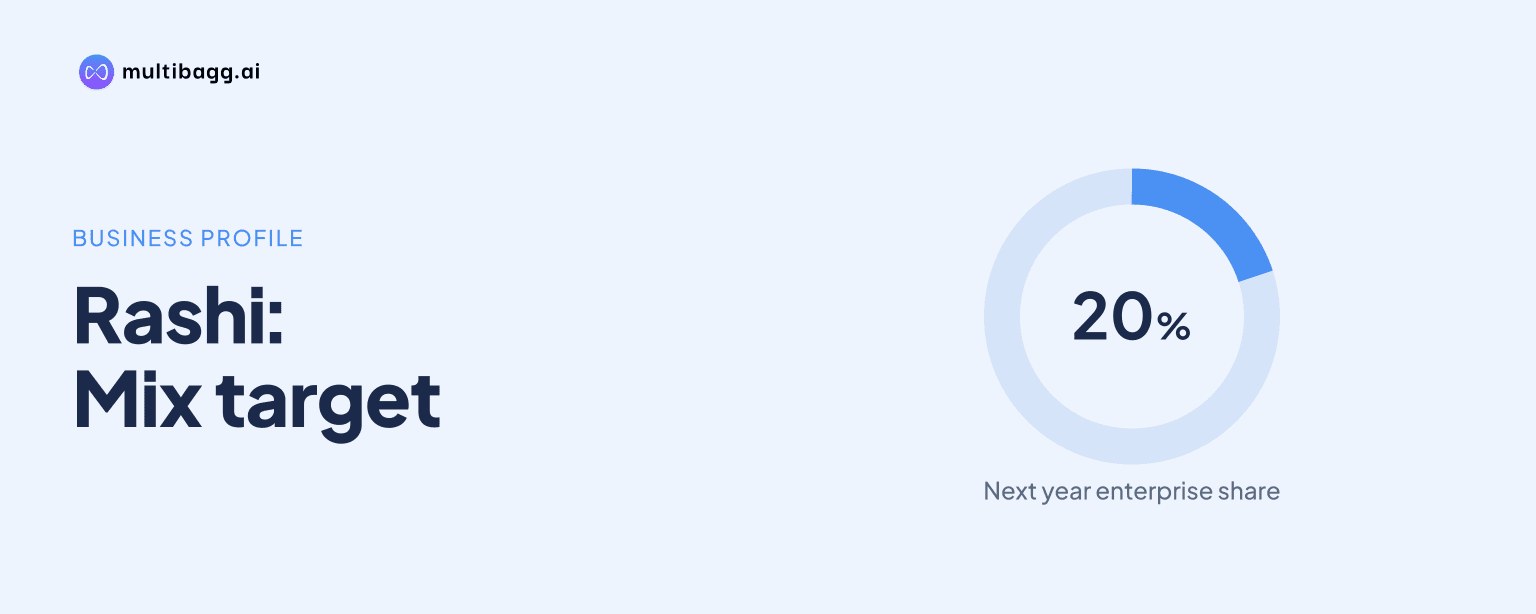
Rashi Peripherals, referred to here as Rashi, aims for enterprise to supply about 20% of business next year while selectively declining artificial intelligence (AI) data-centre projects; management said more than Rs 20,000 crore of such orders were placed in one recent quarter but carried lower returns on investment.
Know Rashi Peripherals inside out
Results, valuation, peers and who's buying, in one view.
Why is Rashi limiting AI data-centre orders?
Rashi is limiting aggressive bidding for AI data-centre projects because management considers them large in exposure value and lower in return on investment, while the company has already sustained about 50% growth for several quarters. Rajesh Goenka said Rashi is present in almost every AI data-centre project as a first mover, but chose not to pursue that segment aggressively during the preceding year.
The decision does not mean Rashi has exited the opportunity. Management said Rashi could enter and win orders when required because it has established credentials in the sector. In the first half, it chose not to play an active role in enterprise and data-centre opportunities, but said it could become active in the second half if needed, alongside expansion into product lines, brands, territories and customers.
Management framed this as a capacity and capital-allocation decision rather than a demand concern. It said the AI opportunity in India is very high over the next one to two years, but participation depends on Rashi's financial capacity and return on capital employed, or ROCE, calculations. The company therefore intends to choose how much business to take and at what cost.
What enterprise mix does Rashi want next year?
Rashi wants enterprise to contribute about 20% of business next year, according to management, while retaining its focus on established distribution operations. Goenka said management wanted enterprise to be around 20% of business in both the current year and next year, without allowing the existing distribution strengths developed over 35 years to be defocused or diluted.
Management did not disclose Rashi's current enterprise revenue share or a segment revenue target. It instead described the addressable opportunity as high and said the extent of participation depends on the volume of business Rashi decides to accept and its cost. That qualification is material because management is explicitly using finance capacity and ROCE to determine the level of AI-related orders it pursues.
Rashi is positioning enterprise as an addition to, rather than a replacement for, its distribution engine. Management identified three growth pillars: core distribution, semiconductors, and managed services and enterprise infrastructure-related information technology services. It said internal accruals, factoring of its debtor book and, if required, a further capital raise could fund these pillars, depending on what it considers prudent for the organisation's economics and financials.
Got a follow-up? Ask IRIS
How is Rashi protecting its distribution business?
Rashi is keeping distribution central while adding enterprise and semiconductor capabilities in measured steps. Management said more than 35% of business is non-personal-computer products, including accessories, peripherals, central processing units, motherboards and hard drives, where its product mix and distribution network can provide scope for additional margin.
Rashi has 57 branches and bills customers in 700 towns, while management said it would continue to improve penetration beyond its existing 57-town footprint. Goenka attributed 30% of growth in the first six months to price increases, but forecast that price would account for only 10% to 15% of growth in the second half. The outlook implies a smaller pricing contribution after the first half.
For the second half, management forecast a decline in consumer unit volumes, while commercial volumes could be flat or positive because January through March is a corporate buying period with year-end budgets and depreciation considerations. Rashi nevertheless expects new product lines, vendors, customers and territories to support growth, with VDA and the Restar joint venture also expected to add to revenue and profit.
Management cited the post-COVID period as a comparison for a possible reversal in product prices. It said prices fell by 10% to 15% after shortage-driven increases in that period, creating market disruption for about one year. Rashi said it grew by about 7% while the market declined by about 15%, attributing the relative performance to its ability to add products, cities, customers and business opportunities.
What will semiconductors and services add to Rashi?
Rashi expects semiconductors and enterprise services to broaden its growth base, with management saying the semiconductor joint venture has only begun but can become substantial in both revenue and profit. Its joint venture with Restar Corporation is intended to add Japanese product lines, design capabilities and potential access to Japanese manufacturers operating in India.
Management said two Japanese brands had already entered Rashi's product basket and distribution was due to start that month. Restar has 200 engineers in Tokyo, and Rashi said one engineer would be deputed to its Bengaluru laboratory to train staff and develop a design centre. Management also said it planned to meet five Japanese manufacturers in India that month.
Rashi said its semiconductor business generated about $20 million in the preceding financial year, but it did not provide a rupee conversion during the call. Business in the first six months was twice the previous full-year level, and management hoped the full year would reach three to four times the prior-year level. It also said semiconductor margins are broadly twice company-level margins, without giving the underlying percentage.
Rashi sees local support as a differentiator in semiconductor distribution. Management estimated existing Japanese distributors reach only 10% of the opportunity, leaving 90% uncatered to, and said many use dollar billing from Japan, Singapore or Hong Kong. Rashi said its presence across 57 cities enables local billing, design, technical support and post-sale service, although individual distribution arrangements may be exclusive or non-exclusive.
Conclusion
Rashi's planned 20% enterprise mix represents a selective expansion beyond distribution rather than a strategy of taking every available AI data-centre order. Management is passing on some projects despite more than Rs 20,000 crore of orders in one recent quarter, placing greater weight on exposure, return calculations and continued development of distribution, semiconductor and services capabilities.
The next disclosures to watch are whether Rashi becomes more active in enterprise and data-centre projects during the second half, progress from VDA and the Restar joint venture, and the expected 10% to 15% pricing contribution to second-half growth. Management also expects consumer unit volumes to decline while commercial volumes could be flat or positive in the January-to-March corporate buying period.