










Rashi Peripherals Limited adds VDA and Restar engines
Key highlights
- RPtech announced a 67% stake acquisition in VDA to add system integration and managed IT services.
- RPtech formalised a Restar Corporation joint venture for embedded and semiconductor solutions.
- H1-FY27 consolidated revenue was Rs 11,287 crore, up 54.5% year on year.
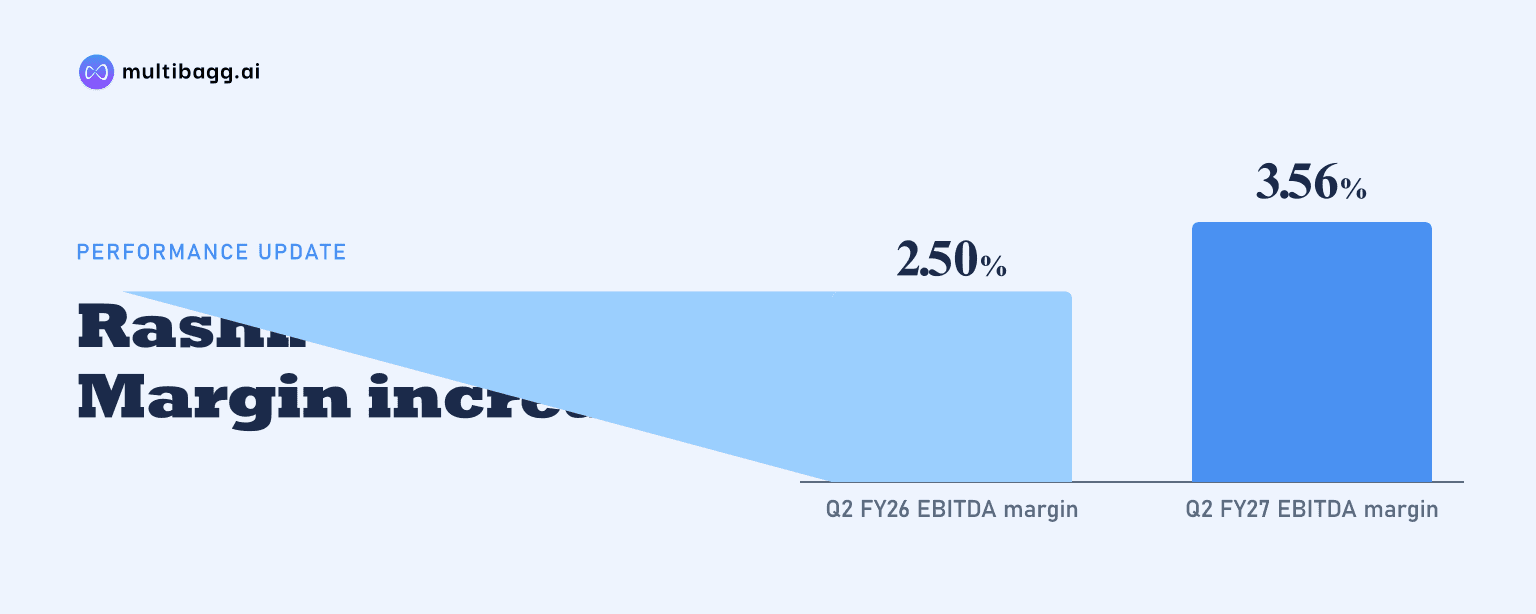
- Q2-FY27 consolidated EBITDA margin increased to 3.56% from 2.50% in Q2-FY26.
powered by IRIS
Rashi Peripherals Limited is expanding beyond technology distribution through an announced 67% stake acquisition in VDA and a Restar Corporation joint venture, while H1-FY27 consolidated revenue reached Rs 11,287 crore, up 54.5% year on year. RPtech’s stated platform combines distribution, system integration and managed services, and embedded-semiconductor solutions.
Know Rashi Peripherals inside out
Results, valuation, peers and who's buying, in one view.
How is RPtech building a three-engine technology platform?
RPtech is combining its existing technology-distribution business with two new engines: system integration and managed services through VDA, and embedded and semiconductor solutions through Restar. The distribution operation supplies global technology brands through a pan-India network, while the VDA engine is designed to integrate, deploy and manage systems and the Restar venture is intended to design, consult and enable component-level technologies.
The company presents the three activities as a progression across the technology value chain. Distribution focuses on supplying products to customers, system integration focuses on solutions for outcomes, and the semiconductor business focuses on technologies for the next generation. RPtech estimates the India information and communications technology market at Rs 1.5 lakh crore for FY24-FY29, with an 8% to 10% compound annual growth rate, or CAGR.
RPtech says its existing distribution platform contributes scale, reach and customer access, including end-to-end logistics and a channel ecosystem. The new integration engine adds solution architecture, cloud and infrastructure, cybersecurity, managed services and support, while the semiconductor engine is intended to provide semiconductor components, embedded solutions, field application engineer-led technical support and application development.
What does the VDA acquisition add to RPtech?
The announced acquisition of a 67% stake in VDA is intended to add enterprise information technology, cloud infrastructure, cybersecurity, system integration and managed IT services to RPtech’s platform. The presentation does not disclose the transaction value or a completion date, but identifies VDA as the group’s system-integration growth engine.
VDA’s listed activities cover solution design and consulting, integration and deployment, and managed services. RPtech also lists 24/7 IT support, cloud and infrastructure management, data backup and recovery, migration, database administration, cybersecurity, security operations centre services and disaster recovery in its managed-service portfolio.
The addressable market cited for this engine is India’s managed IT services market, estimated at Rs 1.7 lakh crore for FY24-FY29 with a 6% to 8% CAGR. That market estimate is distinct from the Rs 1.5 lakh crore information and communications technology market cited for distribution, reflecting the company’s stated aim of moving from supplying products to delivering and managing integrated technology environments.
What is RPtech doing with Restar Corporation?
RPtech has formalised a joint venture with Japan-based Restar Corporation to establish an embedded and semiconductor solutions business. The presentation says the venture will be supported by local design and engineering, talent transfer and technical services, alongside semiconductor components, embedded solutions and proof-of-concept development.
The Restar venture has a different stated role from VDA. VDA is focused on enterprise systems, cloud infrastructure and managed IT services, whereas the Restar operation is intended to support applications through component access, technical consultation and field application engineer-led support. RPtech identifies access to global technologies and application development as mechanisms for creating value in this business.
RPtech cites India’s semiconductor distribution market at more than US$2.5 billion, but provides no growth forecast, revenue target or profit target for the joint venture. The source also does not state the venture’s ownership split, capital commitment or commercial launch date, leaving its financial contribution unquantified in the H1-FY27 presentation.
Got a follow-up? Ask IRIS
What distribution base supports RPtech’s expansion?
RPtech reported a network of 20 regions, 57 branches, 728 locations and more than 10,289 distribution partners as of H1-FY27. The company presents this footprint as the route-to-market base for its distribution portfolio and for broader access to customers seeking integration, managed services and embedded technology support.
The company is a national distribution partner to more than 89 global technology brands and says it has relationships of more than five years with over 20 brands. Its product access spans information technology and lifestyle categories, while its sales channels include general trade, modern trade and e-commerce.
RPtech says a multi-original-equipment-manufacturer portfolio allows it to bundle endpoints, infrastructure and peripherals within the same account. Its stated rationale is to increase wallet share without incremental customer-acquisition cost, while branch expansion is intended to deepen last-mile access in Tier 2 and Tier 3 cities and emerging commercial hubs.
How did RPtech’s financial performance change in Q2-FY27?
RPtech reported Q2-FY27 consolidated revenue from operations of Rs 6,185.1 crore, up 48.8% year on year from Rs 4,155.4 crore in Q2-FY26 and 21.2% sequentially from Rs 5,101.9 crore in Q1-FY27. Consolidated earnings before interest, tax, depreciation and amortisation, or EBITDA, rose to Rs 220.1 crore.
Q2-FY27 consolidated EBITDA increased 112.2% year on year and 41.7% quarter on quarter, while profit after tax increased 120.8% year on year and 25.0% sequentially. EBITDA margin rose to 3.56% from 2.50% in Q2-FY26 and 3.04% in Q1-FY27; profit-after-tax margin was 2.11%, compared with 1.42% and 2.05%, respectively.
For H1-FY27, consolidated EBITDA was Rs 375.4 crore, up 81.2% from Rs 207.2 crore in H1-FY26, and profit after tax was Rs 235.3 crore, up 94.6% from Rs 120.9 crore. Consolidated revenue growth of 54.5% was higher than the 49.0% growth in standalone revenue, although the presentation does not separately disclose revenue or profitability from VDA or the Restar venture.
Conclusion
RPtech’s announced VDA acquisition and Restar Corporation venture establish a stated three-engine model: technology distribution, integrated enterprise systems and managed services, and embedded-semiconductor solutions. The company enters these areas with a network of 728 locations and more than 10,289 distribution partners, against H1-FY27 consolidated revenue of Rs 11,287 crore and EBITDA margin of 3.33%.
The next disclosures to watch are completion details for the announced 67% VDA stake and operational details of the Restar venture’s local engineering and talent-transfer programme. The presentation provides market estimates of Rs 1.7 lakh crore for managed IT services and more than US$2.5 billion for semiconductor distribution, but it does not provide transaction consideration, venture targets or separate financial reporting for the two new engines.