










RPtech says potential QIP could support ₹15,000 crore revenue
Key highlights
- RPtech said a potential equity raise and matching debt could sustain ₹12,000 crore to ₹15,000 crore of additional revenue.
- RPtech reported H1 FY27 consolidated revenue of ₹11,287 crore, up 55% year on year.
- Working-capital days improved to 55 in H1 FY27 from 61 a year earlier.
- Net debt-to-equity was 0.76 times in H1 FY27 as RPtech built inventory and funded the VDA acquisition.
powered by IRIS
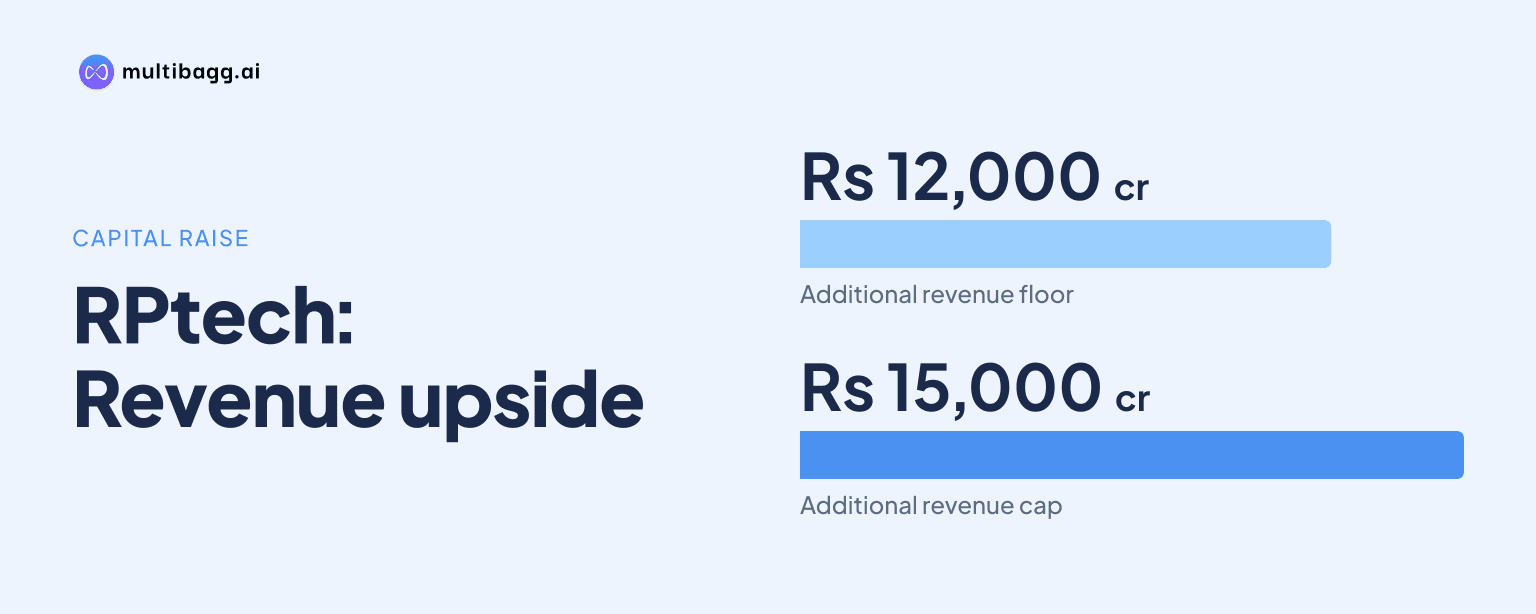
On November 6, 2026, Rashi Peripherals Limited said a potential qualified institutional placement, or QIP, paired with debt at a 1:1 ratio could support ₹12,000 crore to ₹15,000 crore of additional revenue, based on six to seven working-capital cycles. RPtech said it has not decided to raise the capital.
Know Rashi Peripherals inside out
Results, valuation, peers and who's buying, in one view.
Will RPtech raise ₹900 crore through a QIP?
RPtech has not committed to a QIP, including a ₹900 crore issue. Managing Director Kapal Pansari said the company was undertaking advance preparation for growth capital and may not proceed with a QIP if it does not need funding when an opportunity emerges.
The ₹900 crore amount and potential dilution of about 15% were raised by Hitesh Goel of Origin Capital during the November 6 call, rather than confirmed by management. Pansari acknowledged the investor's suggestion that any fundraise be calibrated, leaving the amount, timing and structure of a possible issue unresolved.
Management linked its preparation to the pace of growth and capacity requirements. Pansari said RPtech had been growing at roughly 40% to 60% year on year each quarter and did not want capital availability to constrain expansion, while maintaining that the earlier principle on capital needs at ₹25,000 crore of turnover remained unchanged.
How could a QIP add ₹12,000 crore to ₹15,000 crore of revenue?
RPtech said each equity infusion, combined with a 1:1 debt-equity ratio, could generate ₹1,800 crore to ₹2,000 crore of incremental deployable capital. Management said six to seven working-capital cycles on that capital could sustain ₹12,000 crore to ₹15,000 crore of additional revenue.
This is a management framework rather than FY27 revenue guidance. It depends on RPtech raising equity, accessing matching debt and maintaining the stated working-capital turns, and management said the associated growth would not arrive within one year.
The potential capacity is substantial against the present revenue base. RPtech reported consolidated revenue from operations of ₹6,185 crore in Q2 FY27 and ₹11,287 crore in H1 FY27, meaning the upper end of its cited additional-revenue capacity exceeds its first-half revenue, although no utilisation timetable was provided.
Got a follow-up? Ask IRIS
Why is RPtech preparing growth capital now?
RPtech said the preparation is intended to preserve funding flexibility as its business expands. In Q2 FY27, consolidated revenue rose 49% year on year to ₹6,185 crore, while earnings before interest, tax, depreciation and amortisation, or EBITDA, increased 112% to ₹220 crore and margin expanded 106 basis points to 3.56%.
The company is adding businesses beyond information and communications technology distribution. RPtech acquired a 67% stake in VDA Infosolutions, which brings system integration, cybersecurity, cloud infrastructure and managed IT services, and formalised a joint venture with Japan-based Restar Corporation for semiconductor and embedded solutions.
These newer operations had a limited reported effect in Q2 FY27 because of their recent addition. Management said VDA represented less than 2% of quarterly revenue, while new initiatives added around 6 basis points to EBITDA, with one basis point equal to one-hundredth of a percentage point.
Management expects VDA and the semiconductor business together to contribute more than 10% of revenue over time, without stating a target year. It also attributed its roughly 50% quarterly growth to about 30% from price increases, 10% to 11% from volume growth and about 10% from new businesses.
What do working capital and debt show about the funding need?
RPtech improved reported working-capital efficiency in H1 FY27, with working-capital days falling to 55 from 61 a year earlier. Debtor days declined to 43 from 46, while creditor days rose to 48 from 44, providing the operating backdrop for management's six-to-seven-cycle revenue-capacity calculation.
However, management said operating cash flow was negative in the first half and net debt-to-equity rose to 0.76 times. It attributed these outcomes to inventory built for constrained supply conditions and committed enterprise and artificial intelligence projects, as well as funding the VDA acquisition.
The inventory build also reflected a shift in the festive sales calendar. Management said Diwali was around October 20 in 2025 and November 8 in 2026, delaying the sales cycle by about one month and requiring inventory to be built toward the end of September and through October.
Management said October sales were very good and commercial demand remained firm, describing commercial business as nearly 70% of India's information and communications technology market. Its stated second-half priority is to convert inventory into cash and return working capital towards historical levels, with an update planned in the next quarter.
Conclusion
RPtech has quantified the potential revenue capacity from fresh equity and matching debt, but has not approved or committed to a ₹900 crore QIP. The framework assumes ₹1,800 crore to ₹2,000 crore of deployable capital and six to seven working-capital cycles to sustain ₹12,000 crore to ₹15,000 crore of added revenue, against H1 FY27 consolidated revenue of ₹11,287 crore.
Next, investors can watch RPtech's next-quarter disclosure on inventory conversion, operating cash flow and working capital after 55 working-capital days in H1 FY27. Management also plans to integrate VDA while retaining its people and clients, and to build leadership and engineering teams for the Restar joint venture; any actual QIP decision remains open.