










Rashi H1 FY27 profit tops 80% of FY26 total as margins expand
Key highlights
- Rashi's H1 FY27 consolidated PAT rose 95% year on year to Rs 235 crore.
- Rashi's H1 FY27 consolidated revenue increased 55% year on year to Rs 11,287 crore.
- Rashi's Q2 FY27 consolidated EBITDA margin expanded 106 basis points to 3.56%.
- Rashi's working-capital days improved to 55 in H1 FY27 from 61 a year earlier.
powered by IRIS
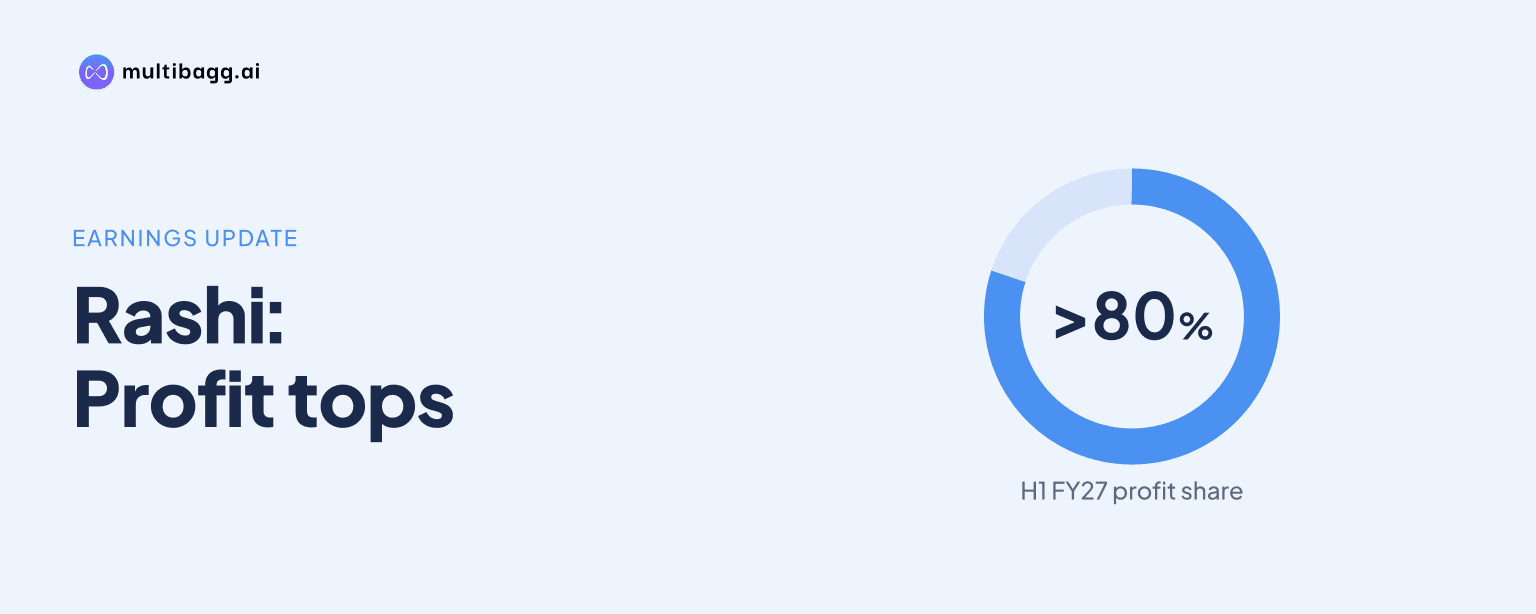
Rashi Peripherals Limited reported H1 FY27 consolidated profit after tax of Rs 235 crore, up 95% year on year and more than 80% of its FY26 full-year profit, as revenue rose 55% to Rs 11,287 crore and the PAT margin increased to 2.08%. Management attributed the margin expansion to mix and pricing discipline.
Know Rashi Peripherals inside out
Results, valuation, peers and who's buying, in one view.
How did Rashi perform in H1 FY27?
Rashi delivered consolidated PAT of Rs 235 crore in H1 FY27, while consolidated earnings before interest, tax, depreciation and amortisation, or EBITDA, rose 81% year on year to Rs 375 crore. Management said the six-month result was its highest-ever H1 profit on both a standalone and consolidated basis, and that the profit exceeded 80% of the amount earned in FY26.
Consolidated revenue from operations grew 55% year on year to Rs 11,287 crore in H1 FY27. PAT growth of 95% and EBITDA growth of 81% both exceeded revenue growth, indicating that the gain was not driven by sales growth alone. Consolidated EBITDA margin rose 49 basis points to 3.33%, while PAT margin rose 43 basis points to 2.08%.
Rashi's Q2 FY27 result showed a faster rise in profit than the first-half average. Quarterly consolidated revenue rose 49% year on year to Rs 6,185 crore, EBITDA increased 112% to Rs 220 crore and PAT grew 121% to Rs 131 crore. The Q2 PAT margin of 2.10% was marginally above the H1 margin of 2.08%.
Why did Rashi's profit margins rise faster than revenue?
Rashi said gross margin improved by close to 100 basis points in Q2 FY27, with management attributing the movement to product mix and pricing discipline rather than operating leverage alone. Consolidated EBITDA margin reached 3.56% in the quarter, up 106 basis points year on year, while PAT margin rose 69 basis points to 2.10%.
The gap between sales and earnings growth was pronounced in Q2 FY27: revenue rose 49%, compared with EBITDA growth of 112% and PAT growth of 121%. Management said profit grew at roughly 2.5 times the rate of revenue during the quarter, reflecting the higher-margin mix and pricing measures it described.
Rashi is building three operating engines: core information and communications technology distribution, the VDA Infosolutions solutions business, and embedded and semiconductor operations through its Restar Corporation joint venture. Management said these activities can use the same channel relationships and customer access to increase customer spending across product categories and services.
Which markets and operations supported Rashi's growth?
Rashi said commercial and enterprise demand remained firmer than consumer demand in FY27, while Chief Executive Officer Rajesh Goenka said commercial activity accounts for almost 70% of India's total ICT market. Management said higher prices were affecting consumer affordability, but described the consumer-market impact so far as minimal.
Management cited IDC data that India's personal-computer market grew about 12% in the April-to-June quarter, supported by commercial, education and small-business demand as well as premium and artificial-intelligence-capable notebooks. It also cautioned that some sales reflected channel buying before anticipated price increases, making commercial and enterprise demand its expected steadier market segment in the second half.
Rashi serves 10,280 channel partners across 728 towns and operates 57 branches, 50 service centres and 728 locations. During H1 FY27, it held artificial-intelligence bootcamps in six metro cities, with almost 150 customers participating at each event to discuss accelerated computing, AI workstations and enterprise AI workloads.
Got a follow-up? Ask IRIS
What changed in Rashi's working capital and debt?
Rashi improved working-capital days to 55 in H1 FY27 from 61 a year earlier. Debtor days declined to 43 from 46, while creditor days increased to 48 from 44, improving the operating-cycle measure despite inventory being built toward the September quarter-end and through October.
Management said H1 FY27 operating cash flow was negative and net debt-to-equity rose to 0.76 times. It attributed both outcomes to inventory secured in a constrained supply environment, stock for committed enterprise and AI projects, and funding for the VDA acquisition. Management identified converting inventory to cash in the second half as a priority.
The Deepavali calendar also affected the inventory cycle, according to management. Deepavali was around October 20 in 2025 and November 8 in 2026, delaying the sales cycle by about one month and requiring stock to be built in late September and October. Management said October sales were very good and continued into the week of the November 6, 2026 earnings call.
What is Rashi planning after the H1 FY27 result?
Rashi plans to integrate its 67% stake in VDA Infosolutions while retaining its people and clients. Management said VDA adds enterprise IT, cloud infrastructure, cybersecurity, system integration and managed IT services, supporting the company's stated move toward higher-value solution-led offerings.
Rashi also formalised a joint venture with Japan-based Restar Corporation for semiconductor and embedded solutions. Management said the venture will build local design and engineering capabilities, talent transfer and technical services, while field application engineers work with manufacturers at the design stage so components can be designed into products over multiple years.
Management said preparations for a possible qualified institutional placement, or QIP, were advance planning rather than a committed fundraise. It said that, for each additional equity raise managed at a 1:1 debt-to-equity ratio, deployment capacity could increase by Rs 1,800 crore to Rs 2,000 crore and support Rs 12,000 crore to Rs 15,000 crore of additional revenue through six to seven working-capital cycles. Management said it may not proceed with a QIP if capital is not needed.
Conclusion
Rashi's H1 FY27 result combined 55% consolidated revenue growth with faster increases in EBITDA and PAT, which rose 81% and 95%, respectively. The resulting PAT of Rs 235 crore exceeded 80% of FY26 full-year profit, while Q2 gross-margin improvement of close to 100 basis points supported management's view that product mix and pricing discipline were contributing to earnings growth.
The next disclosed test is cash conversion in the second half after inventory investment contributed to negative H1 operating cash flow and net debt-to-equity of 0.76 times. Management also plans to integrate the 67%-owned VDA business, build leadership and engineering resources for the Restar venture, and decide whether its QIP preparation results in a capital raise.