










Redington records Rs 39.7 crore Arena impairment share
Key highlights
- Redington disclosed a Rs 39.7 crore share of loss within an Rs 80.3 crore Arena intangible impairment in Q2FY27.
- Arena revenue declined 37% year on year in Q2FY27 after Redington exited Turkish-lira-denominated businesses.
- Redington reported Q2FY27 consolidated PAT of Rs 541 crore and showed Rs 581 crore excluding the exceptional impairment.
- ROW EBITDA grew 9% including Arena in Q2FY27, compared with 49% excluding Arena.
powered by IRIS
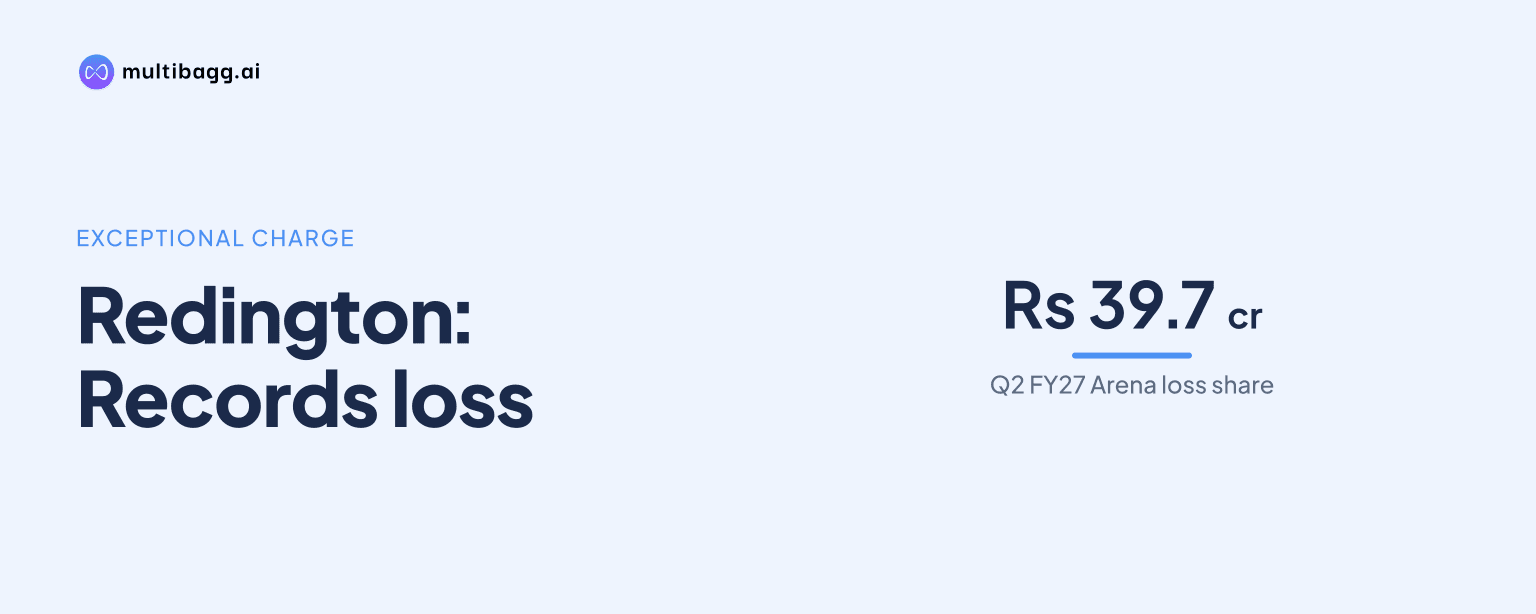
Redington recorded a Rs 39.7 crore share of loss from an Rs 80.3 crore impairment of Arena intangibles in Q2FY27, after Arena revenue fell 37% year on year following an exit from Turkish-lira-denominated businesses. Redington reported consolidated profit after tax of Rs 541 crore, versus Rs 581 crore shown excluding the exceptional impairment.
Know Redington inside out
Results, valuation, peers and who's buying, in one view.
Why did Redington impair Arena in Q2FY27?
Redington impaired Arena after challenging economic conditions in Turkey led to revised future projections for the business. Redington Gulf FZE, Redington’s wholly owned subsidiary, conducted an impairment exercise on its investment in Turkey-based Arena Bilgisayar Sanayi Ve Ticaret A.S. The company recognised the resulting impairment of Arena intangibles as an exceptional item in its Q2FY27 financial results.
Arena’s Q2FY27 operating performance was affected by Redington’s exit from Turkish-lira-denominated businesses. Arena revenue decreased 37% year on year, and the presentation says the exit resulted in a loss during the quarter. The source identifies both the exit and revised projections amid Turkish economic conditions as context for the impairment.
The Q2FY27 charge was the second disclosed stage of the intangible write-down. Redington says it had impaired part of the overall Arena intangible value in Q4FY26 and recognised the remaining impairment in the current quarter. The presentation does not provide a new operating plan, recovery target or timetable for Arena following the Turkey-related exit.
How much of the Arena impairment belongs to Redington?
Redington’s stated share of the Q2FY27 Arena impairment loss was Rs 39.7 crore, within a total intangible impairment of Rs 80.3 crore. Redington classified the total charge as an exceptional item, separating it from the profitability measure highlighted in the presentation.
The difference between the Rs 80.3 crore total impairment and Redington’s Rs 39.7 crore share of loss is Rs 40.6 crore. The presentation does not explain the accounting or ownership mechanics behind that difference. It does state that Redington Gulf FZE is wholly owned by Redington and carried out the impairment exercise for its investment in Arena.
The company’s disclosure therefore distinguishes the asset-level impairment from the loss attributed to Redington. This distinction matters when comparing the exceptional charge with reported consolidated profit: the Rs 39.7 crore share of loss is close to the Rs 40 crore difference between Rs 541 crore reported consolidated profit after tax and Rs 581 crore shown excluding the exceptional item.
What was the effect on Redington’s Q2FY27 profit?
Redington reported consolidated profit after tax, or PAT, of Rs 541 crore in Q2FY27, while presenting Rs 581 crore of profitability excluding the exceptional impairment. The Rs 40 crore difference is shown in whole crores and is close to the Rs 39.7 crore share of loss disclosed for Redington.
Redington’s global Q2FY27 performance slide compares PAT of Rs 581 crore with Rs 388 crore in Q2FY26, a 50% increase. However, the impairment disclosure states that the presentation shows profitability excluding the exceptional charge. The 50% PAT growth comparison is therefore an adjusted presentation measure, not the reported Rs 541 crore consolidated PAT.
Other global metrics increased year on year in the presentation that includes Arena. Revenue rose to Rs 43,002 crore from Rs 29,118 crore, gross margin increased to Rs 2,100 crore from Rs 1,495 crore, and earnings before interest, tax, depreciation and amortisation, or EBITDA, rose to Rs 894 crore from Rs 632 crore. These figures show higher operating scale alongside the Arena-specific exceptional item.
Got a follow-up? Ask IRIS
How did Arena change Redington’s growth comparisons?
Arena reduced reported growth rates in Redington’s Rest of the World, or ROW, business in Q2FY27. ROW revenue grew 27% year on year including Arena and 38% excluding Arena; EBITDA grew 9% including Arena and 49% excluding it; PAT grew 25% including Arena and 41% excluding it.
The largest disclosed difference was in ROW EBITDA growth. Including Arena, EBITDA growth was 40 percentage points below the 49% growth reported excluding Arena. Revenue growth was 11 percentage points lower including Arena, while PAT growth was 16 percentage points lower, showing that Arena affected each of the three comparison measures.
The same pattern appeared in Redington’s global growth metrics. Global revenue grew 48% including Arena and 54% excluding it, while EBITDA grew 41% including Arena and 58% excluding it. Global PAT grew 50% including Arena and 55% excluding it, although Redington separately says its Rs 581 crore profitability figure excluded the exceptional impairment.
ROW still recorded growth in several operating lines in Q2FY27. Including Arena, Technology Solutions Group revenue grew 42%, Security Solutions Group revenue grew 41%, and Enterprise Solutions Group revenue grew 34%. Excluding Arena, Security Solutions Group grew 45%, Technology Solutions Group grew 41%, Enterprise Solutions Group grew 37%, and Mobility Solutions Group grew 34%.
What does Redington disclose about the Turkey exit?
Redington discloses that it exited Turkish-lira-denominated businesses but does not disclose a date for the exit, a replacement strategy or a recovery target for Arena. The stated Q2FY27 consequence was a 37% year-on-year decline in Arena revenue and a loss in the quarter, alongside the revised projections used in the impairment exercise.
The presentation provides operating context for the ROW business but does not link those measures directly to the Arena charge. ROW working-capital days were 39 in Q2FY27, up five days year on year. At the global level, working-capital days were 35, up four days, while debt to equity was 0.55 times.
Singapore, India and South Asia, or SISA, delivered faster reported growth than ROW during the quarter. SISA revenue, EBITDA and PAT grew 66%, 64% and 66%, respectively, compared with ROW growth including Arena of 27%, 9% and 25%. The comparison indicates that the disclosed Arena effect was concentrated in ROW rather than across Redington’s wider business.
Conclusion
Redington’s Q2FY27 disclosure separates broad operating growth from an Arena-specific exceptional charge. The company recorded an Rs 80.3 crore intangible impairment and identified Rs 39.7 crore as its share of loss after Arena revenue declined 37% following the Turkish-lira business exit. Reported consolidated PAT was Rs 541 crore, while the presentation showed Rs 581 crore excluding the exceptional item.
The next disclosed matter to watch is whether Redington provides revised operating projections, a recovery plan or further detail on Arena and Turkey, none of which appears in this presentation. Investors can also track whether the gap between ROW growth including and excluding Arena narrows after Q2FY27, when the EBITDA growth difference was 40 percentage points.