










Relaxo Footwears Limited Acquires 26% in Clean Max MUOI
Key highlights
- Relaxo Footwears completed a 26% acquisition in Clean Max MUOI Private Limited.
- Clean Max MUOI is intended to provide group-captive renewable power to Haryana plants.
- The supplied material notes a 0.93% notable price movement, without a date or direction.
- No transaction value, power capacity or commissioning date was disclosed.
powered by IRIS
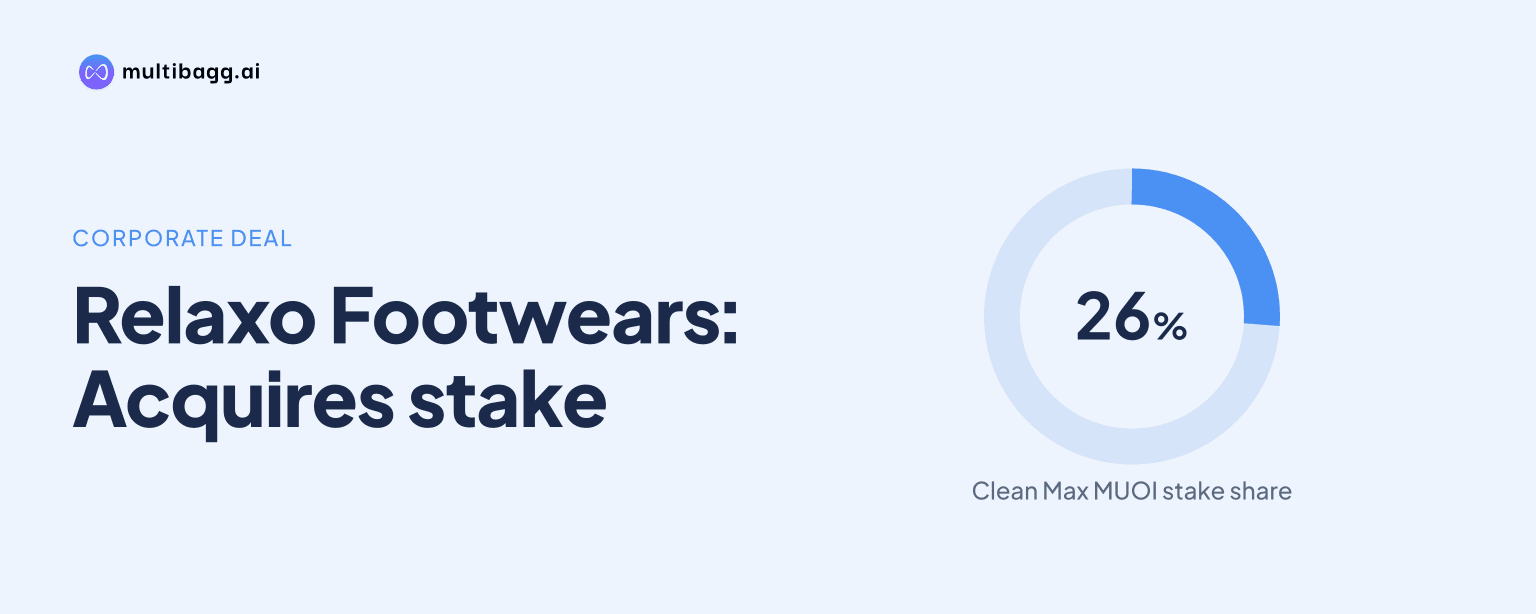
Relaxo Footwears Limited has completed the acquisition of a 26% stake in Clean Max MUOI Private Limited, a special purpose vehicle set up to supply group-captive renewable power to its plants in Haryana. The transaction links Relaxo Footwears to a renewable-energy arrangement designed for its manufacturing operations.
Know Relaxo Footwears inside out
Results, valuation, peers and who's buying, in one view.
What has Relaxo Footwears acquired in Clean Max MUOI?
Relaxo Footwears has acquired 26% of Clean Max MUOI Private Limited, according to the company's Regulation 30 update on the incorporation of the special purpose vehicle. Clean Max MUOI is intended to operate as a group-captive renewable power vehicle for Relaxo Footwears' Haryana plants.
The company drew market attention after the completion of the stake acquisition. The available disclosure identifies the investee entity, the size of the stake and the stated operational purpose of the arrangement, namely renewable power supply for the Haryana facilities.
The transaction follows definitive agreements signed with Clean Max entities for group-captive renewable power. The supplied information does not state the purchase consideration, the commissioning schedule, the renewable-energy capacity, or the expected volume of electricity to be supplied.
A 26% holding gives Relaxo Footwears an ownership interest in the dedicated vehicle while the SPV structure separates the power arrangement from the company's principal footwear business. The announcement is classified as an update on acquisition under Regulation 30 of the Listing Obligations and Disclosure Requirements regulations.
Why is Clean Max MUOI being used for Haryana plants?
Clean Max MUOI is being used to support group-captive renewable power supply for Relaxo Footwears' plants in Haryana. The stated purpose places the SPV within the company's manufacturing energy requirements rather than its retail, brand-building or footwear distribution activities.
Group-captive arrangements generally involve electricity generation for use by participating industrial consumers that also hold ownership in the generating entity. In this case, the disclosed 26% acquisition is the key ownership detail provided by Relaxo Footwears, while the announcement does not quantify the power project or the share of plant demand it may serve.
Haryana is specifically identified as the location of the plants covered by the arrangement. No separate list of facilities, project sites, vendors, tariffs, generation technology or expected operational date has been provided in the supplied material.
What does the disclosure say about the transaction?
The disclosure says Relaxo Footwears completed a 26% acquisition in Clean Max MUOI after entering definitive agreements with Clean Max entities. It also describes Clean Max MUOI as a solar group-captive SPV meant to supply renewable power to the company's Haryana operations.
The information supplied also notes a 0.93% notable price movement in connection with investor attention on the development. It does not specify the date, direction, market price or trading period associated with that figure, so it should not be treated as a complete assessment of the stock's market reaction.
Relaxo Footwears has been described as an Indian footwear company based in New Delhi and as part of the Relaxo Group. The available material identifies its incorporation year as 1984, but it does not provide financial forecasts, capital-expenditure estimates or projected savings related to the renewable-power arrangement.
Got a follow-up? Ask IRIS
How does the acquisition relate to Relaxo Footwears' earlier disclosures?
The acquisition adds an ownership-linked renewable-power arrangement to disclosures that previously said Relaxo Footwears had no holding company, subsidiary, associate company or joint venture during the financial year under review. That BRSR statement relates to the period covered by that report and should be read alongside, rather than substituted for, the subsequent acquisition update.
The company has also disclosed historical corporate actions, including the National Company Law Tribunal, Delhi order approving the merger of Marvel Polymers Private Limited and Relaxo Rubber Private Limited with the company. The certified true copy of that order was received on January 4, 2019.
These prior records provide corporate context but do not establish the financial terms or accounting treatment of the Clean Max MUOI investment. Relaxo Footwears has not disclosed such details in the material provided.
What does the Clean Max MUOI stake mean for investors and operations?
For investors, the transaction is relevant because it connects Relaxo Footwears' manufacturing footprint with a specified renewable-energy supply initiative. The 26% holding and Haryana focus are the concrete elements available for evaluating the announcement.
For operations, the stated objective is renewable power supply to Haryana plants through a group-captive structure. However, the company has not disclosed whether the project is already generating electricity, when supply will begin, or its impact on power costs, production costs, profitability or emissions.
The announcement therefore establishes the direction of the initiative without providing enough data to quantify its financial contribution. Any assessment of the effect on earnings, margins or valuation would require further disclosures on capacity, investment, pricing and commissioning.
Conclusion
Relaxo Footwears has completed a 26% investment in Clean Max MUOI, linking its Haryana manufacturing operations to a group-captive renewable power SPV. The disclosure is operationally relevant because it identifies a dedicated energy arrangement, but it does not quantify the project's cost, scale or expected financial benefit.
The next important updates would be any disclosure on the SPV's commissioning, renewable-power capacity, supply commencement and commercial terms. Investors can also watch for future company filings that clarify the investment's accounting treatment and its measurable effect on operations.