










Relaxo Footwears Limited says 90% BIS exemption aids rivals
Key highlights
- Relaxo said 90% of the footwear industry remains exempt from BIS quality-control standards.
- Relaxo said working-capital days rose by 10 days to 144 days from 134 days after expected volume growth did not materialise.
- Relaxo reported 18% sports-shoe growth over six months and said it would seek double-digit growth in shoes and sneakers.
- Relaxo had 51 reimagined outlets and plans to add 50 more over the next six months.
powered by IRIS
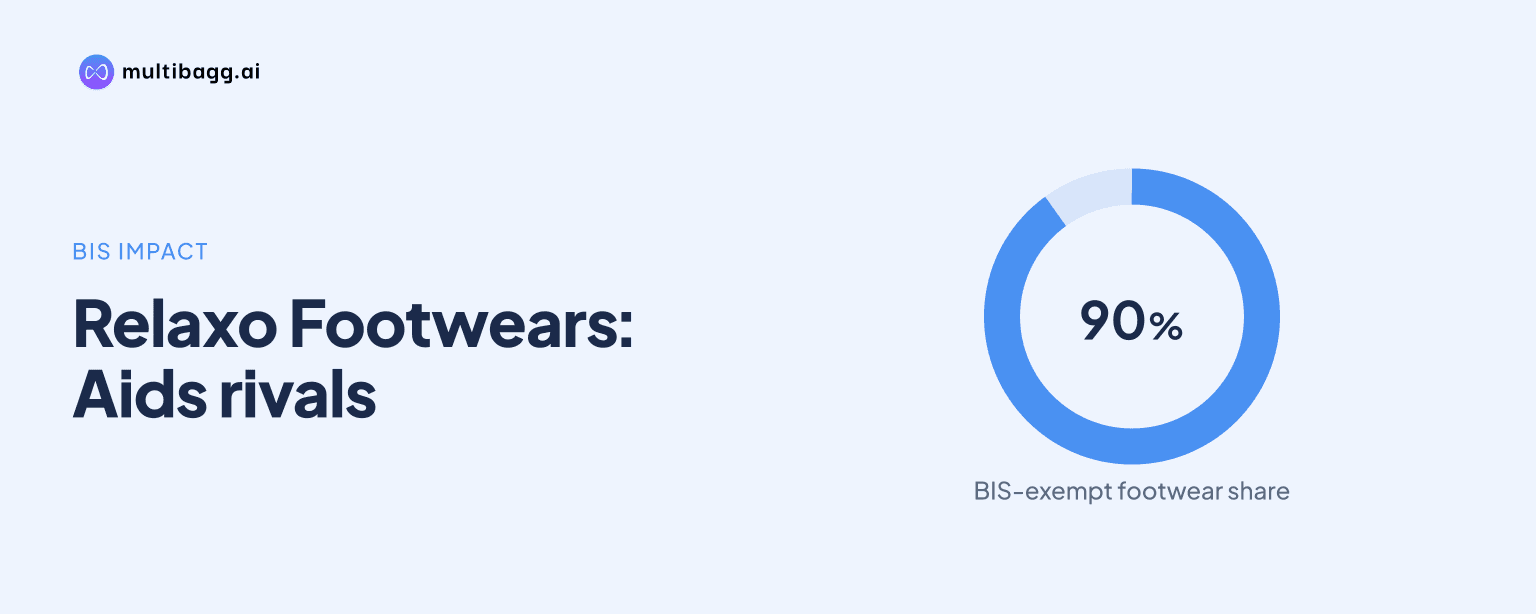
On its November 16, 2026 conference call, Relaxo said 90% of footwear producers remained exempt from BIS quality-control standards, giving unorganised competitors scope to reduce costs while Relaxo met the rules. Management said the disparity contributed to competition intensity and disappointing volume performance.
Know Relaxo Footwears inside out
Results, valuation, peers and who's buying, in one view.
What did Relaxo say about BIS exemptions?
Relaxo said government quality-control standards had affected only 10% of the footwear industry, while 90% remained exempt. Ramesh Kumar Dua said Relaxo had to comply with the standards and keep its products above the required specifications, while exempt market participants could make products to standards of their choice. Management called the resulting market situation unhealthy but did not quantify its compliance cost.
An analyst raised the exemption in the context of a Rs 50 crore top-line threshold for smaller manufacturers. Relaxo did not confirm that threshold or provide a timetable for expanding BIS coverage. Ramesh Kumar Dua said the 90% of producers benefiting from the exemption had little reason to support its withdrawal, leaving Relaxo without visibility on a change in the current treatment.
The company’s concern was therefore not simply the existence of quality rules. It was the split between the 10% required to meet the standards and the 90% outside them. Management said that split required Relaxo to maintain specifications that other producers did not have to match, creating different operating conditions within the same footwear market.
How did Relaxo link BIS rules to unorganised competition?
Relaxo said exempt unorganised producers had been able to reduce costs significantly, take some market share and increase competitive intensity. Management did not disclose Relaxo’s market-share movement or estimate the share held by unorganised competitors. Its explanation was that producers outside the quality-control requirement could supply products at standards they selected, unlike compliant manufacturers.
Management separated this issue from imports in its core open-footwear categories. Ramesh Kumar Dua said Chinese imports had not been material in categories such as Hawaii and ethylene-vinyl acetate, or EVA, footwear. He added that some articles could still enter through Bangladesh without duty, but described the routing and its effect as complicated rather than providing an import-volume measure.
The response also placed the regulatory issue alongside a broader change in competition. Gaurav Kumaar Dua said consumer preferences were evolving, digital channels were becoming more important and customers increasingly wanted differentiated products rather than only affordable footwear. That assessment means Relaxo sees lower-cost competition as one factor among several affecting its volume performance.
Why have Relaxo volumes disappointed despite policy changes?
Relaxo acknowledged that it had not delivered the growth investors expected in recent years. An analyst said volumes had declined in 2025, 2026 and the first half of the current year, despite expectations that quality standards, reduced Chinese dumping and a goods and services tax rate of 5%, compared with about 12% earlier, would support the industry. Management did not provide a volume percentage in its response but said it was not satisfied with performance.
Gaurav Kumaar Dua said Relaxo needed to move beyond being a predominantly volume-driven footwear company and become more consumer-centric and innovation-led. Management linked that shift to changing demand, more competition and the growing role of digital channels. Its stated response is to build differentiated and premium products rather than rely solely on broad volume growth in affordable footwear.
Pricing and working capital illustrate the difficult demand environment. Relaxo said it raised open-footwear prices by around 15% to 18%, while Sparx shoes received increases of roughly 6% to 7%. Working-capital days rose by 10 days to 144 days from 134 days because expected volume growth did not materialise, according to Gaurav Kumaar Dua, who also cited inflation from the 15% to 20% price increase.
Raw-material costs remain another variable. Management said rubber had reached Rs 300 per kg, which it described as its highest level, and said costs remained volatile. Amit Roy said increased costs and wage effects were being partly absorbed and partly passed through in prices, while margins would remain under pressure unless the war situation settled.
Got a follow-up? Ask IRIS
What is Relaxo doing to respond to competition?
Relaxo is focusing on premiumisation, sports shoes, sneakers, retail presentation and separate commercial attention for its portfolios. Open footwear contributes around 80% of total sales, but management reported 18% growth in sports shoes over six months. It said it would seek double-digit growth in shoes and sneakers, which it identified as its fastest-growing category.
Management said Sparx generates roughly Rs 1,000 crore in revenue and Flite produces a similar amount, with the balance coming from Hawaii and Bahamas categories. Within Sparx, closed-footwear shoes contribute around Rs 500 crore. Relaxo said it has focused more on sneakers and sports shoes because retail has the highest closed-footwear contribution and e-commerce offers potential for those products.
Relaxo split its general-trade team into a Sparx division and a Hawaii-and-Flite division from April 1, 2026. Management said it was appointing distributors separately for Sparx and launching exclusive articles in e-commerce and company retail shops. It also said it consults advisers on shifting from mass-market products to premium articles, describing the change as gradual.
The retail format is another part of the plan. Relaxo had opened 51 reimagined outlets, of which 30 were completely new, and management planned to add 50 more in the next six months. The stores have broadly similar floor area but display premium products, sneakers and sports shoes more prominently; the company said typical capital expenditure was roughly Rs 22 lakh per store.
The format started in North India and includes around 10 new-format outlets in Karnataka. Relaxo also has 10 outlets in Mumbai that had not yet been converted at the time of the call. Management said displays and external boards require a slight increase in store spending, while manufacturing capacity was already sufficient and substantial capital expenditure was not expected for closed-footwear growth.
Conclusion
Relaxo’s comments show that its response to weaker volumes combines a regulatory concern with a change in product and channel strategy. The company says the 10%-90% divide in quality-control coverage has allowed lower-cost unorganised competition, while its own Rs 500 crore closed-footwear shoes business and 18% six-month sports-shoe growth point to the categories it is prioritising.
The next disclosed operating markers are the planned addition of 50 reimagined stores in the next six months and management’s expectation of double-digit growth from the fourth quarter after trade adjusted to price increases. Investors will also watch the execution of the sales-team split introduced on April 1, 2026, and whether a change in BIS coverage emerges while 90% of producers remain exempt.