










Relaxo shifts Africa supply to Kenya manufacturing, targets 50,000
Key highlights
- Relaxo targets Kenyan capacity of about 50,000 pairs per day from Q1 FY 2027-2028.
- Relaxo will hold 51% of Relaxo Kenafric Footwears Limited and can invest up to Rs 35.7 crore.
- The Kenya project has total planned investment of Rs 70 crore and will initially serve East Africa.
- Relaxo reported H1 FY27 revenue of Rs 1,407 crore, up 9.6% year on year.
powered by IRIS
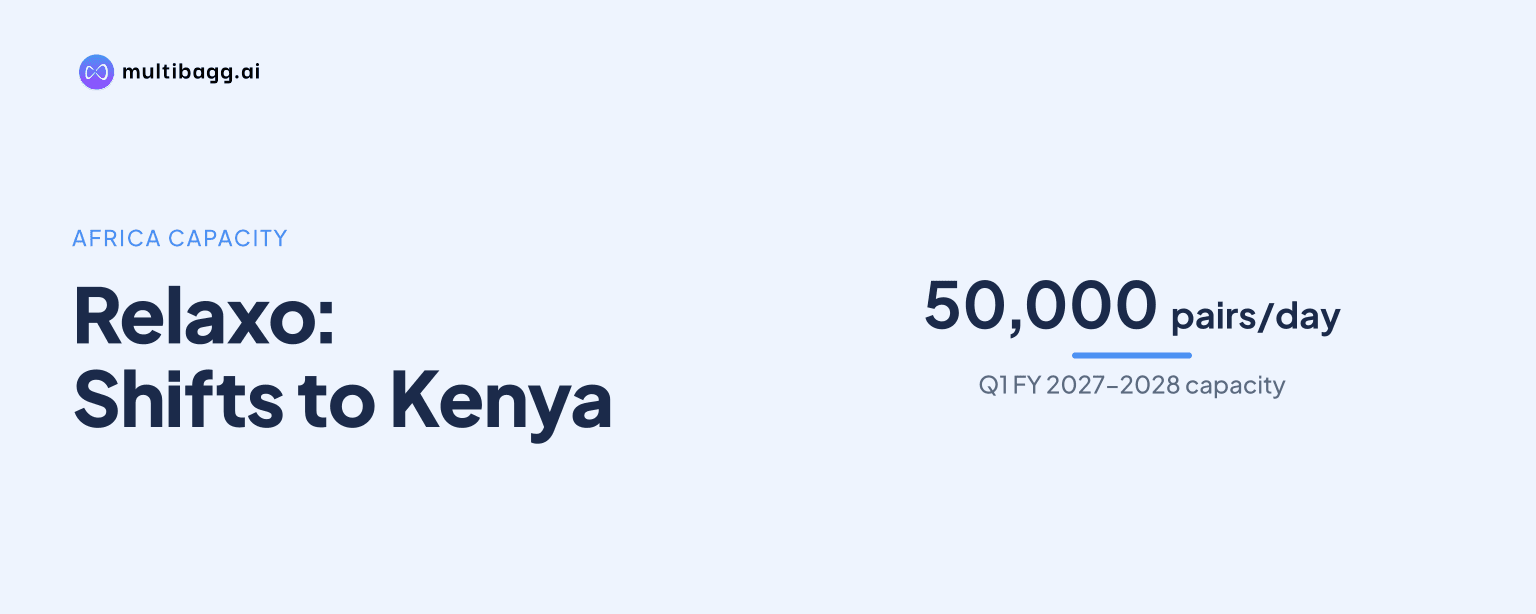
Relaxo Footwears Limited plans to start Kenyan manufacturing at about 50,000 pairs a day in the first quarter of FY 2027-2028, replacing an export-led African model that management said was constrained by import tariffs and uncertain logistics. The majority-owned venture will initially produce Hawaii slippers and gumboots for East Africa.
Know Relaxo Footwears inside out
Results, valuation, peers and who's buying, in one view.
Why is Relaxo making footwear in Kenya instead of exporting from India?
Relaxo is shifting to Kenyan manufacturing because management said exports from India faced heavy import duties and unreliable delivery timelines at African ports. Ritesh Dua said the company had operated an export-led model in Africa for several years, but logistical challenges meant customers lacked certainty about when goods would arrive.
The plan changes Relaxo’s route to market rather than adding another export destination. Management said the company had received a good response from African consumers while exporting from India, but now intends to manufacture locally in Kenya and sell from there while retaining the quality standards used for exported products.
Management identified a regional trade mechanism as a reason to localise production. It said that manufacturing in Kenya removes the tariff barrier for exports among East African countries covered by a pact cited on the call. Relaxo will therefore initially focus on East Africa rather than set a timeline for the rest of the continent.
What products and capacity will Relaxo have in Kenya?
Relaxo is targeting capacity of about 50,000 pairs per day in Kenya, initially producing Hawaii slippers and selected gumboots. Management identified both products as having local demand and said the facility was not operational during the second-quarter and first-half FY27 earnings call.
The company is targeting a start in the first quarter of FY 2027-2028. The call did not disclose annual production, utilisation assumptions, phased commissioning, factory location within Kenya or the capacity split between slippers and gumboots.
The Kenya range differs from Relaxo’s domestic emphasis on sports shoes and sneakers. Management said sports-shoe sales grew 18% in H1 FY27, while Hawaii, a mass-market open-footwear category, faced volume pressure after price increases. For Kenya, the choice of Hawaii slippers and gumboots reflects the local demand cited by management.
How is the Relaxo Kenafric venture funded and controlled?
Relaxo will own 51% of Relaxo Kenafric Footwears Limited, making it a subsidiary, and can invest up to Rs 35.7 crore in a project with total planned investment of Rs 70 crore. Kenafric Group is the partner, bringing local operational capabilities and a distribution network, according to management.
The structure combines Relaxo’s manufacturing expertise, brands and portfolio with Kenafric’s local presence. Management said the partnership’s available product range extends from slippers to gumboots, but the transcript did not disclose Kenafric’s investment, debt funding, projected revenue, break-even point or profitability.
The Rs 70 crore project is being undertaken as Relaxo reported revenue from operations of Rs 1,407 crore in H1 FY27, up 9.6% from Rs 1,283 crore in H1 FY26. Profit after tax rose 8.0% to Rs 92 crore from Rs 85 crore. Those company-wide results provide scale context, but management gave no financial target for the Kenyan subsidiary.
Got a follow-up? Ask IRIS
Which African markets will Relaxo serve first?
Relaxo will begin by serving East Africa from Kenya and may later expand to other African countries depending on market response. Management said Kenyan-made footwear would be sold to various countries in Africa, with the East African region as the initial focus.
The sequence is linked to the regional duty arrangement management described. Relaxo said local production in Kenya would eliminate the tariff barrier affecting trade among East African countries, whereas finished products exported from India had faced heavy import duties.
Management called Africa a market with substantial potential based on consumer response under its previous export model. That is management’s assessment rather than a disclosed market-size forecast: the call did not identify destination countries, quantify demand or set a timetable for expansion outside East Africa.
How does Kenya fit Relaxo’s wider growth plan?
Relaxo’s Kenyan venture creates a local African supply route while its Indian growth strategy remains centred on retail, e-commerce, modern trade, sports footwear and sneakers. Management said retail was its fastest-growing channel, followed by e-commerce and modern trade, and expected that order to continue over the next two to three years.
The company added 16 exclusive business outlets, or EBOs, in Q2 FY27, taking the network to 445, and said it remained on track for 500 stores by year-end. Management also said retail revenue grew at least 23% and that 50 outlets had been converted into “Reimagined Stores” with revised merchandising, product visibility and dedicated brand zones.
Domestic pricing and category demand remain relevant to the group’s wider investment programme. Open footwear contributes about 80% of Relaxo sales and received price increases of about 15% to 18%, while Sparx closed footwear received increases of roughly 6% to 7%. Management said Hawaii volumes were under pressure, but sports shoes and sneakers were recording double-digit growth.
Cost conditions also remain unresolved. Earnings before interest, tax, depreciation and amortisation, or EBITDA, increased 7.1% to Rs 193 crore in H1 FY27 from Rs 181 crore in H1 FY26, while the EBITDA margin was 13.8%. Management attributed pressure on profitability to raw-material volatility, higher statutory minimum wages and investments in brand building, distribution and retail expansion.
Conclusion
Relaxo’s Kenya venture is a substantive move from supplying Africa through Indian exports to manufacturing within the region. Its 51% ownership, investment limit of Rs 35.7 crore and planned capacity of 50,000 pairs per day are designed to address the tariff and logistics barriers management identified, beginning with Hawaii slippers and gumboots in East Africa.
The next disclosed milestone is the targeted Q1 FY 2027-2028 production start. Investors will need to watch whether market response supports expansion beyond East Africa, as management said that decision will depend on demand, and whether input-cost volatility, including rubber at Rs 300 per kg cited by management, affects group margins before the facility begins operations.