










Relaxo price hikes fail to fully shield operating margins
Key highlights
- Relaxo reported Q2 FY27 revenue of Rs 702 crore, up 11.6% year on year, and EBITDA of Rs 85 crore.
- Relaxo raised open-footwear prices by 15%-18%; the portfolio contributes around 80% of total sales.
- Relaxo’s Q2 FY27 EBITDA margin was 12.2% as wages, salaries and raw-material volatility continued.
- Relaxo reached 445 stores after adding 16 in Q2 FY27 and targets 500 stores by year-end.
powered by IRIS
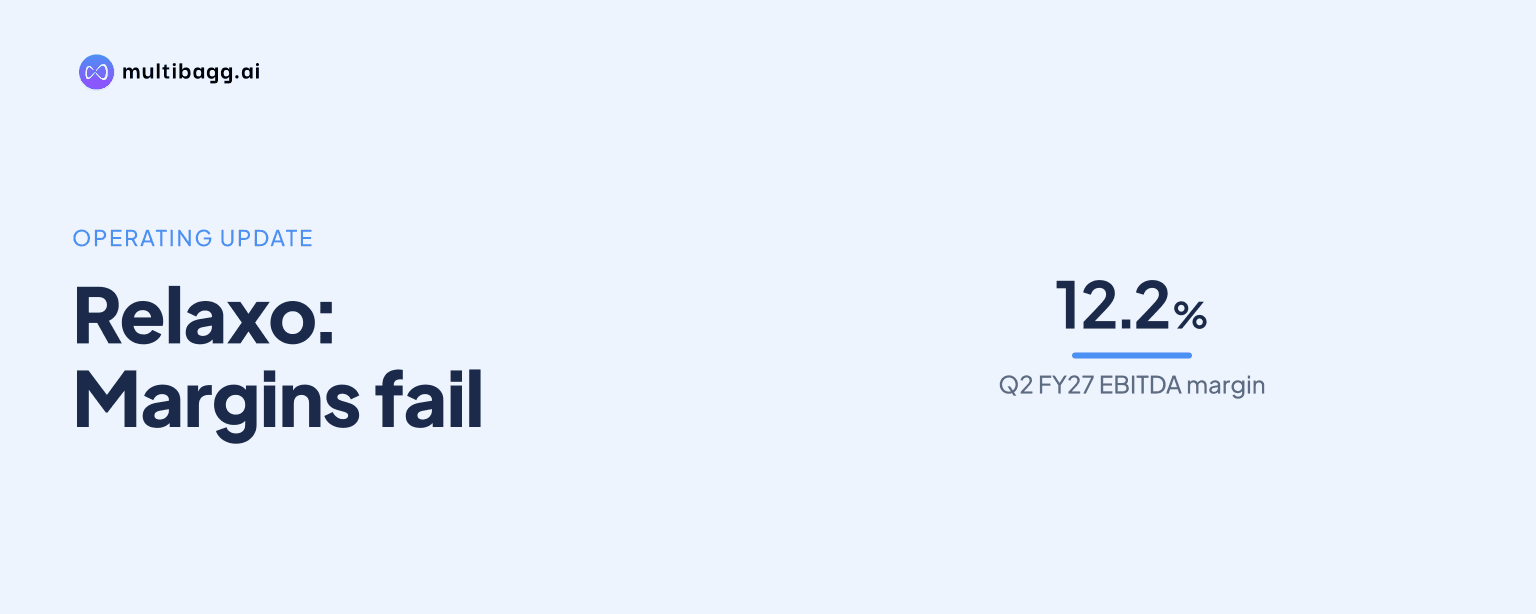
Relaxo Footwears Limited’s 15%-18% open-footwear price increases did not fully protect profitability in Q2 FY27: earnings before interest, tax, depreciation and amortisation (EBITDA) margin was 12.2% as statutory wage changes, higher salaries and volatile raw-material costs, including rubber at Rs 300 per kg, absorbed much of the pass-through. Management said it has raised prices across categories.
Know Relaxo Footwears inside out
Results, valuation, peers and who's buying, in one view.
How much did Relaxo raise footwear prices?
Relaxo raised prices by around 15%-18% in its open-footwear portfolio, which contributes around 80% of total sales, while its Sparx closed-footwear range saw an increase of roughly 6%-7%. Management said the actions addressed two cost pressures: higher raw-material prices and higher labour costs following statutory minimum-wage revisions.
Relaxo said it increased prices gradually rather than passing all cost inflation through immediately. It also launched around 150 new articles to change the product mix and reduce the direct impact on consumers, particularly in price-sensitive categories. Management said it had raised prices in all categories but could not say whether further increases would be needed.
The differing price actions reflect demand conditions across the portfolio. Open footwear includes the Hawaii mass-market category, where management acknowledged a volume dip after the pricing changes. Sparx is part of Relaxo’s closed-footwear portfolio, where management said it had passed on the price impact and was seeing growth.
Why did Relaxo’s margin remain under pressure after price hikes?
Relaxo’s Q2 FY27 EBITDA was Rs 85 crore, up 5.1% from Rs 81 crore in Q2 FY26, while revenue rose 11.6% to Rs 702 crore from Rs 629 crore. The 12.2% EBITDA margin reflected higher indirect costs, with Chief Financial Officer Amit Roy identifying wages and salaries as the main factors affecting EBITDA despite higher revenue and pricing-led realisations.
For H1 FY27, revenue from operations increased 9.6% to Rs 1,407 crore from Rs 1,283 crore in H1 FY26, while EBITDA rose 7.1% to Rs 193 crore from Rs 181 crore. H1 EBITDA margin was 13.8%. Management attributed the profitability challenge to raw-material volatility linked to the continuing West Asia conflict, statutory wage revisions, and selective spending on brand building, distribution capabilities and retail expansion.
Rubber remains a specific unresolved input risk. Management said rubber cost Rs 300 per kg, its highest-ever level, and said some other materials were also becoming more expensive. It did not forecast Q3 FY27 or the following one to two quarters because raw-material movements and the war scenario remained difficult to predict.
Which Relaxo footwear categories are holding up better?
Relaxo said its Hawaii mass category is under pressure, with volume declining even as value growth continued. Management said changes to the portfolio mix supported value growth of around 10% in other categories. The comparison shows that sales value has grown outside the mass segment while Hawaii volumes have not grown.
Sports footwear and sneakers are recording double-digit growth, according to management. Relaxo is increasing its focus on these categories, which management said are growing across the wider market as well as within the company. The company also said its premium polyurethane, or PU, light-PU range helped lift revenue in the retail channel.
Seasonality could affect the second-half mix. Management said Q3 is the period when Sparx normally records its greatest growth because it is a closed-footwear brand and winter supports demand. Sparx appointed Tamannaah Bhatia and Lakshya for advertising that began in October 2026, while Flite appointed Ali Fazal and Sanya Malhotra for a new campaign.
Got a follow-up? Ask IRIS
What is Relaxo doing beyond pricing to protect profitability?
Relaxo said productivity improvements and other cost actions are now a prime focus after price increases taken over the previous six months. Management said these measures could help improve the bottom line rather than relying solely on another selling-price increase. That focus follows management’s view that most raw-material and labour-cost pass-through has already occurred.
Retail expansion is another part of the operating plan. Relaxo added 16 stores during Q2 FY27, taking its network to 445 stores and keeping it on track for 500 by year-end. Management said it had opened more than 30 outlets in H1 FY27 compared with H1 FY26, including 50 reimagined stores, and reported retail-channel revenue growth of at least 23%.
The reimagined stores have updated merchandising, product visibility and dedicated brand zones. Management said retail is currently Relaxo’s fastest-growing channel, followed by e-commerce and modern trade, with general trade after those channels. Its stated rationale is that these formats support its sports, sneaker and premium portfolios.
Can Relaxo’s Africa plan change its cost and growth mix?
Relaxo is establishing Relaxo Kenafric Footwears Limited with Kenya-based Kenafric Group, with total investment of Rs 70 crore. Relaxo will hold a 51% stake and invest up to Rs 35.7 crore. The local-manufacturing plan is intended to address import duties and logistics delays that affected its earlier export-led model from India.
The Kenya facility is targeted to begin in the first quarter of FY28 with capacity of around 50,000 pairs a day. Management plans to manufacture Hawaii slippers and gumboots for local demand, initially focusing on East Africa. Management said local production would remove the tariff barrier for exports within East African countries.
The project does not address the current FY27 margin pressure because production is scheduled for FY28 and management gave no financial contribution target. It does, however, form part of Relaxo’s plan to reduce trade and logistics constraints while opening new demand channels. Management said expansion beyond East Africa will depend on market response.
Conclusion
Relaxo’s price increases have lifted realisations and supported revenue growth, but EBITDA growth of 5.1% in Q2 FY27 lagged the 11.6% increase in revenue as wages, salaries and raw-material costs rose. The company is balancing volume pressure in Hawaii against value growth in other categories and double-digit growth in sports and sneakers.
The next indicators are whether management’s expected double-digit growth from Q4 FY27 emerges after trade adjusts to revised prices, and whether productivity measures reduce the effect of volatile rubber and higher wages. Management’s targets of 500 stores by year-end and a first-quarter FY28 Kenya production start at around 50,000 pairs a day are additional milestones to watch.