










Robokidz says government mix drives 120-130-day cash cycle
Key highlights
- Robokidz said government customers account for 75% of revenue, compared with 25% from private customers.
- Robokidz said its usual working-capital cycle runs for 120 to 130 days.
- Robokidz reported H1 FY27 consolidated revenue from operations of Rs 60.67 crore and EBITDA of Rs 13.93 crore.
- Robokidz said laboratory set-ups contribute about 75% of revenue, while subscriptions and other business contribute about 25%.
powered by IRIS
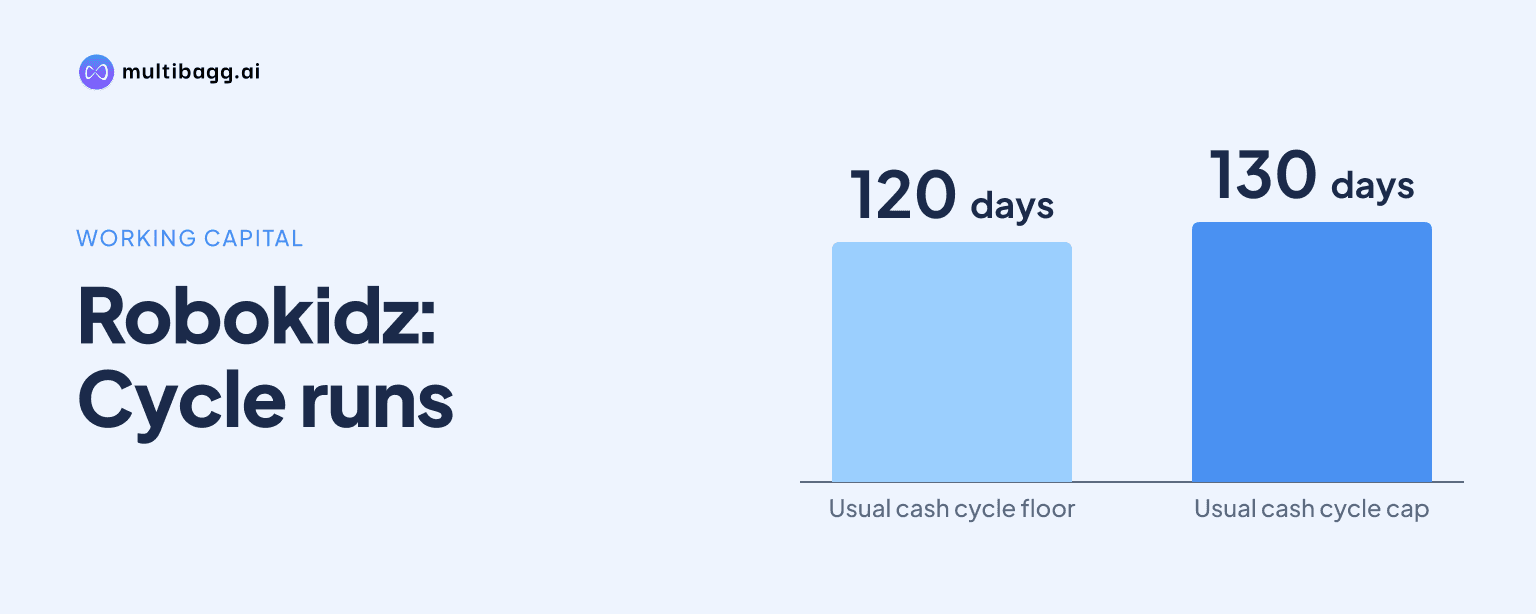
Robokidz Eduventures said 75% of its revenue comes from government customers, and management said their milestone-based payment and budget cycles result in a usual working-capital cycle of 120 to 130 days. In H1 FY27, Robokidz reported consolidated revenue from operations of Rs 60.67 crore while executing a large first-half order book.
Know Robokidz Eduventures inside out
Results, valuation, peers and who's buying, in one view.
Why does Robokidz have a 120-130-day working-capital cycle?
Robokidz said its usual 120-to-130-day working-capital cycle reflects how government and institutional customers pay against project milestones and budget cycles. Management said the company delivered a large part of its order book during H1 FY27 and expected collection for that work in H2, with some payments expected in December and January.
Robokidz said year-end receivables do not necessarily fall after H2 collections because its cycle rolls forward. Management explained that collections for H1 delivery come in H2, while collections for work delivered in H2 generally arrive in the following H1. It described this as the normal pattern in government business rather than a one-time feature of FY27.
An analyst said working capital was about Rs 73 crore against H1 FY27 revenue of about Rs 60 crore, and referred to FY26 year-end working capital of about Rs 62 crore and receivables of about Rs 72 crore. Those figures were raised by the analyst, not independently restated by management. Management responded that the sharp H1 FY27 execution level and government payment timing explained the elevated requirement.
How dependent is Robokidz on government and laboratory revenue?
Robokidz said government customers contribute 75% of revenue, while private customers provide the remaining 25%. Management specifically identified government customers as the group that takes longer to pay, making the customer mix central to the 120-to-130-day collection cycle.
Robokidz said laboratory set-ups account for about 75% of revenue, with subscriptions and other education services contributing about 25%. The laboratory offering covers robotics, artificial intelligence and related programmes provided through school and institutional partnerships. Management said H1 FY27 growth was driven largely by large institutional laboratory orders from government bodies and schools that had been received late in the previous year.
Robokidz reported stand-alone total income of Rs 52.37 crore for H1 FY27, up about 182% from Rs 18.55 crore in H1 FY26. In responding to the working-capital question, management similarly contrasted previous-H1 turnover of about Rs 18 crore with current-H1 turnover of about Rs 60 crore. The comparison indicates that delivery expanded substantially in the first half, before related collections were expected.
Got a follow-up? Ask IRIS
How has Robokidz changed its revenue mix and margins?
Robokidz said the revenue mix has shifted from about 95% laboratory set-ups and 5% other business in the previous year to about 75% laboratory set-ups and 25% subscriptions and other business. Management said services can begin after laboratories installed in the prior year, when the initial capital expenditure on the lab has already been completed.
Robokidz said laboratory set-ups have earnings before interest, tax, depreciation and amortisation, or EBITDA, margins of about 18% to 20%, compared with about 28% to 30% for other services. Management said it is trying to increase subscription and service activity, but also said education laboratory set-ups will remain the primary focus because they are the revenue driver.
On a consolidated basis, Robokidz reported H1 FY27 revenue from operations of Rs 60.67 crore, total income of Rs 60.86 crore and EBITDA of Rs 13.93 crore, representing an EBITDA margin of about 22.9%. Depreciation was Rs 0.32 crore, finance costs were Rs 2.65 crore and profit after tax was Rs 7.93 crore. Management said it considered an EBITDA margin of about 22% to 23% sustainable, which is management’s stated expectation.
What could increase Robokidz's working-capital needs next?
Robokidz said it had a confirmed order book of Rs 75 crore for the current year. In another answer, management said H1 order book was about Rs 56 crore, of which about Rs 52 crore had been executed, and later referred to Rs 75 crore as the H2 order book. The call therefore disclosed a substantial pipeline but did not provide a reconciled bridge between the figures.
Management said it is seeking annual growth of about 30% to 35%, while explaining that H1 FY27 growth was boosted by orders pending from the prior H2 that were executed in the current first half. It expects FY27 revenue to split about 35% in H1 and 65% in H2, compared with a 20% H1 and 80% H2 split in FY26. That seasonal pattern can influence the timing of both project delivery and collections.
An analyst estimated that Robokidz might require a further Rs 15 crore to Rs 18 crore in FY28 to support working capital if growth continued. Management did not confirm that amount, a funding requirement or a financing route. It said the finance team would review needs internally, any fund-raising decision would be taken by the board, and any decision would be disclosed to the exchange.
Conclusion
Robokidz’s H1 FY27 consolidated revenue of Rs 60.67 crore was generated within a model led by laboratory projects and government customers, which account for 75% of revenue. Management’s explanation links the 120-to-130-day working-capital cycle to milestone payments, budget cycles and the rolling timing of H1 and H2 project collections. The move from a 95%-5% to a 75%-25% laboratory-and-services mix may change the composition of revenue while laboratory projects remain the main delivery business.
The next indicators are the December and January collections management expected from H1 FY27 execution, progress against the Rs 75 crore confirmed order book, and the stated FY27 revenue split of 35% in H1 and 65% in H2. Investors should also watch for any board decision on additional funding, because management said future capital needs would be reviewed rather than confirming whether external funds will be required.