










Robokidz confirms Rs 75 crore H2 orders for execution by March 2027
Key highlights
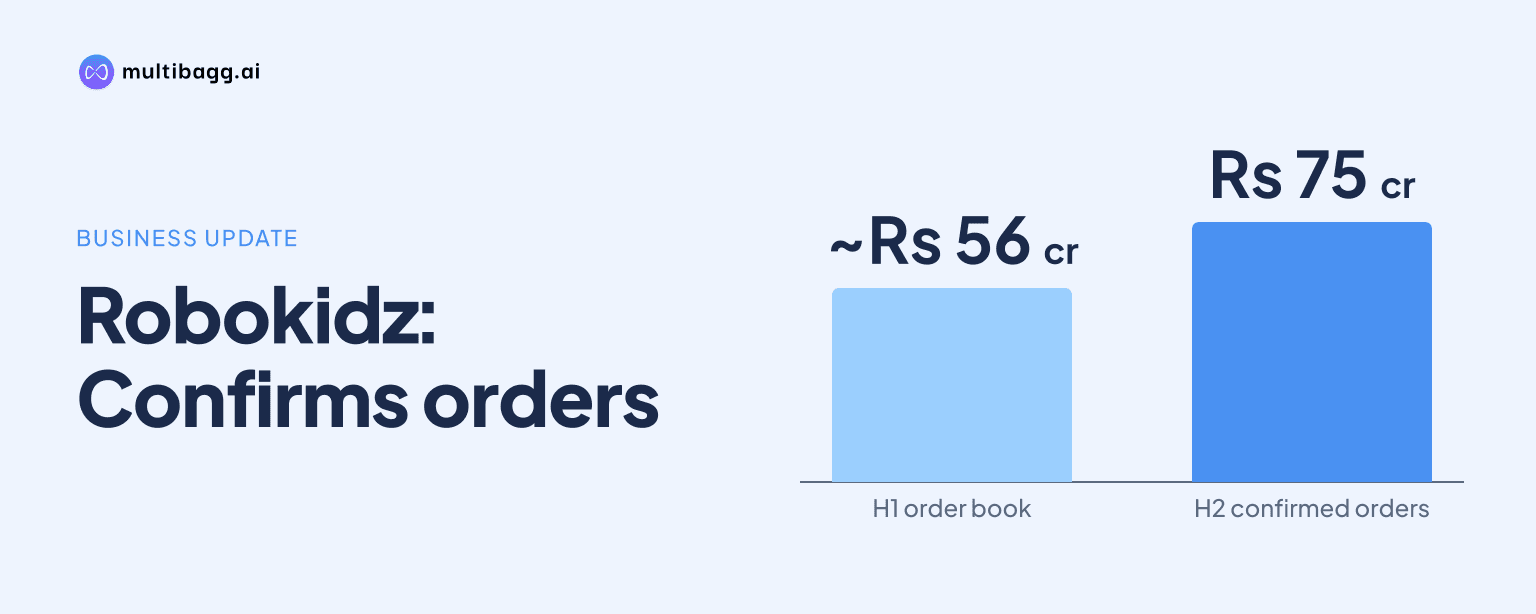
- Robokidz said it had Rs 75 crore of confirmed H2 orders for execution by March 31, 2027.
- Robokidz executed Rs 52 crore from an H1 order book of about Rs 56 crore.
- Service income was about 12.8% of H1 revenue and is excluded from the Rs 75 crore order book.
- Management expects Rs 25 crore to Rs 30 crore of further orders, but said these are not confirmed.
powered by IRIS
Robokidz Eduventures Limited said it had Rs 75 crore of confirmed H2 laboratory-project orders for execution before March 31, 2027, after Rs 10 crore had been executed in H2. The disclosed order book excludes service income, giving a separate measure of near-term project delivery activity.
Know Robokidz Eduventures inside out
Results, valuation, peers and who's buying, in one view.
What does Robokidz's Rs 75 crore H2 order book cover?
Robokidz said the Rs 75 crore was its confirmed order book as of the earnings call, and management confirmed that it remained after Rs 10 crore of H2 execution. Management said the full current order book would be executed before March 31, 2027, making the amount a defined execution pipeline rather than an estimate of unconfirmed opportunities.
The order book relates to new laboratory work, according to management's response to a question on its composition. Subscription and service income are additional to this Rs 75 crore figure, while the private-school business sits in Robokidz Retail's subscription model and Young Engineers Academy, or YEA, is a separate business.
Management also identified another Rs 25 crore to Rs 30 crore of potential orders in its pipeline. However, it said these orders were expected rather than confirmed, and it did not provide a quotation value, conversion rate or tender-win ratio for the November-to-March period.
How does H2 execution compare with H1?
Robokidz reported Rs 52 crore of execution from an H1 order book of about Rs 56 crore, compared with Rs 10 crore of H2 execution at the time of the call. H1 therefore reflected execution of most of the order book available for that period, whereas H2 had a larger confirmed balance still to be delivered by March 2027.
Management attributed H1 growth to two sources: a strong carried-forward order book from the previous year and new institutional orders generated through school relationships and memorandums of understanding. It said much of the carried-over work involved large institutional laboratory set-up orders from government bodies and schools that were received late in the prior year and substantially executed in H1.
The distinction between H1's Rs 56 crore order book and H2's Rs 75 crore confirmed balance matters because the latter is not presented as service revenue. Management confirmed that service income would be on top of project execution, and said service income represented about 12.8% of H1 revenue.
How does Robokidz win and deliver laboratory projects?
Robokidz said laboratory projects are generally won through government tender processes, where technical eligibility is assessed before financial bids are opened. Management said bidders need to meet technical, turnover and experience requirements, after which the lowest-price bidder, or L1, can win if it has qualified technically.
Management described the annual cycle as beginning with the education budget in February, followed by state-level budget allocations. In the first quarter, Robokidz's staff approach government departments to understand budgets and present products, after which government bodies may float tenders. The company said it worked across three states in H1 and set up laboratories in around 1,100 schools.
Robokidz said it does not take these government orders directly in its own name, instead using channel partners in different states. Management said these partners are established local suppliers that work regularly with government departments across multiple product categories, while Robokidz's role is project implementation and delivery.
The tender model creates dependencies beyond the Rs 75 crore confirmed balance. Future wins require budget availability, technical qualification, channel-partner participation and successful delivery, while financial pricing remains relevant after qualification. Management said its experience in the sector since 2014 supports its technical eligibility for such projects.
Got a follow-up? Ask IRIS
What revenue sits outside Robokidz's confirmed H2 orders?
Robokidz said service income is outside the Rs 75 crore laboratory order book, and management put service income at about 12.8% of H1 revenue. It said 60% of that service-income base came from existing customers and 40% from new customers, meaning installed laboratories as well as new additions contribute to this stream.
The private-school business is reported through a subscription model under Robokidz Retail rather than through the government laboratory order book. Management said its private-school customer retention ratio was 80% as of the call and stated that some schools signed 14 or 15 years earlier were still customers.
YEA is also distinct from subscriptions and laboratory orders. Management said it had four YEA centres in place, three in the pipeline, and planned to have 12 to 15 owned centres around March. It described revenue sources as personalised courses, short drop-in activities involving robotics, artificial intelligence and 3D printing, and revenue from nearby private schools; management put YEA earnings before interest, tax, depreciation and amortisation, or EBITDA, margin at 28% to 30% and profit after tax margin at 17% to 18%.
Management said education laboratory set-up would remain the main focus because it is the revenue driver, while it was also working to make YEA sustainable. It did not identify a new business stream beyond laboratory projects, subscription services and YEA.
What could add to Robokidz's order pipeline after March 2027?
Robokidz said it expected Rs 25 crore to Rs 30 crore of additional orders, but management stressed that these were not confirmed. It said it expected bigger tenders to emerge in the December-January period, without specifying tender sizes, bid values or the probability of award.
Management also pointed to composite skill labs, which it said the Central Board of Secondary Education, or CBSE, had made mandatory for schools by the end of August 2027. It added that the deadline could be extended and said government budgets for education initiatives were available over the next five years; these statements describe management's view of potential demand, not contracted revenue.
Conclusion
Robokidz has disclosed a Rs 75 crore confirmed H2 laboratory-project balance for execution by March 31, 2027, separate from service income that represented about 12.8% of H1 revenue. Compared with Rs 52 crore executed from a roughly Rs 56 crore H1 order book, the H2 balance gives a larger stated workload, while delivery depends on implementation through channel partners.
The next items to watch are execution of the Rs 75 crore balance by March 2027, the December-January timing management gave for larger tenders, and whether the Rs 25 crore to Rs 30 crore expected pipeline becomes confirmed. Management's comments on composite skill labs and the August 2027 CBSE deadline provide a possible demand marker, although it also said the deadline may be extended.