










Robokidz targets 12-15 YEA centres at 28-30% EBITDA margin
Key highlights
- Robokidz had 4 YEA stores in place and 3 centres in the pipeline.
- Robokidz targets 12 to 15 company-owned YEA centres by around March 2027.
- Management cited YEA EBITDA margin of 28% to 30% and PAT margin of 17% to 18%.
- Laboratory setup represents about 75% of Robokidz revenue, versus 25% from subscriptions and other business.
powered by IRIS
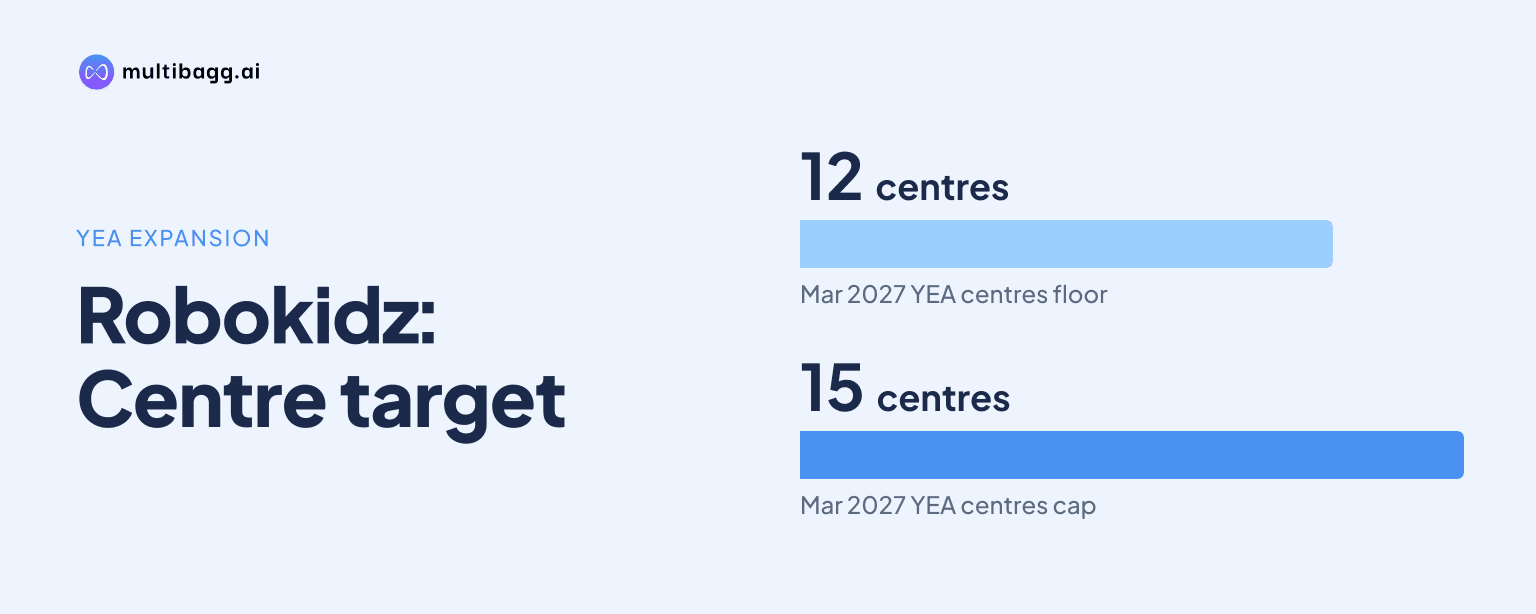
Robokidz Eduventures said it plans to operate 12 to 15 of its own Young Engineers Academy (YEA) centres by around March 2027, compared with four stores currently in place and three in progress. Management cited earnings before interest, tax, depreciation and amortisation (EBITDA) margins of 28% to 30% for YEA centres, versus 18% to 20% for laboratory setups.
Know Robokidz Eduventures inside out
Results, valuation, peers and who's buying, in one view.
What is Robokidz planning for Young Engineers Academy centres?
Robokidz is planning 12 to 15 company-owned YEA centres by around March 2027. Management said four stores were already in place, three more were in the pipeline, and it expected another four or five stores as it pursued the network target.
YEA provides Robokidz with a direct student-facing channel alongside its institutional education laboratory projects. Management said it was working vigorously on YEA and intended to make it a sustainable project, while maintaining that education laboratory setup would remain the main focus because it is the company’s revenue driver.
Robokidz did not provide expected sales per centre. When asked about store-level revenue, management said it could not directly disclose the expected sales because of regulatory compliance, so the proposed 12-to-15-centre network cannot be used to calculate a company-provided centre revenue run rate.
When will Robokidz open the next YEA centres?
Robokidz said the three YEA centres in progress were expected to start by December. Management clarified during the call that these three centres had not yet started, distinguishing them from the four stores already in place.
Opening the three pipeline centres would take the disclosed operating network to seven centres. On that basis, Robokidz would need a further five to eight centres to reach its stated 12-to-15 range by around March 2027, although management did not give a detailed opening schedule for those additional locations.
The network plan comes while management is targeting annual growth of 30% to 35%. It attributed 182% growth in H1 FY27 total income mainly to the execution of a strong opening order book, including large government and school laboratory-setup orders received late in the prior year, as well as new institutional orders through school relationships and memoranda of understanding.
Management expects FY27 revenue to be less concentrated in the second half than FY26. It described FY26 revenue as split 20% in H1 and 80% in H2, compared with an expected 35% in H1 and 65% in H2 for FY27 after orders pending in March were executed in H1.
How will Robokidz earn revenue from YEA centres?
Robokidz expects YEA centres to earn revenue from personalised student courses, including courses related to robotics and artificial intelligence (AI). Management identified these courses as one revenue stream for the direct student-facing centre format.
A second revenue stream is the drop-in activity model. Management said parents can leave children at a centre for one-hour or two-hour programmes, where students can build projects related to robotics, AI, three-dimensional printing and other activities.
A third stream is business from private schools located around the centres. Management said revenue from private schools near YEA centres would be matched directly to those centres, linking the physical network to both walk-in activity and local school relationships.
The private-school element would diversify a business that management said currently derives 75% of revenue from government customers and 25% from private customers. Management also said government customers generally take longer to pay, with H1 collections arriving in H2 and H2 collections arriving in the following H1.
Got a follow-up? Ask IRIS
What margins does Robokidz expect from YEA centres?
Robokidz said the YEA-centre EBITDA margin is around 28% to 30%, while profit after tax (PAT) margin is around 17% to 18%. These are management indications for the centre model rather than reported centre-level results, as the company did not disclose sales or profit for individual YEA locations.
The stated YEA EBITDA range is 8 to 12 percentage points above the 18% to 20% range management cited for laboratory setups. Management also put subscription and other service margins at about 28% to 30%, placing YEA in the same margin range as those service activities.
Robokidz said its overall sustainable EBITDA margin is in the 22% to 23% range. That compares with approximately 22.5% in H1 FY27, a figure raised by an analyst and confirmed by management, and sits between the laboratory-setup margin range and the margin cited for services and YEA centres.
Why does Robokidz still prioritise laboratory setups?
Robokidz said education laboratory setup remains its principal focus because it is the revenue driver. Management put the revenue mix at about 75% from lab setups and 25% from subscriptions and other business, compared with 95% and 5%, respectively, in the prior year.
The movement toward services follows laboratory capital expenditure completed in the prior year. Management said service models had started in the current year for labs set up last year, allowing the company to generate service revenue from its installed laboratory base as well as from new setup projects.
Laboratory setups also account for the disclosed order-book scale. Management said the H1 order book was Rs 56 crore, of which Rs 52 crore had been executed, while the confirmed H2 order book stood at Rs 75 crore after Rs 10 crore had been executed.
Robokidz said this order book would be executed before March 31, 2027. Laboratory execution also drove the latest growth, with H1 turnover of Rs 60 crore versus Rs 18 crore in the prior H1, while management linked the collection lag to the 75% government share of revenue.
Conclusion
Robokidz’s planned YEA network adds a direct student channel to a business still led by laboratory setups, which account for about 75% of revenue. Management has identified three YEA revenue streams, personalised courses, short drop-in activities and nearby private-school business, and cited a 28% to 30% EBITDA margin for the model compared with 18% to 20% for laboratory setups.
The next disclosed milestones are the expected December start of three centres in progress and progress toward the 12-to-15-centre target by around March 2027. Management’s plan also leaves unresolved the revenue contribution per YEA centre, while execution of the Rs 75 crore confirmed H2 order book before March 31, 2027 remains a separate operating milestone.