










Runwal Enterprises Limited targets equal housing sales mix
Key highlights
- Runwal targets a 33% contribution each from affordable, mid-income and luxury products after launches stabilise.
- An investor cited an almost 14% rise in Runwal's average selling price in the first half.
- About 70% of Runwal's 0.38 million square feet of ready inventory is in Runwal MyCity, Cluster 5.
- Runwal said its pipeline and launches can support roughly 20% to 25% annual growth.
powered by IRIS
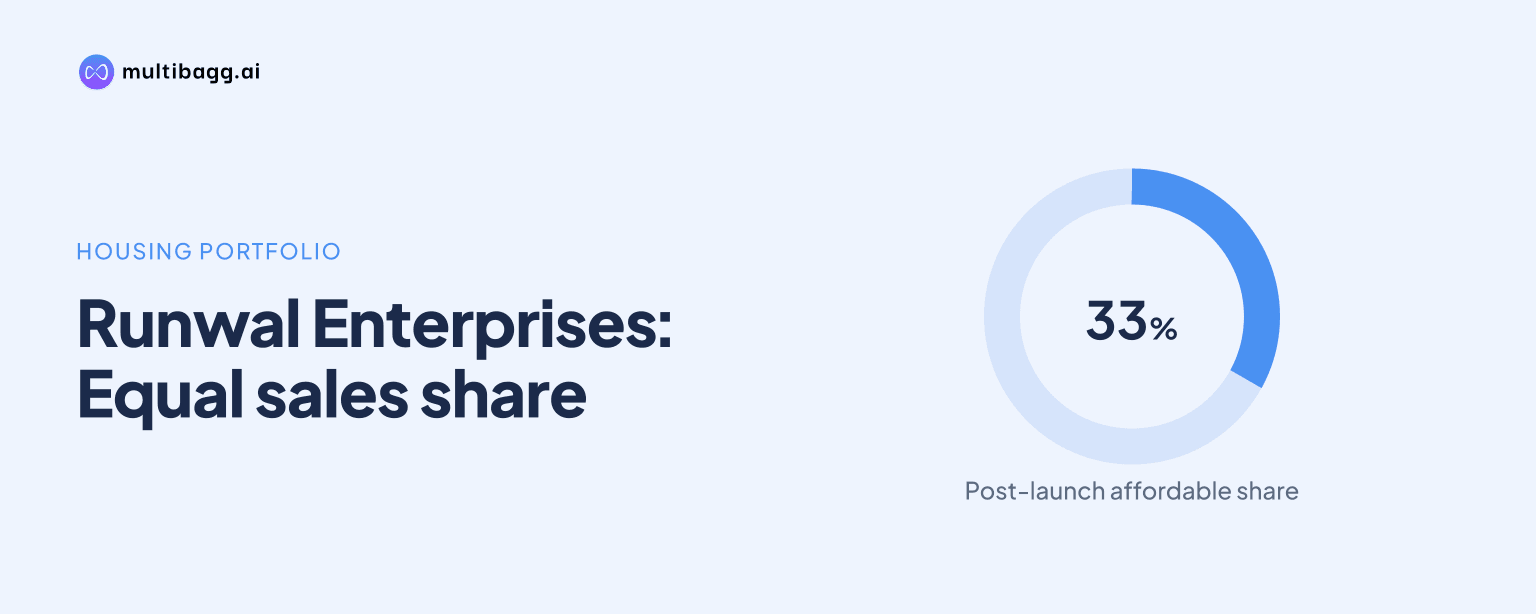
Runwal Enterprises Limited said in its first-half earnings call that it expects affordable, mid-income and luxury products each to contribute 33% after launches stabilise, a portfolio shift management expects to support pricing through higher-priced launches in South Mumbai and the western side of Mumbai. An investor cited an almost 14% rise in average selling price during the first half.
Know Runwal Enterprises inside out
Results, valuation, peers and who's buying, in one view.
How will Runwal change its housing sales mix?
Runwal aims for affordable, mid-income and luxury products to contribute 33% each once its launches have stabilised. Pradumna Kanodia said the current contribution from the three segments differs from that intended split, and management did not disclose the present percentage allocation among the categories.
The 33%-33%-33% objective is a future portfolio mix rather than a change already reported in sales. Management said the shift should appear in its disclosures as it launches and sells projects in South Mumbai and the western side of Mumbai, where it expects higher selling prices than in its existing mix.
The strategy links segment mix to the blended average selling price, or ASP. Runwal calculates ASP by dividing total sales value achieved in a period by area sold, so a greater contribution from luxury housing or higher-priced commercial strata units can alter the measure even without a uniform price movement across every project.
What drove Runwal's first-half average selling price increase?
Runwal attributed the almost 14% first-half ASP increase cited by an investor primarily to a higher contribution from 7 Mahalaxmi. Management said 7 Mahalaxmi has a significantly higher ASP than its Mumbai and Dombivli projects, increasing the blended realisation when its share of sales rises.
Sales of retail, commercial and office units on a strata basis were the second mechanism identified by management. Those transactions contribute both sales value and area sold to the ASP calculation, meaning their proportion in a six-month period can raise the aggregate figure alongside residential sales at 7 Mahalaxmi.
Management expects ASP to remain broadly in the range achieved in the six months on a normalised quarterly and annual basis because the contribution from 7 Mahalaxmi has stabilised. It said a launch in a particular quarter could cause a temporary movement in ASP, while new South Mumbai and western-side projects are expected to improve price points over time.
Which launches could change Runwal's pricing trajectory?
Runwal has already launched Runwal Woods in Chembur and Runwal Bliss phase three in Kanjurmarg, while two towers at Mahalaxmi are selling. Management said a third Mahalaxmi tower may be launched in the fourth quarter of the fiscal year, making it the specifically identified prospective launch that could affect a quarterly ASP calculation.
Runwal Woods has no further launches planned, according to management. Runwal Bliss phase three was launched in the previous fiscal year, although the company may still launch one or more towers within that phase; it nevertheless treats phase three as launched for planning purposes.
At Mahalaxmi, the two existing towers continue across sales, collections and construction. Management described the possible tower-three launch as probable rather than confirmed, so the call did not provide a committed launch date, sales-value target or expected ASP for that tower.
Runwal also said no project was awaiting approvals primarily for launch and no running project faced an approval-related delay or timeline extension. That statement addresses an execution condition for its planned launch programme, though it does not remove the uncertainty around the timing of the potential Mahalaxmi tower-three launch.
Got a follow-up? Ask IRIS
Why does Runwal remain focused on the Mumbai Metropolitan Region?
Runwal said the Mumbai Metropolitan Region, or MMR, remains its strong focus area, even though it has not ruled out expansion beyond it. Management said it may evaluate peripheral markets such as Pune, but identified MMR and nearby areas as its immediate geographic priority.
That concentration supports the planned sales-mix shift because management specifically named South Mumbai and the western side as locations for higher-priced future launches. Its current stock also retains a Dombivli component: about 70% of its 0.38 million square feet of ready-to-move-in saleable inventory is in Runwal MyCity, Cluster 5.
Runwal expects to sell almost all of the 0.38 million square feet of completed inventory by the end of FY27. The proposed liquidation concerns existing ready stock, whereas the 33% segment contribution is tied to launch stabilisation, but both programmes will influence the relative weight of newer Mumbai micro-markets in the portfolio.
Management said its projects and launch pipeline can keep the company on track for roughly 20% to 25% annual growth, without issuing a fixed FY27 sales-value target. That growth expectation depends on available projects and launches, while the company continues to position MMR as the principal market for those opportunities.
Conclusion
Runwal's stated direction is to move from an undisclosed uneven mix to equal 33% contributions from affordable, mid-income and luxury products. The almost 14% first-half ASP increase cited on the call illustrates the mechanism management described: a larger contribution from 7 Mahalaxmi and strata commercial sales can raise blended realisations.
The next item to watch is the possible fourth-quarter launch of Mahalaxmi tower three and the pace of future South Mumbai and western-side launches. Management also expects roughly 20% to 25% annual growth and plans to sell almost all 0.38 million square feet of ready inventory by the end of FY27, while leaving the current segment split and a fixed FY27 sales target undisclosed.