










Sagar Cement Q2 volume rises 26% as EBITDA per tonne falls
Key highlights
- Sagar Cement’s Q2 FY27 sales volume rose 26% year on year to 17.09 lakh tonnes, while operating EBITDA fell 12% to Rs 45.31 crore.
- Net realisation declined 7% to Rs 4,127 per tonne, while power and fuel cost rose 3% to Rs 1,473 per tonne and freight cost increased 5% to Rs 900 per tonne.
- Q2 FY27 operating EBITDA per tonne fell 30% to Rs 265, reducing the operating EBITDA margin to 6% from 9%.
- Sagar Cement completed a 0.75 MTPA grinding-capacity expansion in Andhra Pradesh during Q2 FY27.
powered by IRIS
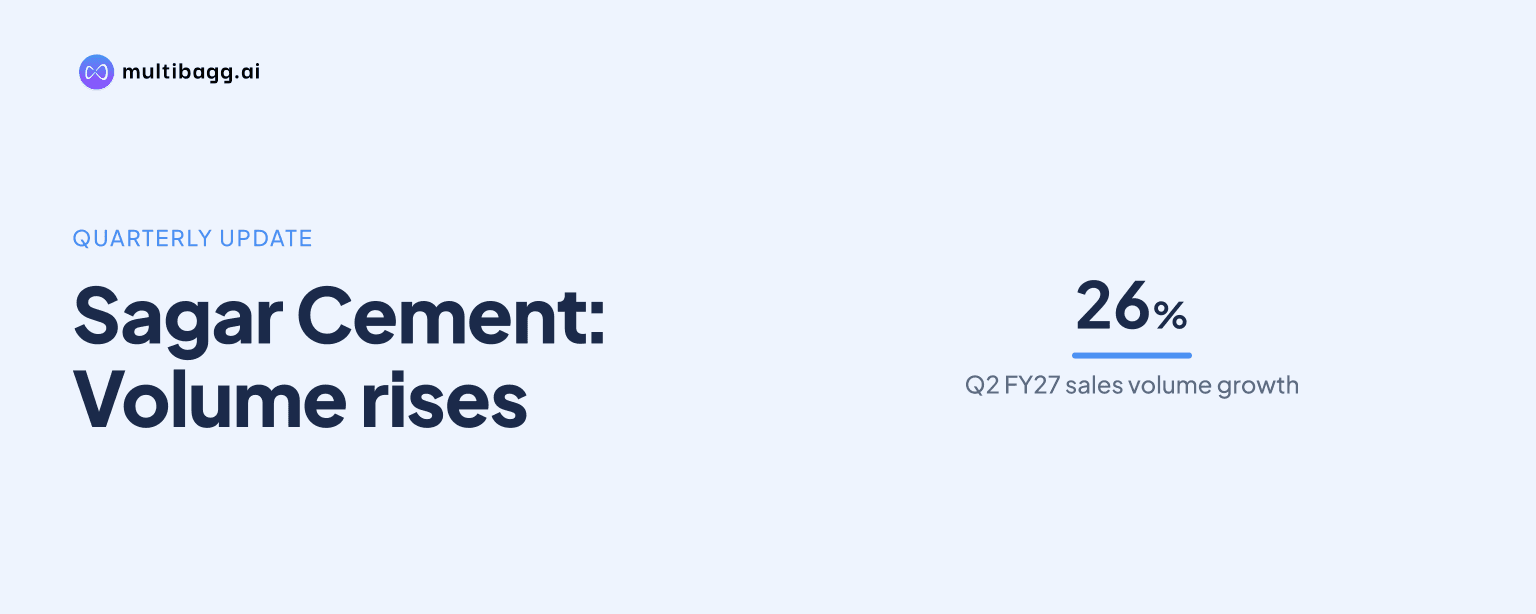
Sagar Cements Limited, referred to as Sagar Cement, raised consolidated Q2 FY27 sales volume by 26% year on year to 17.09 lakh tonnes, but operating EBITDA per tonne fell 30% to Rs 265. Revenue rose 17% to Rs 705.36 crore, while lower realisation and higher power, fuel and freight costs reduced operating EBITDA margin to 6% from 9%.
Know Sagar Cements inside out
Results, valuation, peers and who's buying, in one view.
Why did Sagar Cement's volume growth not lift Q2 earnings?
Sagar Cement's Q2 FY27 volume growth did not lift earnings because revenue growth of 17% lagged the 26% rise in sales volume, while operating expenses increased 20%. Consolidated operating EBITDA consequently declined 12% year on year to Rs 45.31 crore from Rs 51.33 crore, despite sales increasing to 17.09 lakh tonnes from 13.60 lakh tonnes.
The mismatch is clearer on a per-tonne basis. Net realisation fell 7% year on year to Rs 4,127 per tonne from Rs 4,425, while total expenditure per tonne declined only 5% to Rs 3,862 from Rs 4,048. This reduced EBITDA per tonne by Rs 112 to Rs 265. The EBITDA margin declined by 300 basis points to 6%.
What caused Sagar Cement's per-tonne margin squeeze?
Sagar Cement's per-tonne margin squeeze was caused by a 7% year-on-year fall in net realisation alongside increases in power and fuel and freight costs. Power and fuel cost rose 3% to Rs 1,473 per tonne, and freight increased 5% to Rs 900 per tonne in Q2 FY27, offsetting reductions in raw-material, employee and other expenses.
Management said cement prices remained soft in July and August before recovering to some extent during September, and that sequential realisations were lower by around 6%. The presentation records Q2 FY27 realisation of Rs 4,127 per tonne, down from Rs 4,396 in Q1 FY27. Total expenditure was Rs 3,862 per tonne, 2% below Q1 FY27's Rs 3,945, but EBITDA per tonne fell 41% sequentially from Rs 451.
Higher logistics costs coincided with an average lead distance of 263 kilometres in Q2 FY27, up 3% from 255 kilometres in Q2 FY26 and 5% from 251 kilometres in Q1 FY27. Management also cited elevated fuel, packaging and other operating costs reflecting geopolitical developments in West Asia. The quarter's freight charge of Rs 900 per tonne was above Rs 855 a year earlier and Rs 858 in Q1 FY27.
How did Sagar Cement's sales mix and utilisation change?
Sagar Cement increased capacity utilisation to 63% in Q2 FY27, 1,000 basis points above the prior-year level, while production grew 25% to 16.91 lakh tonnes. Sales slightly exceeded production at 17.09 lakh tonnes, and non-trade volume grew 37%, compared with 15% growth in trade volume.
The channel mix shifted towards non-trade business, which accounted for 46% of Q2 sales against 49% in Q2 FY26, while trade represented 54% against 51%. Bulk volume increased 43% year on year and accounted for 36% of sales, compared with 32% a year earlier. Packed cement remained the larger category at 64% of Q2 FY27 sales.
Telangana was Sagar Cement's largest Q2 FY27 market at 5.02 lakh tonnes, or 29% of sales, versus 3.23 lakh tonnes and 24% a year earlier. Andhra Pradesh contributed 4.66 lakh tonnes, or 27%, compared with 4.00 lakh tonnes and 29% in Q2 FY26. The two states accounted for 56% of Q2 volume, compared with 53% a year earlier, while Maharashtra remained at 10%.
Got a follow-up? Ask IRIS
What do Sagar Cement's half-year results show?
Sagar Cement's H1 FY27 results show that margin pressure extended beyond one quarter: sales volume rose 19% to 33.15 lakh tonnes, whereas operating EBITDA fell 32% to Rs 117.73 crore. Revenue from operations increased 11% to Rs 1,411.43 crore, below volume growth, and EBITDA per tonne fell 43% to Rs 355 from Rs 620 in H1 FY26.
The half-year EBITDA margin was 8%, down from 14% in H1 FY26. H1 net realisation decreased 7% to Rs 4,257 per tonne, while total expenditure declined only 1% to Rs 3,902 per tonne. Power and fuel cost increased 3% to Rs 1,478 per tonne and freight rose 3% to Rs 880, even as raw material consumed per tonne declined 5% to Rs 763.
The resulting consolidated loss after tax widened to Rs 79.64 crore in H1 FY27 from Rs 36.68 crore in H1 FY26. In Q2 alone, loss after tax was Rs 51.54 crore, compared with a Rs 44.17 crore loss a year earlier. Finance cost grew 19% in Q2 to Rs 55.16 crore and depreciation rose 10% to Rs 61.29 crore.
What is Sagar Cement doing to address costs and capacity?
Sagar Cement is pursuing waste-heat recovery, green-power use, logistics optimisation and plant-efficiency measures to address costs, according to management. Green-power usage reached 19% in Q2 FY27 from 16% in the prior-year quarter, and was 21% in H1 FY27 compared with 16% in H1 FY26.
Sagar Cement completed a 0.75 million tonnes per annum, or MTPA, grinding-capacity expansion in Andhra Pradesh during Q2 FY27. Management said this addition, recently commissioned waste heat recovery system capacity at Gudipadu and the Jeerabad expansion are expected to improve operating efficiencies and support future growth. The presentation does not quantify future cost savings or margin effects from these projects.
Management expects demand momentum to improve during H2 FY27 following the monsoon, supported by a recovery in construction activity and continued infrastructure spending. It also said planned maintenance shutdowns occurred during Q2. Q2 utilisation of 63% was below the H1 FY27 level of 64%, although it was 1,000 basis points above the comparable quarter a year earlier.
Conclusion
Sagar Cement's Q2 FY27 performance shows that a 26% increase in consolidated sales volume did not translate into higher operating earnings. A 7% fall in realisation per tonne, combined with 3% higher power and fuel expense and 5% higher freight expense per tonne, reduced EBITDA per tonne to Rs 265 and margin to 6%. The H1 decline of 43% in EBITDA per tonne indicates that the pressure was not limited to one quarter.
The next issue to watch is whether management's expected H2 FY27 post-monsoon demand recovery improves pricing and whether green-power, waste-heat recovery, logistics and plant-efficiency actions reduce costs. The Andhra Pradesh 0.75 MTPA grinding expansion was completed in Q2, but the presentation gives no quantified timeline for margin improvement from that capacity and the related efficiency projects.