










Sagar Cements Limited Q2 FY27 Revenue Rises 17%, Loss Widens
Key highlights
- Sagar Cements reported Q2 FY27 revenue of ₹705.36 crore, up 17.1% year-on-year.
- Sales volume increased 26% year-on-year to 1.71 million tonnes in Q2 FY27.
- Operating EBITDA declined 11.8% year-on-year to ₹45.31 crore, with EBITDA per tonne at ₹265.
- Total capacity reached 11.75 million tonnes after 0.75 million tonnes of Andhra Pradesh grinding capacity was completed.
powered by IRIS
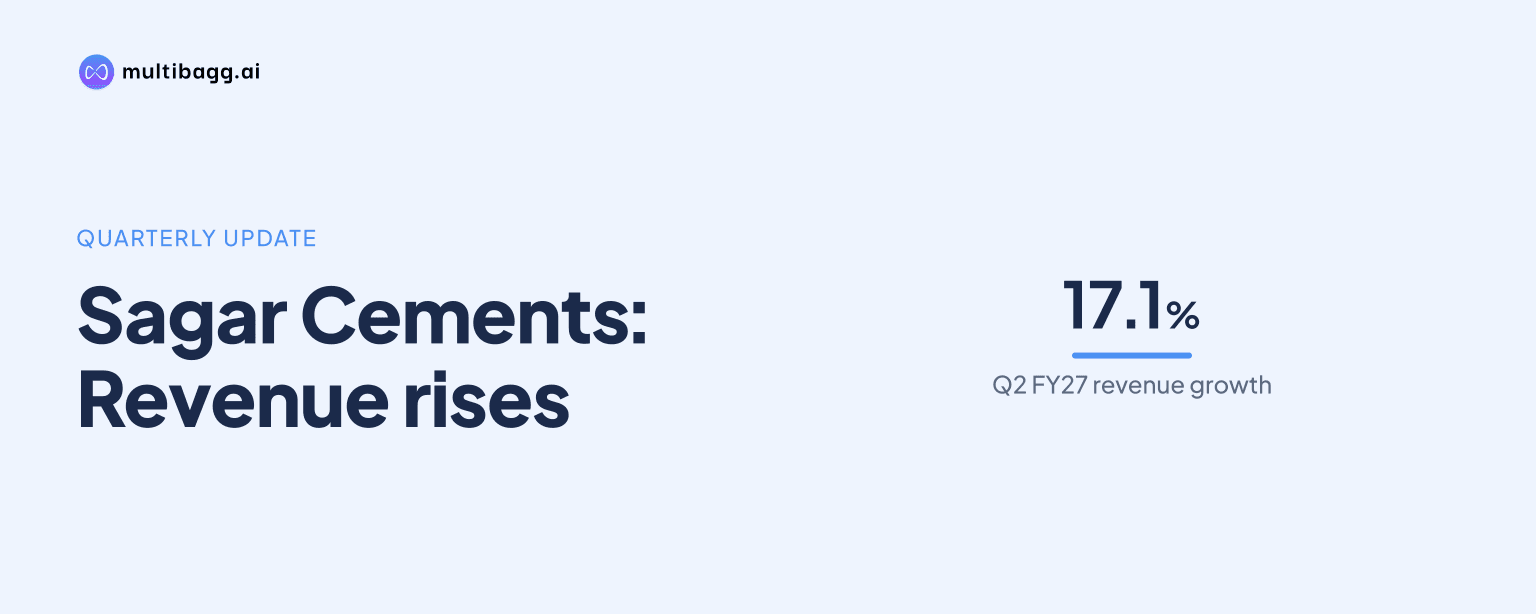
Sagar Cements Limited reported Q2 FY27 revenue of ₹705.36 crore, up 17% year-on-year, as sales volume increased 26% to 1.71 million tonnes, but its net loss widened to ₹51.54 crore amid elevated fuel, packaging and other operating costs.
Know Sagar Cements inside out
Results, valuation, peers and who's buying, in one view.
What were Sagar Cements' Q2 FY27 financial results?
Sagar Cements reported higher revenue in the quarter ended September 30, 2026, but operating profitability and net earnings weakened. Revenue rose to ₹705.36 crore from ₹602 crore in Q2 FY26, supported mainly by volume growth across its three key markets.
Sales volume increased 26% year-on-year to 1.71 million tonnes despite the seasonal slowdown associated with the monsoon. The company said cement demand remained relatively resilient during the quarter, enabling it to improve dispatches even as broader operating conditions remained challenging.
Operating EBITDA declined 12% year-on-year to ₹45.31 crore from ₹51 crore. EBITDA margin narrowed to 6% from 9% a year earlier, while EBITDA per tonne was ₹265. Net loss widened to ₹51.54 crore from ₹44 crore in Q2 FY26. Loss before tax stood at ₹69 crore, compared with ₹47 crore in the corresponding quarter of the previous year.
Why did Sagar Cements' profitability decline despite volume growth?
Sagar Cements' profitability declined because higher input and operating costs outweighed the benefit of stronger sales volumes. Management cited elevated expenses for fuel, packaging and other operating items, linking part of the pressure to geopolitical developments in West Asia.
The company also indicated that maintenance affected quarterly profitability. These cost pressures resulted in a lower operating margin even as revenue increased, showing that higher dispatches did not fully translate into earnings growth during the quarter.
On a sequential basis, revenue was broadly unchanged from ₹706 crore in Q1 FY27. However, EBITDA fell from ₹72 crore in the preceding quarter, and operating margin declined from 10% to 6%. Net loss also widened from ₹28 crore in Q1 FY27 to ₹52 crore in Q2 FY27.
Management said it expects profitability to improve in the second half of FY27 through post-monsoon demand recovery, higher renewable-energy usage, logistics optimisation and efficiency gains from recent plant upgrades. These are management expectations, while the reported Q2 figures reflect the cost conditions experienced during the quarter.
Got a follow-up? Ask IRIS
How is Sagar Cements expanding its manufacturing capacity?
Sagar Cements completed 0.75 million tonnes of grinding capacity in Andhra Pradesh during Q2 FY27, taking its total capacity to 11.75 million tonnes. The addition expands the company's manufacturing footprint as it seeks to serve demand across its operating markets.
The capacity commissioning comes as the company targets approximately 7 million tonnes of sales volume in FY27. Management said the target is supported by expanded capacity and an improving demand outlook. It has also stated a FY28 volume target of 8 million to 8.25 million tonnes.
Cement demand in the quarter was supported by resilient market conditions despite monsoon-related disruption. In its market commentary, the company pointed to infrastructure investment, urbanisation and a pipeline of housing and industrial projects as factors underpinning the medium- to long-term industry outlook.
The new Andhra Pradesh grinding unit is therefore relevant both operationally and financially. Greater installed capacity can support volume growth, but the Q2 results also show that cost control and realisations remain important for converting higher output into improved margins.
What does the Q2 performance mean for investors and the cement sector?
Sagar Cements' Q2 FY27 performance shows that volume growth remained strong, while cost inflation constrained earnings. Revenue growth of 17% lagged the 26% rise in volume, and EBITDA per tonne of ₹265 remained affected by input-cost pressure.
For investors, the key reported contrast is between improving scale and weaker profitability. The company's capacity has increased to 11.75 million tonnes, and management has maintained its FY27 volume guidance of about 7 million tonnes. But operating EBITDA fell year-on-year and sequentially during the quarter, while the net loss widened.
Management guided for FY27 EBITDA of ₹350 crore to ₹375 crore, equivalent to about ₹525 to ₹550 per tonne according to comments on the earnings call. This guidance places focus on demand recovery after the monsoon, input-cost trends and the company's planned operational efficiency measures.
For the wider cement industry, the quarter reflected the seasonal impact of monsoons alongside continued underlying demand. Sagar Cements' experience indicates that demand conditions may support dispatches, but fuel, packaging and logistics costs can materially affect quarterly margins.
Conclusion
Sagar Cements delivered 26% volume growth and 17% revenue growth in Q2 FY27, supported by demand across its markets and a larger operating footprint. However, EBITDA declined to ₹45.31 crore, EBITDA per tonne was ₹265, and net loss widened to ₹51.54 crore as elevated operating costs and maintenance pressure limited profitability.
The next items to watch are the post-monsoon demand recovery, the impact of renewable energy and logistics initiatives on costs, and progress toward the company's approximately 7 million-tonne FY27 volume target. Management's ₹350 crore to ₹375 crore FY27 EBITDA guidance and its FY28 volume target of 8 million to 8.25 million tonnes provide the disclosed benchmarks for assessing subsequent performance.