










Sagar Cements targets 542 kg CO2 emissions intensity by FY30
Key highlights
- Sagar Cements targets gross Scope 1 and Scope 2 emissions intensity of 542 kg CO2 per MT by FY30, down from 651 kg CO2 per MT in H1 FY27.
- Sagar Cements aims to increase green power to 50% by FY30 from 21% in H1 FY27, with an interim FY27 target of 24%.
- The company plans to raise thermal substitution from 2.35% in H1 FY27 to 25% by FY30 and reduce its clinker factor from 74% to 64%.
- Sagar Cements has disclosed 17 MW of planned solar and waste-heat recovery capacity requiring Rs 180 crore of capex, including a 9 MW Dachepalli WHRS project scheduled for FY29.
powered by IRIS
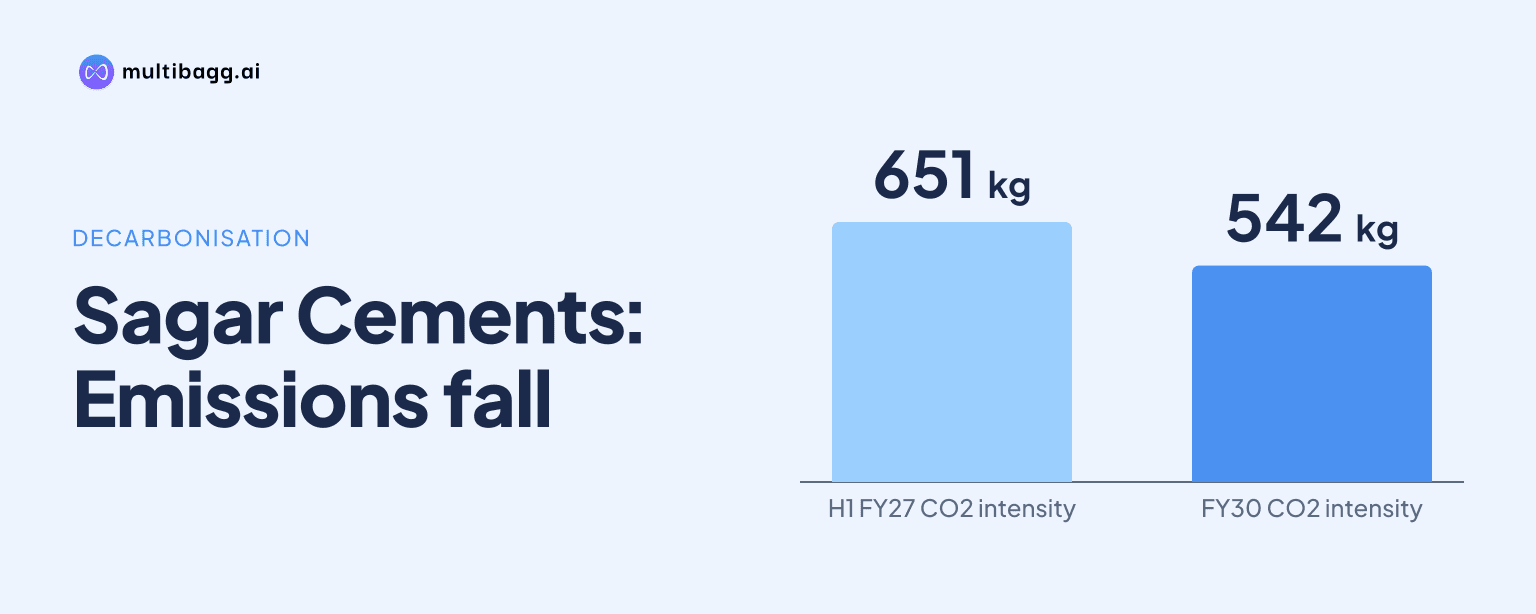
Sagar Cements targets gross Scope 1 and Scope 2 emissions intensity of 542 kg CO2 per metric tonne (MT) of cementitious material by FY30 and 50% green power. SCL reported 651 kg CO2 per MT and 21% green power in H1 FY27, while setting a 615 kg CO2 interim intensity target for FY27.
Know Sagar Cements inside out
Results, valuation, peers and who's buying, in one view.
How far must SCL cut emissions intensity by FY30?
SCL must reduce gross Scope 1 and Scope 2 emissions intensity by 109 kg CO2 per MT from its H1 FY27 level to meet its FY30 target of 542 kg CO2 per MT. The company has also set an FY27 target of 615 kg CO2 per MT, 36 kg below its reported H1 FY27 performance of 651 kg CO2 per MT.
SCL’s FY23-24 baseline separates emissions into 634 kg carbon dioxide equivalent (CO2e) per tonne of cementitious material for Scope 1 and 34 kg CO2e for Scope 2. Its FY30 pathway identifies energy and operational efficiency, alternative-fuel substitution, decarbonated raw materials, clinker-factor reduction, green and renewable energy, innovative technology and green transportation as its stated levers.
The emissions plan also covers cement composition and kiln fuel. SCL reported a clinker factor of 74% in H1 FY27, targeting 70.80% in FY27 and 64% in FY30, while thermal substitution rate (TSR) is targeted to rise from 2.35% in H1 FY27 to 15% in FY27 and 25% in FY30.
How will SCL increase green power to 50%?
SCL targets green power of 50% by FY30, from 21% reported in H1 FY27 and an interim target of 24% for FY27. It also aims to reduce specific electricity consumption from 73.08 kilowatt-hours per MT of cement in H1 FY27 to 70.64 kilowatt-hours in FY27 and 50.74 kilowatt-hours by FY30.
Specific thermal consumption was 721 kilocalories per kilogram of clinker in H1 FY27. SCL targets 710.68 kilocalories per kilogram in FY27 and 700 kilocalories per kilogram in FY30, alongside the planned increase in TSR to 15% and then 25%.
SCL also includes onsite transport in its energy-transition roadmap. It reported 8% zero-emission vehicles onsite in H1 FY27, including 11 electric loaders, trucks and sweeping machines, and has set a FY30 target for 30% zero-emission transportation onsite.
Which renewable and waste-heat projects has SCL disclosed?
SCL lists 17 megawatts (MW) of further solar and waste-heat recovery capacity with disclosed capital expenditure of Rs 180 crore. The listed projects comprise two 4 MW solar installations and a 9 MW waste-heat recovery system (WHRS) at Dachepalli.
SCL says its 4.35 MW WHRS at Gudipadu has been commissioned and is operating at full capacity. It also says alternative fuel and raw material feeding systems have been completed at Jeerabad, supporting the operational infrastructure relevant to its FY27 TSR target of 15%.
The FY27 materials contain different disclosures for Jeerabad solar. The capex update lists a 4 MW project for FY27 at Rs 18 crore, while the planned-activities page says a 7 MW solar plant for Jeerabad is under evaluation; a separate budget table allocates Rs 20 crore each to Jeerabad and Mattampally solar projects.
Got a follow-up? Ask IRIS
What is SCL’s syngas alternative-fuel project?
SCL’s Mattampally project uses cotton crop residue to produce syngas and biochar, with the syngas trial beginning on 12 September 2026. The company describes it as an integrated biochar and gasification project intended to accelerate decarbonisation.
The disclosed mechanism is to use syngas as an alternative fuel in the cement process and provide biochar to farmers as manure. SCL says the project may reduce greenhouse-gas emissions from its process and from open-field burning of crop residue; Gow Reap is the execution partner and Ankur is the gasification technology provider.
The project is separate from SCL’s company-wide TSR target because the presentation does not quantify expected syngas volumes, fuel substitution or emissions reductions. Its stated status is that the project was completed and a trial had started by 12 September 2026, rather than that it had entered full commercial operation.
What other environmental targets does SCL have for FY30?
SCL targets 10-times water positivity by FY30, compared with three-times water positivity in H1 FY27, and a 20% reduction in freshwater consumption from 2022. Specific freshwater consumption for the cement process was 37 litres per tonne of cementitious material in H1 FY27, while the FY27 target calls for an 8.6% reduction from 2022.
On materials, SCL reported 0.81% decarbonated raw materials and 45% blended cements in H1 FY27. Its FY27 target is 1.11% decarbonated raw materials, while its FY30 roadmap cites 20% use of decarbonated raw materials and a clinker factor of 64%.
The roadmap follows SCL’s 2025-26 double-materiality assessment, which listed climate change, air emissions, energy, circular economy and waste, water, biodiversity, sustainable product and resources among 15 material topics. SCL says its environmental, social and governance framework was established in 2021 and revised in 2025, and reports a CDP rating of B in climate change and water.
Conclusion
SCL’s disclosed pathway links its FY30 emissions-intensity objective of 542 kg CO2 per MT to targets across electricity, kiln heat, cement composition and vehicle use. The combination includes 50% green power, a 25% TSR, a 64% clinker factor and 30% zero-emission transportation onsite, compared with H1 FY27 levels of 21%, 2.35%, 74% and 8%, respectively.
The next disclosed milestones are SCL’s FY27 targets of 24% green power, 615 kg CO2 per MT emissions intensity and 15% TSR. Investors and other stakeholders can also track the 4 MW Jeerabad solar project listed for FY27, the 7 MW Jeerabad solar plant under evaluation, and the 9 MW Dachepalli WHRS scheduled for FY29.