










Sagar Cements cuts FY27 EBITDA target to Rs 350-375 crore
Key highlights
- Sagar Cements cut FY27 EBITDA guidance to Rs 350 crore-Rs 375 crore from Rs 410 crore.
- Management expects about Rs 650 per tonne of EBITDA in Q3 FY27 if pricing holds.
- Q2 FY27 power and fuel cost rose to Rs 1,473 per tonne from Rs 1,428 per tonne a year earlier.
- Gross debt was Rs 1,735 crore and cash and bank balances were Rs 106 crore on September 30, 2026.
powered by IRIS
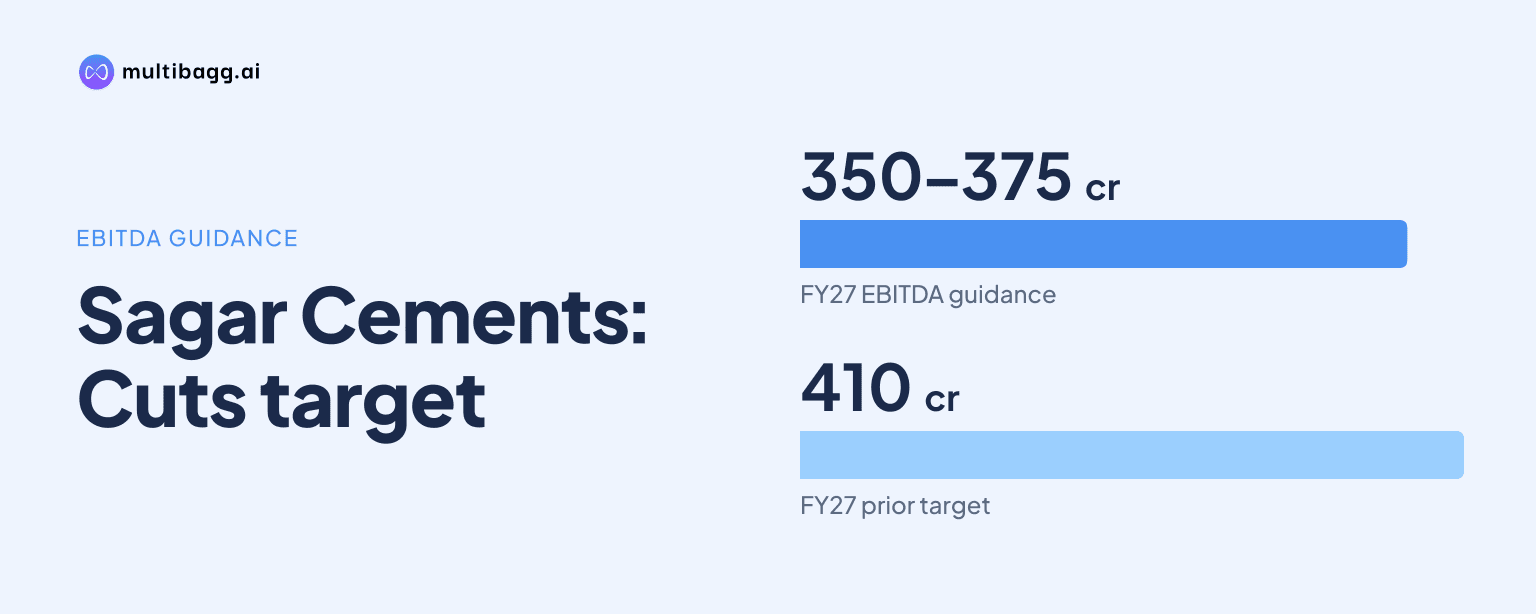
Sagar Cements Limited cut its FY27 EBITDA target to Rs 350 crore-Rs 375 crore from Rs 410 crore after a Rs 200-per-tonne fuel-cost increase, but management expects about Rs 650 per tonne in Q3 FY27 as higher cement prices, completed maintenance and efficiency measures support a second-half recovery.
Know Sagar Cements inside out
Results, valuation, peers and who's buying, in one view.
Why did Sagar Cements cut its FY27 EBITDA target?
Sagar Cements cut its FY27 EBITDA target because higher input costs reduced the expected benefit from price increases and operating savings. Management revised its target to Rs 350 crore-Rs 375 crore, compared with the earlier Rs 410 crore projection, and said the new range would equate to roughly Rs 525-Rs 550 per tonne. It retained its FY27 cement-volume guidance of approximately 7 million tonnes.
Fuel was the main pressure on profitability. Management said fuel costs had risen by around Rs 200 per tonne through the period covered by its inventory, which extends to end-January FY27. In Q2 FY27, power and fuel cost rose to Rs 1,473 per tonne from Rs 1,428 per tonne in Q2 FY26, while freight cost increased to Rs 900 per tonne from Rs 855 per tonne, which management attributed to higher diesel prices.
The revised annual target requires a materially better second half. An analyst on the call cited H1 FY27 EBITDA of about Rs 118 crore, while management said H1 EBITDA was around Rs 355 per tonne. Reaching the bottom of the Rs 350 crore-Rs 375 crore range would therefore require more than Rs 230 crore in H2 FY27, supported by management's expectation of around Rs 650 per tonne during the next half.
What supports Sagar Cements' Rs 650-per-tonne Q3 expectation?
Sagar Cements expects an EBITDA environment of about Rs 650 per tonne in Q3 FY27 if prevailing cement prices hold. Management said realisations had increased by around Rs 500-Rs 550 per tonne, partly offsetting the Rs 200-per-tonne rise in fuel costs. It said the Q3 estimate reflected conditions through the end of October and was conditional on prices not declining.
Price increases were concentrated in southern markets and arrived late in Q2 FY27. Management said southern non-trade prices rose Rs 20 per bag from August to September and another Rs 20 per bag from September to October. Trade prices rose Rs 20 per bag in September and Rs 5 per bag in October. Across Sagar Cements' markets, the company estimated an average Rs 25-per-bag increase from the end of August through end-October, or roughly Rs 500 per tonne in realisations.
The improvement was uneven across regions. Management reported price increases of Rs 5-Rs 10 per bag in Madhya Pradesh and about Rs 5 per bag in Odisha, while other markets were broadly flat and Maharashtra's increase was largely offset. This regional mix is why management said a Q3 average could be difficult to assess, even as it indicated that the higher exit pricing had held so far.
Got a follow-up? Ask IRIS
How did maintenance and new capacity affect Q2 FY27?
Sagar Cements' Q2 FY27 profitability was affected by planned maintenance shutdowns at Mattampally and Jeerabad. Management described the Mattampally shutdown as long and expensive. The company reported Q2 EBITDA of Rs 265 per tonne and a loss after tax of Rs 52 crore, despite 26% year-on-year volume growth and 17% revenue growth.
Plant utilisation varied across the network during the quarter. Mattampally operated at 73%, Gudipadu at 85%, Bayyavaram at 52%, Jeerabad at 72%, Jajpur at 38% and Dachepalli at 57%. Management said Andhra operations were performing well and expected other units to become equivalent to, or better than, Andhra after maintenance-related disruption was behind them.
Capacity additions expanded the production base. Sagar Cements completed 0.75 million tonnes of grinding capacity in Andhra in Q2 FY27, taking total capacity to 11.75 million tonnes. It also commissioned 4.35 megawatts of waste-heat recovery capacity at Gudipadu and a 0.5 million-tonne expansion at Jeerabad. Management said it was targeting overall capacity utilisation of about 65%-70% in H2 FY27, subject to demand trends continuing.
What are Sagar Cements' debt-reduction and volume plans?
Sagar Cements expects net debt to remain broadly stable in Q3 FY27 before declining from Q4 FY27 as capital expenditure ends. Gross debt was Rs 1,735 crore at September 30, 2026, including Rs 1,482 crore of long-term borrowings. Cash and bank balances were Rs 106 crore, consolidated net worth was Rs 1,781 crore, and the debt-to-equity ratio was 0.83:1.
Management said project-related cash outflows continued into October and November after commissioning at the end of September, but most capital expenditure was complete. Its stated two-year objective is to reduce net debt from roughly Rs 1,450 crore-Rs 1,600 crore to around Rs 700 crore. Management linked that plan to operating cash generation, anticipated debt reduction from next year and monetisation of Vizag land.
The proposed Vizag land sale remains part of the balance-sheet plan. Management expects total net monetisation value of Rs 350 crore and around Rs 150 crore of advance receipts after taxes and related costs. It said it expected to receive an advance before the end of FY27. Separately, Sagar Cements targets 8 million-8.25 million tonnes of cement volume in FY28, compared with about 7 million tonnes in FY27; management said both figures exclude clinker.
Conclusion
Sagar Cements has lowered its FY27 EBITDA target because fuel, freight and other inputs rose while Q2 maintenance work constrained profitability. Management's recovery case combines a Rs 500-Rs 550-per-tonne improvement in realisations, completed shutdowns, higher capacity utilisation and cost savings from waste-heat recovery and operational measures.
The next test is whether Q3 FY27 EBITDA approaches management's Rs 650-per-tonne expectation while prices sustain after October. Investors will also watch for net debt to begin declining from Q4 FY27, an advance on the Vizag land sale before FY27 ends, and progress toward Andhra's operational break-even in H2 FY27 or Q1 FY28.