










Sai Life Sciences Limited starts first end-to-end pharma engagement
Key highlights
- Sai began operations on its first end-to-end large-pharma engagement in Q2 FY27 and converted a second existing customer to a similar model.
- Sai's Q2 FY27 revenue rose 23% year on year, with CRO growth of 28% and CDMO growth of 20%.
- Sai reported a 28% EBITDA margin in both Q2 FY27 and H1 FY27.
- Sai spent Rs 621 crore on capital expenditure in H1 FY27 and expects an additional 225 KL capacity in Q3 FY28.
powered by IRIS
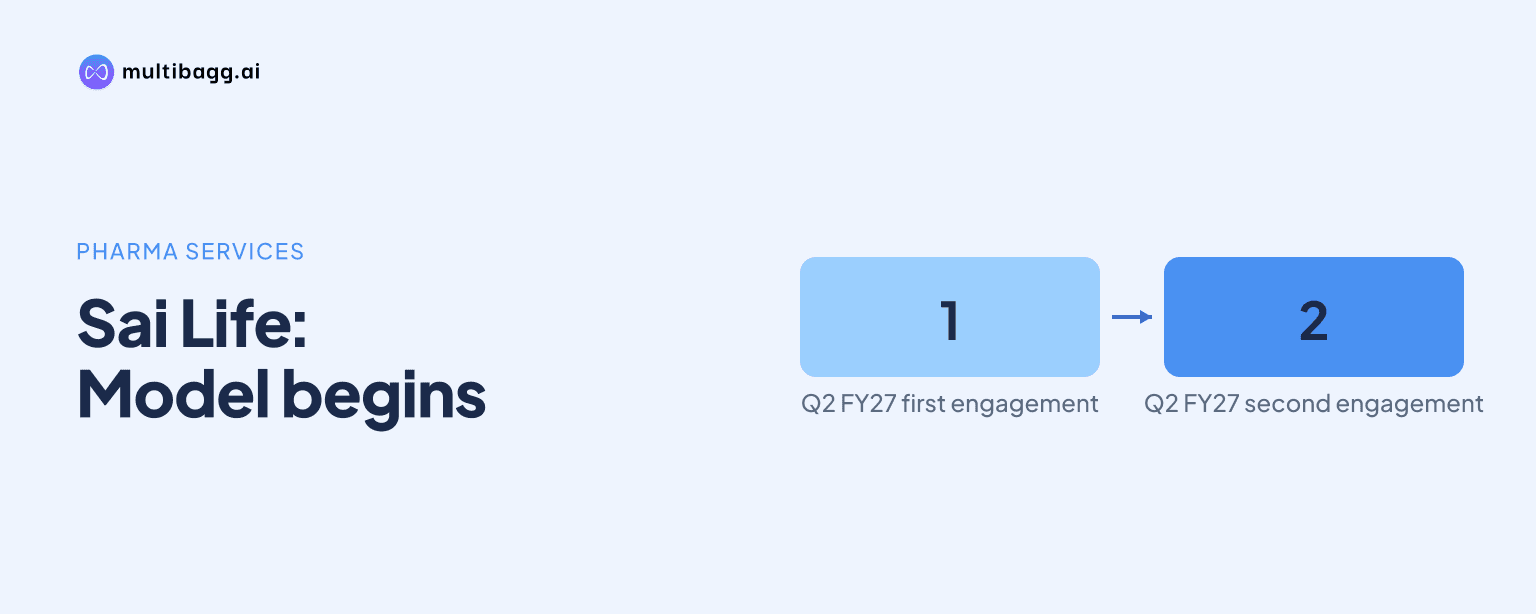
Sai Life Sciences Limited began operations on its first end-to-end engagement with a top-tier market-cap pharmaceutical company in Q2 FY27 and converted a second large-pharma customer to a similar strategic model, while revenue increased 23% year on year. Management did not disclose revenue, contract value or timing for the second relationship to begin operations.
Know Sai Life Sciences inside out
Results, valuation, peers and who's buying, in one view.
What does Sai's end-to-end pharma engagement include?
Sai describes the arrangement as an integrated service relationship spanning discovery, development and commercial manufacturing, rather than as one integrated programme. Management said customers that previously used one or two individual services are moving from piecemeal mandates to a broader relationship across the drug-development life cycle.
The first relationship, announced on the prior investor call, had commenced operations by the November 6, 2026 Q2 FY27 call. Sai said it converted another existing large-pharma relationship to a similar strategic engagement during the quarter, but did not identify the customers or disclose the number of molecules, services or commercial terms involved.
The work can start at different stages. Management said a customer may first use Sai for manufacturing and subsequently add development and discovery work, or move from discovery into development and commercial manufacturing. It said the service mix is not linear because a customer may require more development work at one time and more manufacturing work at another.
Sai said its offering covers medicinal chemistry, early process work, clinical scale-up and commercial manufacturing. Management also cited more than 10 years of relationships with most of these customers and Sai's scale across discovery, development and commercial operations as factors supporting the broader engagements.
How did Sai perform in Q2 FY27?
Sai's revenue rose 23% year on year in Q2 FY27, with Contract Research Organisation, or CRO, revenue up 28% and Contract Development and Manufacturing Organisation, or CDMO, revenue up 20%. Earnings before interest, tax, depreciation and amortisation, or EBITDA, represented 28% of quarterly revenue, matching the H1 FY27 EBITDA margin.
The 23% quarterly growth rate exceeded the 17% rate reported for H1 FY27, and CRO grew 8 percentage points faster than CDMO in Q2. CDMO nevertheless remained the larger business in the half year, contributing 62% of revenue against CRO's 38%.
Management attributed CRO growth to integrated discovery work that expands business with existing customers and to a larger pharmaceutical-company presence. It said pharmaceutical customers accounted for 40% of CRO revenue at the end of 2026, after being a minimal part of that business a few years earlier, and Sai had about 4,400 employees at the end of September 2026.
Management expects the second half of FY27 to be stronger than the first half but declined to provide revenue, margin, partnership-revenue or scientist-hiring guidance. It also reported an uptick in biotech enquiries, especially for integrated peptide work, while characterising those enquiries as early signs of biotech-sector recovery rather than a forecast.
Got a follow-up? Ask IRIS
How could broader customer work change Sai's concentration?
Broader customer work could reduce dependence on a single product or service within an account, although it may increase that customer's share of Sai's revenue. Management said an integrated relationship can involve five or six services, five to seven clinical molecules and two to three commercial molecules, instead of one product.
Sai said its largest customer represented about 12% of revenue at the end of the previous year. Management expects the ranking of the top 10 customers may change over the next two to three years as strategic relationships develop, but it did not provide an updated largest-customer percentage for Q2 FY27.
The two end-to-end outsourcing relationships are with existing customers, according to management. Sai is also discussing similar arrangements with a few other large-pharma customers, but management said contract negotiations move slowly and may not result in agreements.
Management linked the opportunity to pharmaceutical companies seeking China-independent or wider supply chains. It said almost every large pharmaceutical company is considering some form of strategic engagement in India, whether in discovery, manufacturing or a wider model, which is management's assessment of market discussions rather than a disclosed order pipeline.
What capacity is Sai adding to support customer demand?
Sai has incurred Rs 621 crore of capital expenditure in H1 FY27, including Rs 358 crore in Q2, and remains on track for Rs 1,100 crore to Rs 1,300 crore in FY27. Its expanded small-molecule manufacturing capacity at Bidar, described in prepared remarks as around 220 kilolitres, or KL, is ready for final quality trials before commercial batches begin.
Management expects the ready Bidar capacity to become revenue accretive during FY27 after commercial batches start. In the question-and-answer session, it referred to two production blocks of 225 KL each, while its prepared remarks described the ready expansion as around 220 KL; the company did not reconcile the difference.
The additional 225 KL capacity is now expected in Q3 FY28 rather than at the end of Q4 FY27, which would have been Q1 FY28. Management said it reprioritised work because other capacity or capabilities were needed sooner for a couple of large-pharma customers, and said the revised schedule would not affect FY28 revenue commitments.
Sai has also begun design work for a new Telangana manufacturing site and expects to break ground in Q4 FY27, with management referring to January or February during the call. Its first peptide development laboratory has been commissioned, more peptide laboratories are under construction, and management said it does not yet have manufacturing capacity for peptide or antibody-drug conjugate modalities.
Conclusion
Sai's first operating end-to-end large-pharma engagement and the conversion of a second client indicate a move from individual mandates toward wider service relationships. Revenue growth of 23% in Q2 FY27, including 28% growth in CRO and 20% in CDMO, provides the operating context, but management has not disclosed the revenue, duration or wallet share attached to either relationship.
The next disclosed milestones are commercial batches from the ready Bidar expansion, the expected Q3 FY28 availability of the additional 225 KL capacity and the planned Q4 FY27 start of construction at the Telangana site. Management also expects a stronger second half of FY27, while discussions with further large-pharma customers remain unresolved and subject to contract negotiations.