










Sai Life Delays 225 KL Block but Retains FY27 Capex Plan
Key highlights
- Sai Life retained its Rs 1,100 crore-Rs 1,300 crore FY27 capex plan after spending Rs 621 crore in H1 FY27.
- The second 225 KL manufacturing block is now expected in Q3 FY28, revised from the end of Q4 FY27.
- Sai Life's first Bidar production block is ready and completing final quality trials before commercial batches.
- Q2 FY27 revenue grew 23% year on year, with CRO up 28% and CDMO up 20%.
powered by IRIS
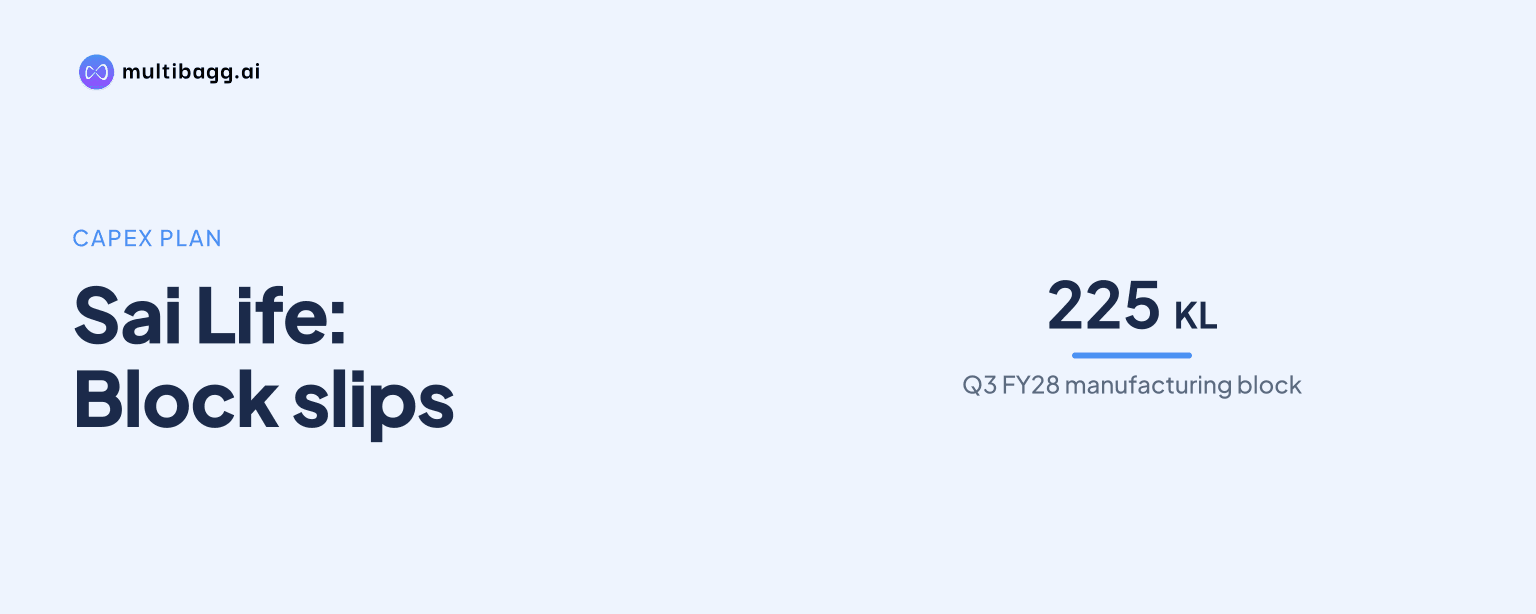
Sai Life Sciences Limited has moved the commissioning of its second 225 kilolitre (KL) manufacturing block to Q3 FY28 from the end of Q4 FY27, while maintaining its FY27 capital-expenditure plan of Rs 1,100 crore-Rs 1,300 crore after spending Rs 621 crore in the first half. Management said the reprioritisation supports requirements from large pharmaceutical customers.
Know Sai Life Sciences inside out
Results, valuation, peers and who's buying, in one view.
Why did Sai Life delay the second 225 KL manufacturing block?
Sai Life delayed the second 225 KL block to prioritise other capacity or capabilities required by a couple of large pharmaceutical customers. Management said the block had previously been scheduled for the end of Q4 FY27, equivalent to Q1 FY28, but would now be available in Q3 FY28 after the project sequence was changed.
The company said it reviewed its development and commercial pipeline and retained sufficient capacity following the recent addition of the first block. Management therefore described the shift as a timing change intended to bring other customer requirements online faster, rather than a reduction in the manufacturing expansion programme.
Sai Life said the revised Q3 FY28 date would not affect its ability to meet FY28 revenue commitments. That statement is based on management's assessment of available capacity and customer demand, rather than on disclosed plant-level order commitments, which the company said it does not provide for individual facilities.
What manufacturing capacity is ready for commercial batches?
Sai Life has one additional Bidar production block ready and is completing final quality trials before starting commercial batches. Management described the expanded small-molecule capacity as around 220 KL in its prepared remarks, while later clarifying in the question-and-answer session that it is the first of two planned 225 KL production blocks.
The difference between the approximately 220 KL and 225 KL descriptions was not further explained in the call. What management confirmed is that the first block is ready, while the second 225 KL block is the project rescheduled to Q3 FY28 from the end of Q4 FY27.
Sai Life expects the ready Bidar capacity to be revenue accretive in FY27 once commercial batches begin. The company said capacity must meet the required quality standards before commissioning, making the completion of final trials the immediate operational milestone for the first block.
How much is Sai Life spending on FY27 expansion?
Sai Life retained its FY27 capex plan of Rs 1,100 crore-Rs 1,300 crore despite rescheduling the second block. It incurred approximately Rs 621 crore of capex in H1 FY27, including Rs 358 crore in Q2 FY27, leaving part of the full-year programme to be executed after September 2026.
Management said the broader investment plan remains intact because projects have been reprioritised around customer needs. The company has not provided a three-to-four-year capex forecast, although it said it expects a strong capex cycle over the next couple of years based on the opportunities it sees.
Sai Life said pharmaceutical plants typically require 24 to 36 months for planning and execution. The company does not require complete commitments for every new plant, according to management, because it needs capacity available as customer molecules move from clinical work toward commercial manufacturing.
Got a follow-up? Ask IRIS
What is Sai Life building at its Telangana site?
Sai Life has begun planning and design work for a new manufacturing site in Telangana and expects to break ground in Q4 FY27. Management also referred to a January or February start once the site master plan is completed, placing that target within the final quarter of FY27.
The Telangana facility is intended to add longer-term manufacturing infrastructure rather than replace the Bidar expansion. Management said its land parcel is larger than Sai Life's current Bidar site and could support capacity higher than Bidar's, but did not provide a capacity number because the project is planned for multiple modalities.
The company is also progressing development infrastructure for peptides and antibody-drug conjugates (ADCs). Sai Life said its first peptide development laboratory has been commissioned, further peptide development laboratories are under construction for completion in the next few months, and Class 6 containment development laboratories for ADC work are expected to come on board soon.
Sai Life said peptide and ADC discovery sites are already active, while chemical, manufacturing and controls work is nearing availability during the year. Management said it currently has no manufacturing capacity in these newer modalities, and is assessing the next steps for larger ADC-scale activities.
How does the revised timing fit Sai Life's operating outlook?
Sai Life said the delayed second block should not affect FY28 revenue commitments, while Q2 FY27 revenue rose 23% year on year. Its contract development and manufacturing organisation (CDMO) business grew 20%, compared with 28% growth in the contract research organisation (CRO) business, making CRO the faster-growing segment in the quarter.
For H1 FY27, revenue rose 17% year on year, with CDMO contributing 62% of revenue and CRO contributing 38%. Earnings before interest, tax, depreciation and amortisation (EBITDA) margin was 28% in both Q2 FY27 and H1 FY27, showing no reported change in the margin rate between the quarter and first half.
Management expects H2 FY27 to be stronger than H1 FY27, but did not provide revenue or margin guidance. It attributed CRO growth to integrated discovery services and a larger pharma presence, saying pharma accounted for 40% of CRO revenue at the end of 2026.
The company's pipeline data provides context for the capacity programme. One molecule moved from late phase to commercial during Q2 FY27 and one molecule entered the late-phase pipeline, leaving Sai Life with 14 late-phase programmes and 34 commercial programmes at the end of the period.
Conclusion
Sai Life has changed the order of its manufacturing projects rather than its stated FY27 investment envelope. The second 225 KL block will now arrive in Q3 FY28 because management prioritised capabilities for large-pharma customers, while the first Bidar block is in final quality trials and the company retains its Rs 1,100 crore-Rs 1,300 crore FY27 capex plan.
The next disclosed markers are the start of commercial batches at the ready Bidar block, expected ground-breaking at Telangana in Q4 FY27, and availability of the second 225 KL block in Q3 FY28. Investors will also watch whether Sai Life gives further details on the Telangana site, longer-term capex and manufacturing plans for peptides and ADCs.