










SAMHI plans Rs 2,250 crore capex as net debt stays broadly stable
Key highlights
- SAMHI plans Rs 2,250 crore of net FY27-FY31 capex after Rs 150 crore of expected GIC funding.
- Management expects net debt to remain near Rs 1,450 crore to Rs 1,500 crore, with quarterly movement of about Rs 100 crore.
- SAMHI targets net debt to EBITDA of about 2.5 times over 18 months, from about 3.1 times currently.
- Management expects W Hyderabad to open in FY28 and said it could generate up to Rs 170 crore of revenue.
powered by IRIS
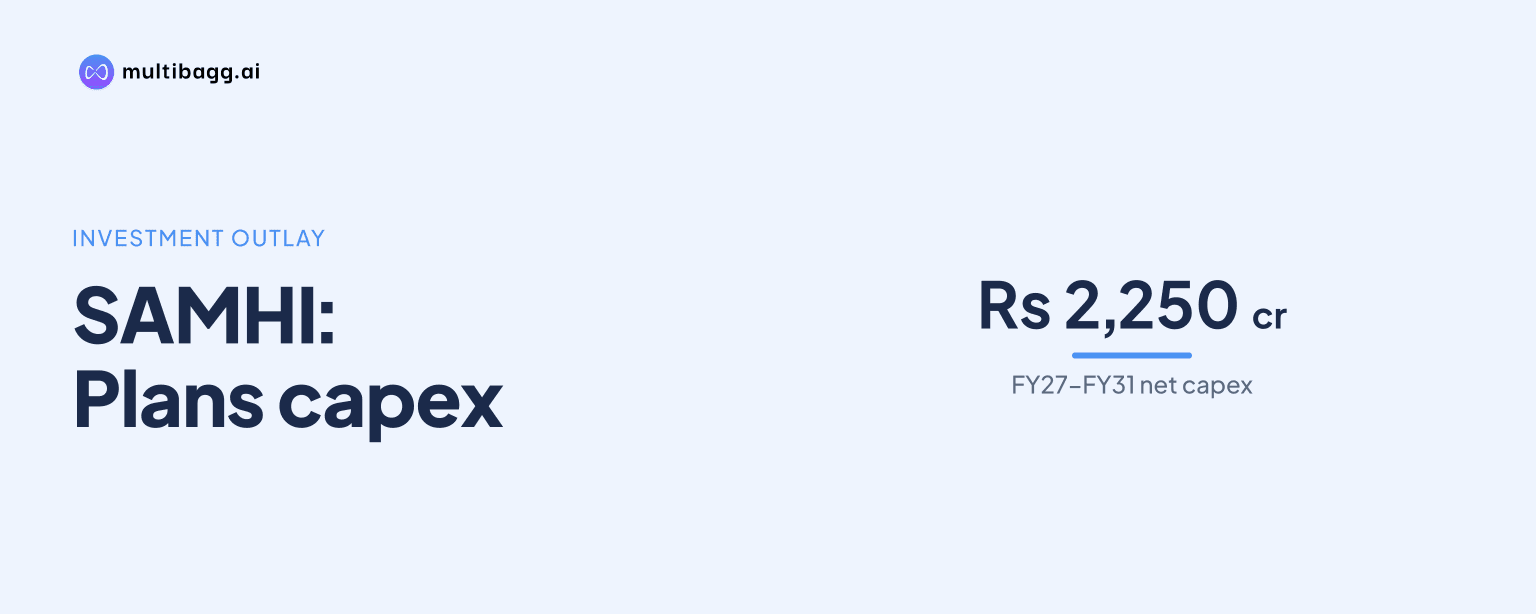
SAMHI plans to fund Rs 2,250 crore of net capital expenditure between FY27 and FY31 through internal accruals while keeping net debt near Rs 1,450 crore to Rs 1,500 crore. Management said the programme includes Navi Mumbai and targets net debt to EBITDA of about 2.5 times over roughly 18 months.
Know Samhi Hotels inside out
Results, valuation, peers and who's buying, in one view.
How much capex is SAMHI planning through FY31?
SAMHI plans Rs 2,400 crore of gross capital expenditure from FY27 through FY31, of which Rs 150 crore is expected to be funded by GIC, leaving Rs 2,250 crore for SAMHI. Management initially cited about Rs 2,200 crore, then added Navi Mumbai and clarified that the total programme rises to Rs 2,400 crore.
The Rs 2,250 crore commitment covers a multi-year sequence of openings rather than a single asset. Management identified W Hyderabad for FY28, incremental inventory at Sheraton Hyderabad for FY29, Westin Bangalore potentially in FY30, followed by Ingka and Navi Mumbai. The schedule extends development spending and revenue additions across the period to FY31.
Management said new openings should supplement its same-store hotel business, for which it continues to use a 9% to 11% growth range. SAMHI said 98% of revenue had been from same-store hotels during the past two years, whereas W Hyderabad, Sheraton Hyderabad additions, Westin Bangalore, Ingka and Navi Mumbai are intended to add non-same-store revenue through 2031.
Can SAMHI fund the capex without raising net debt?
SAMHI says it can fund the Rs 2,250 crore net capex programme from internal accruals without a material increase in net debt. Management expects to generate about Rs 320 crore to Rs 350 crore of free cash flow from operations in the current year, broadly matching its capex for that year and therefore leaving net debt unchanged on that measure.
The company’s cash-generation case depends on higher earnings from existing hotels and assets that are still under development. Management said W Hyderabad currently carries cash and debt but produces no earnings before interest, tax, depreciation and amortisation, or EBITDA. Once the hotel opens in FY28, its EBITDA is expected to add to same-store growth while debt remains broadly within the stated range.
Management said finance costs in the next year should remain in the Rs 125 crore to Rs 140 crore range, even if there are another two rounds of repo-rate increases. That expectation is part of its internal-accrual funding plan, alongside EBITDA growth, rather than a commitment to eliminate quarterly changes in borrowings or cash balances.
What net debt and leverage path has SAMHI set?
SAMHI expects net debt to remain around Rs 1,450 crore to Rs 1,500 crore, although management said the figure may move by about Rs 100 crore in either direction from quarter to quarter. It linked those movements to seasonality, with capex higher in the first and second quarters and EBITDA and cash production generally higher in the third and fourth quarters.
Management put net debt to EBITDA at about 3.1 times and said it is working to reduce the ratio below 3 times by the end of the fiscal year or another quarter later. It then expects the ratio to reach about 2.5 times over a conservative 18-month period, based on stable net debt, same-store EBITDA growth and incremental earnings from W Hyderabad.
This leverage path does not rely on unusually high room-rate growth, according to management. It said the reduction should be execution-led because development assets start producing EBITDA while net debt remains broadly steady. Management also said potential capital recycling is not included in its stated route to about 2.5 times, though a transaction could provide additional balance-sheet flexibility.
Got a follow-up? Ask IRIS
How could W Hyderabad support SAMHI’s funding plan?
W Hyderabad is central to SAMHI’s plan because management expects it to open in FY28, begin contributing EBITDA and stabilise in FY29. The hotel has 170 rooms, and management said the FY29 stabilisation assumption reflects an FY28 opening that would allow the property to participate in the following calendar year’s request-for-proposal cycle.
Management said W Hyderabad has potential to generate up to Rs 170 crore of revenue, which it described as more than 10% of FY27 total revenue. It attributed that expectation to the HITEC City location, the W brand and Marriott Bonvoy distribution, while cautioning that the Rs 170 crore estimate represented upside potential rather than a guaranteed outcome.
SAMHI cited its Holiday Inn Express in HITEC City as an internal indication of the market’s rate premium. Management said the hotel had operated at a 20% to 25% premium to the Holiday Inn Express portfolio average, with the portfolio average daily rate at about Rs 4,000 and the HITEC City hotel at about Rs 5,000 to Rs 5,100.
Management also estimated that W Hyderabad alone could add 6% to 7% to revenue growth in FY28 and FY29, on top of roughly 10% same-store growth in its illustration. That combination would imply total revenue growth of about 16% to 17%, although the company maintained that its formal 9% to 11% range applies only to same-store hotels.
What other cash-flow and capital-recycling options does SAMHI have?
SAMHI said its three-year same-store compound annual growth rate has been 10.4%, compared with its continuing 9% to 11% same-store growth range. Management expects the contribution from new hotels and additions to increase company-wide growth beyond that range, with openings or ramp-ups planned across FY28, FY29 and potentially FY30.
The company also expects a contribution from RARE, its asset-light fee platform, beginning in FY28. Management said RARE should generate Rs 15 crore to Rs 20 crore of revenue in the next fiscal year, its first full year of operations for some hotels, and earns a commission of about 18% on bookings made through the distribution platform.
SAMHI has identified two hotels for possible capital recycling, with cumulative expected proceeds of Rs 200 crore to Rs 230 crore. Management said it would like to execute at least half of that amount in the next fiscal year, but did not commit to a timetable because a transaction requires a counterparty.
Management described the two assets as small hotels with insignificant EBITDA contributions. It said a sale would therefore not materially affect revenue or EBITDA, while returning capital to the balance sheet. The company distinguished this recycling option from a funding necessity, saying its Rs 1,450 crore to Rs 1,500 crore net-debt plan does not require external support.
Conclusion
SAMHI’s stated capital-allocation plan combines Rs 2,250 crore of FY27-FY31 net capex with net debt held near Rs 1,450 crore to Rs 1,500 crore. The plan depends on internal accruals, current-year free cash flow of about Rs 320 crore to Rs 350 crore, same-store growth and the EBITDA contribution from new properties, especially W Hyderabad.
The next milestones are whether SAMHI reduces net debt to EBITDA from about 3.1 times to below 3 times by the end of the fiscal year or the following quarter, and whether it reaches about 2.5 times over 18 months. Management’s FY28 W Hyderabad opening, the hotel’s expected FY29 stabilisation and possible Rs 200 crore to Rs 230 crore capital recycling are further disclosed events to watch.