










SAMHI targets 85-90 RARE hotels through Marriott rollout
Key highlights
- SAMHI targets 85 to 90 RARE India hotels within five to six months, up from 70 hotels in Q2 FY27.
- RARE India’s first properties are targeted to join Outdoor Collection by Marriott Bonvoy in December 2026.
- Management expects the fee-based RARE India platform to begin contributing to year-on-year revenue and EBITDA growth in Q1 FY28.
- RARE India had about 900 rooms in Q2 FY27, compared with about 1,050 rooms across 75 hotels in Q1 FY27.
powered by IRIS
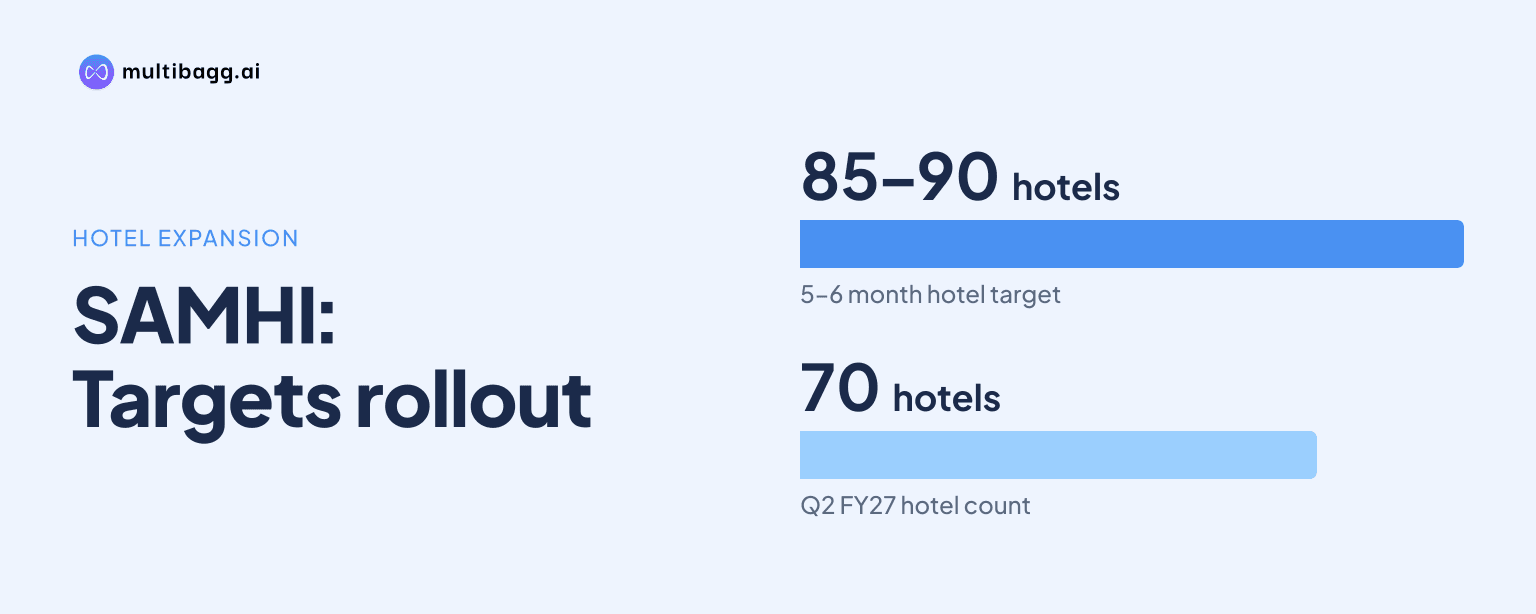
SAMHI Hotels Limited targets 85 to 90 RARE India hotels within five to six months, up from 70 hotels in Q2 FY27, as its first partner properties are scheduled to join Outdoor Collection by Marriott Bonvoy in December 2026. Management expects this fee-based platform to begin adding to year-on-year revenue and earnings before interest, tax, depreciation and amortisation, or EBITDA, growth from Q1 FY28.
Know Samhi Hotels inside out
Results, valuation, peers and who's buying, in one view.
How many RARE India hotels is SAMHI targeting?
SAMHI is targeting 85 to 90 RARE India hotels within five to six months, compared with 70 hotels and about 900 rooms in Q2 FY27. Management said about 20 to 25 hotels were waiting to join the platform, leaving scope to add 15 to 20 hotels above the reported Q2 level.
The Q2 portfolio was smaller than the 75 hotels and about 1,050 rooms reported in Q1 FY27. Management said there had been no significant change in the proposition, describing hotel numbers as subject to almost monthly movements and confirming that some portfolio rationalisation occurred during the preceding two to three months.
The target is therefore not simply a recovery in hotel count. SAMHI said its larger priority is to establish the timing and pace of moving partner hotels onto the Outdoor Collection, because that is where it expects fee income to begin. The company did not disclose the names of potential additions, their room mix or RARE India’s fee terms.
When will RARE India join Outdoor Collection by Marriott Bonvoy?
SAMHI said the RARE India pilot was in final-stage integration and its first properties were targeted to go live on Outdoor Collection by Marriott Bonvoy in December 2026. Management said the Marriott connection would give RARE partners access to global distribution, although it did not disclose how many hotels would be included in the first group.
Following that launch, SAMHI expects to add hotels to the RARE Outdoor Collection every month. Management identified this onboarding process as the point at which the fee engine would begin, rather than the earlier stage of signing partner hotels to RARE India.
The December timetable places the first rollout shortly before Q1 FY28, when management expects the platform to start contributing to year-on-year revenue and EBITDA growth. The source does not provide a revenue target, EBITDA estimate or margin forecast for the platform, so the financial scale of that contribution remains undisclosed.
How will RARE India grow without material capital expenditure?
SAMHI described RARE India as a fee-based platform requiring very little capital, designed to create non-same-store growth without material capital expenditure. The model depends on partner hotels obtaining Marriott distribution through the Outdoor Collection while SAMHI and RARE receive fee income as properties are onboarded.
That structure differs from SAMHI’s owned-hotel development programme, where the company is funding construction and renovation. Capital work in progress rose to Rs 219 crore in September 2026 from Rs 139 crore in March, principally reflecting investment in W Hyderabad and the Westin project in Bangalore.
SAMHI said its secured pipeline adds about 1,670 rooms and moves another 473 rooms upmarket through rebranding. RARE India can add partner properties outside that owned and leased portfolio, potentially creating a separate source of growth from fee income. Management did not state whether the 85 to 90 hotel target includes a particular room target.
The platform will start against a core business that was already expanding in Q2 FY27. SAMHI reported total income of Rs 342.7 crore, up 15.6% year on year, while consolidated EBITDA rose 12% to Rs 123.8 crore. Those figures do not separately identify RARE India income, which management expects only from Q1 FY28.
Got a follow-up? Ask IRIS
How does RARE India fit into SAMHI’s wider growth plan?
SAMHI is pairing the lower-capital RARE India expansion with owned-hotel developments, including a 170-room W Hotel in HITEC City, Hyderabad, targeted to open in Q2 FY28. Management expects the W, once stabilised, to add about 10% to the FY27 income base at margins above the portfolio average.
Its Bangalore project combines 142 operating Trinity Hotel rooms being renovated into a Tribute Portfolio hotel with a 220-room Westin Tower under construction, creating a 370-room upscale complex. Management said upscale hotels delivered EBITDA almost 800 basis points ahead of the broader portfolio in the preceding six months and expects upper and upper-upscale hotels to rise from 42% to about 60% of income by FY30.
The asset-light strategy also sits beside an ongoing balance-sheet plan. Net debt stood at Rs 1,458 crore in September 2026, down Rs 35 crore from June, while net debt to trailing-12-month EBITDA was 3.1 times, or 2.2 times after adjusting for capital deployed in growth projects. Management reiterated a long-term target of 2.5 times and said it expected to reach at least a 2-times level by the end of FY27 or early next year.
SAMHI’s operating base grew during Q2 FY27, with same-store revenue up 12.6% and revenue per available room, or RevPAR, up about 14%. The RevPAR increase reflected a 9% rise in average rates and 3.6% occupancy growth, while occupancy reached 78.6% from 75% a year earlier. Management positions RARE India as incremental to this core hotel growth rather than a replacement for it.
Conclusion
SAMHI’s plan moves RARE India from pilot integration towards a Marriott-distributed fee platform. The company expects the portfolio to rise from 70 hotels in Q2 FY27 to 85 to 90 within five to six months, while the December 2026 launch is intended to establish the mechanism for recurring fee income without the construction spending required for owned hotels.
The next measures to watch are the size of the first December 2026 onboarding group, the monthly pace of additions to the Outdoor Collection and any separately disclosed fee contribution from Q1 FY28. Management has also set targets for W Hyderabad to open in Q2 FY28 and for net debt to EBITDA to reach at least a 2-times level by the end of FY27 or early next year.