










SAMHI expects Rs 25-30 crore net H2 FY27 deferred-tax benefit
Key highlights
- SAMHI expects about Rs 100 crore of deferred-tax asset recognition in Q4 FY27.
- SAMHI expects a net H2 FY27 tax benefit of about Rs 25 crore to Rs 30 crore.
- SAMHI said the tax assets arise from accumulated losses and unabsorbed depreciation.
- Management expects about 14% to 15% RevPAR growth through Q3 FY27 and Q4 FY27.
powered by IRIS
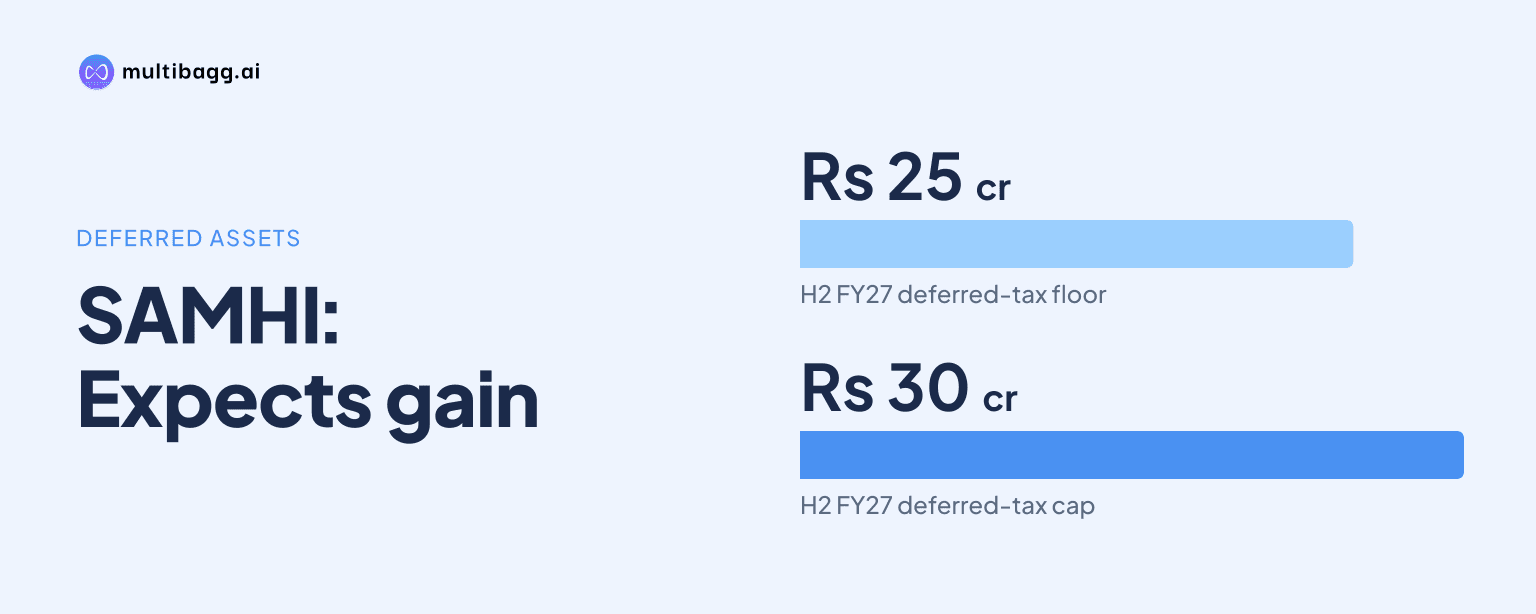
In H2 FY27, SAMHI expects a net deferred-tax benefit of about Rs 25 crore to Rs 30 crore, even as it plans to recognise roughly Rs 100 crore of deferred-tax assets in Q4 FY27. Management said the accounting entry reflects accumulated losses and unabsorbed depreciation, rather than an improvement in hotel operations.
Know Samhi Hotels inside out
Results, valuation, peers and who's buying, in one view.
How much deferred-tax benefit does SAMHI expect in H2 FY27?
SAMHI expects a net H2 FY27 tax benefit of about Rs 25 crore to Rs 30 crore after accounting for deferred-tax expense, while the gross deferred-tax asset recognition planned for Q4 FY27 is roughly Rs 100 crore. Rajat Mehra said the Q4 recognition would be taken to the profit and loss account, or P&L, under SAMHI’s internal accounting policy after discussions with auditors.
The gross Q4 entry and the net H2 result are different measures. The approximately Rs 100 crore amount is the deferred-tax asset SAMHI expects to recognise in Q4 FY27, whereas the Rs 25 crore to Rs 30 crore range is the net benefit for the entire second half after deferred-tax expense related to tax assets recognised in past periods.
Management did not give a quarterly forecast for profit after tax, or PAT, or quantify the deferred-tax expense separately for Q3 FY27 and Q4 FY27. It described the recognition as an effective P&L upside for Q4, but said the expense from previously recognised tax assets would remain part of the H2 calculation.
Why is SAMHI recognising deferred-tax assets in Q4 FY27?
SAMHI is recognising the remaining deferred-tax asset because management says it can now demonstrate recovery of accumulated losses and unabsorbed depreciation through future tax credits. Mehra said SAMHI had carried these tax attributes from years when it was not profitable and could therefore not recognise their benefit in the balance sheet and P&L.
The tax credits are intended to be set off against taxable profit in later years, reducing cash tax outflows when SAMHI becomes tax payable. The Q4 FY27 recognition is therefore not a cash receipt of about Rs 100 crore; it is an accounting asset based on management’s expectation that historical losses and depreciation can be used against future taxable income.
SAMHI said it recognised deferred-tax assets last year for assets where it had established recovery certainty with auditors. The balance is expected to be recognised in Q4 FY27, which explains why the accounting effect can be concentrated in one reporting period rather than following quarterly hotel revenue or earnings.
Does the deferred-tax recognition change SAMHI’s hotel operations?
No, the deferred-tax recognition does not change SAMHI’s room demand, pricing, occupancy or hotel-level earnings. The tax entry is linked to accumulated losses and unabsorbed depreciation, while operating performance is measured through revenue per available room, or RevPAR, total revenue and earnings before interest, tax, depreciation and amortisation, or EBITDA.
For the quarter discussed on the call, SAMHI reported about 14% RevPAR growth and said it expected to maintain that rate through Q3 FY27 and Q4 FY27. Management attributed the outlook to about 10% to 11% room-rate growth and the balance from better capacity utilisation, while saying same-store total revenue could rise about 13% to 14% as events and weddings support food and beverage income.
Management said Q4 FY27 could be stronger than Q3 FY27 because the period after New Year through 31 March has a fuller demand calendar. Q3 FY27 includes a Diwali week and roughly 15 to 20 days of disruption around Christmas and New Year, factors that are separate from the expected Rs 25 crore to Rs 30 crore net tax benefit.
Got a follow-up? Ask IRIS
What should readers compare with SAMHI’s reported profit?
Readers should separate SAMHI’s gross Q4 FY27 deferred-tax asset recognition from its net H2 FY27 tax benefit and from underlying hotel performance. Treating the approximately Rs 100 crore accounting entry as operating profit would not reflect management’s explanation that the entry represents the expected use of historical tax attributes.
The company’s operating indicators show a different pattern. Same-store RevPAR increased 14.5% in the quarter cited by management, while same-store total revenue increased 10%; management expects total revenue growth to move towards about 13% to 14% in H2 FY27 as food and beverage revenue rises with events, weddings and other demand periods.
Management also said EBITDA growth from Q3 FY27 onward could be in the high teens because goods and services tax, or GST, effects would be present in both the current and comparison periods. That EBITDA outlook is based on hotel trading conditions, whereas the expected Q4 FY27 tax recognition arises from the recovery assessment of accumulated losses and depreciation.
How does the tax entry relate to SAMHI’s financial plan?
SAMHI’s tax recognition is separate from its plan to keep net debt broadly in the Rs 1,450 crore to Rs 1,500 crore range while funding development through internal accruals. Management said net debt can move by about Rs 100 crore from quarter to quarter because capital expenditure and cash generation are seasonal, with Q3 and Q4 generally producing higher EBITDA and cash.
Management placed net debt to EBITDA at about 3.1 times and said it aims to reach about 2.5 times over a conservative 18-month period. Its stated route is stable debt, same-store growth and incremental EBITDA from openings including W Hyderabad, not reliance on the Q4 FY27 deferred-tax asset recognition.
SAMHI has also earmarked two hotels for possible capital recycling with a cumulative potential realisation of about Rs 200 crore to Rs 230 crore. Management said the hotels have insignificant EBITDA contribution and would like to execute at least half of the recycling in the next fiscal year, though it did not commit to a transaction timeline.
Conclusion
SAMHI’s expected Q4 FY27 deferred-tax asset recognition of about Rs 100 crore is materially larger than its expected net H2 FY27 benefit of Rs 25 crore to Rs 30 crore because deferred-tax expense from prior recognitions continues. The entry may affect reported PAT, but it does not represent a change in room rates, occupancy, RevPAR or hotel operating income.
The next event to watch is SAMHI’s Q4 FY27 result, when management expects to record the remaining deferred-tax asset under its internal accounting policy. Readers can also assess whether management delivers the indicated 14% to 15% RevPAR growth, 13% to 14% same-store revenue growth and progress towards a 2.5-times net-debt-to-EBITDA target.