










SAMHI expects RARE FY28 revenue of Rs 15-20 crore, 50% ROCE
Key highlights
- SAMHI expects RARE to generate Rs 15 crore to Rs 20 crore of revenue in FY28.
- RARE had 70 hotels and 900 rooms in Q2, with 85 to 90 hotels expected within five to six months.
- SAMHI expects to earn about 18% commission on each booking made through RARE's platform.
- Management said RARE could potentially achieve 50% ROCE, while noting its small investment will not materially change portfolio ROCE.
powered by IRIS
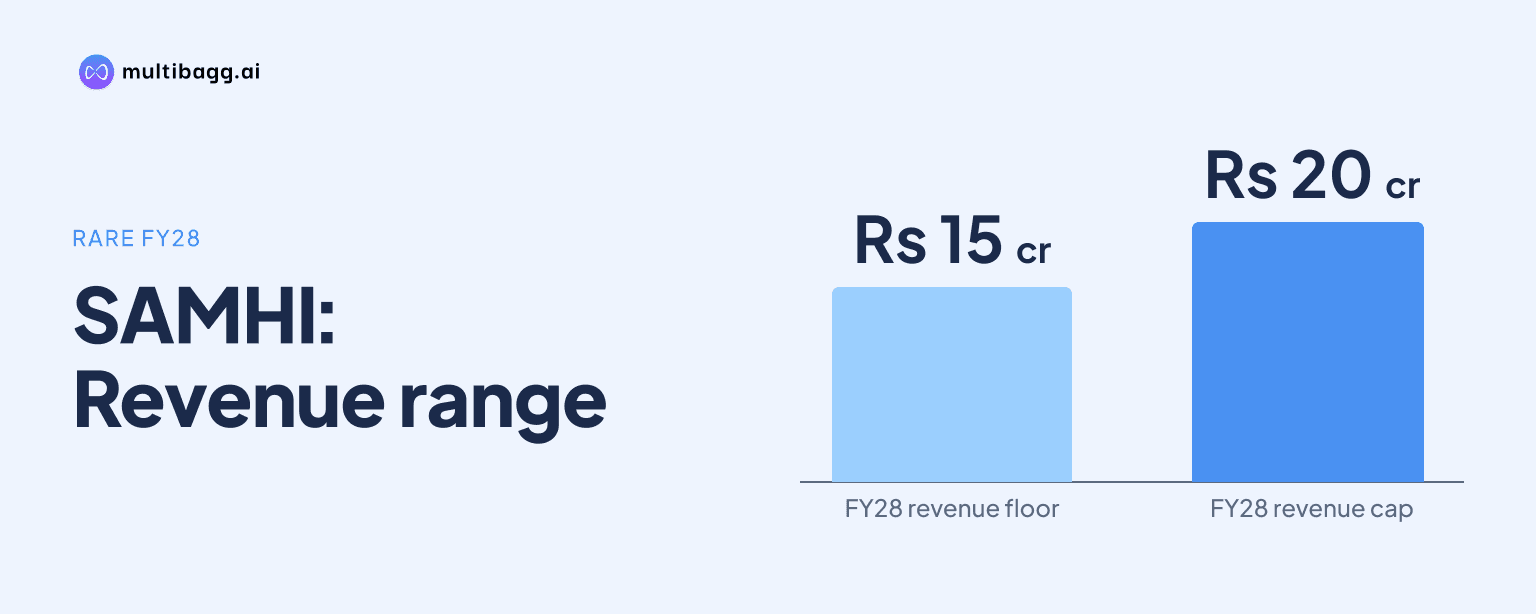
SAMHI expects RARE to generate Rs 15 crore to Rs 20 crore of revenue in FY28, its first full year of operations for some platform hotels, while management said a 50% return on capital employed, or ROCE, could be achievable through an asset-light booking-commission model.
Know Samhi Hotels inside out
Results, valuation, peers and who's buying, in one view.
What revenue does SAMHI expect from RARE in FY28?
SAMHI expects RARE to generate Rs 15 crore to Rs 20 crore of top-line revenue in FY28. Management said FY28 would be the first full year of operations for some hotels after the distribution platform goes live at the end of the calendar year, and described the projected revenue as almost half of its total RARE investment in one year.
The FY28 figure is a management expectation, not reported revenue. Management said both revenue and profit should begin ramping up in FY28 as hotels move onto the distribution platform, making RARE a new revenue source separate from SAMHI's established same-store hotel portfolio.
RARE had 70 hotels and 900 rooms in Q2, compared with 75 hotels and about 1,050 rooms in Q1. Management said there had been no significant change in the business, although it acknowledged portfolio rationalisation during the preceding two to three months and said the number of participating hotels can change monthly.
Management also said about 20 to 25 hotels were waiting to join RARE. It expects the network to rise from 70 hotels in Q2 to about 85 to 90 hotels over the next five to six months, which would add 15 to 20 hotels from the Q2 level.
How will SAMHI generate fee income through RARE?
SAMHI expects RARE to generate fee income by earning a commission of about 18% on each booking made through its distribution platform. Management said the first set of hotels would join the RARE Outdoor Collection at the end of December, after which it expects to add hotels to the collection each month.
Management identified this rollout as the point at which the fee engine should begin, rather than the headline count of 70 hotels alone. The source does not disclose the expected gross booking value, bookings per hotel, or the proportion of the network expected to join the RARE Outdoor Collection by FY28.
The model differs from SAMHI's owned-hotel business because it is intended to generate distribution income without property construction spending. Management said its aim was to create a long-term, non-capex-led fee stream after roughly 15 years in which growth had come through same-store performance or investment in hotels.
The near-term execution measure is therefore hotel activation. The platform must convert its stated pipeline of 20 to 25 hotels and place participating properties into the RARE Outdoor Collection before the 18% booking commission can produce the Rs 15 crore to Rs 20 crore FY28 revenue management expects.
Got a follow-up? Ask IRIS
Why does SAMHI see potential for 50% ROCE at RARE?
SAMHI said a 50% ROCE is not difficult to achieve for RARE because the platform has limited capital and operating-cost needs. Management cited the absence of employees on its rolls, power expense and the other cost requirements associated with operating an owned hotel, while describing RARE as a reasonably good-margin business.
This is management's assessment of potential economics, not a dated ROCE forecast. Its rationale is that a commission-led platform can expand fee income without the property investment required for hotel development, so capital employed remains comparatively limited as hotel bookings are added.
Management contrasted RARE with the Sriperumbudur hotel expansion, where about 134 rooms are planned alongside an existing 155-room hotel. The incremental expansion is expected to require about Rs 160 crore of capital and deliver a 15% to 17% return on capital employed, partly because the existing hotel has already absorbed the land cost.
Management said RARE's potential 50% ROCE would not materially change SAMHI's consolidated portfolio ROCE because the investment is small. It said the broader return profile still depends more on bringing larger assets, including W Hyderabad and Westin Bangalore, into operation.
How does RARE fit into SAMHI's FY28 growth plan?
SAMHI expects RARE to contribute non-same-store revenue in FY28 alongside W Hyderabad, while retaining its 9% to 11% long-term same-store growth range. Management said same-store hotels delivered a 10.4% compound annual growth rate, or CAGR, over the last three years, and that new openings and RARE would sit on top of that base.
Management said W Hyderabad could add about 6% to 7% to revenue growth on an FY28 or FY29 basis, in addition to same-store growth. RARE is expected to be smaller than a new owned hotel, but its fee model extends the planned growth mix beyond room inventory owned or developed by SAMHI.
The company reported net debt of Rs 1,458 crore as of September 2026, with net debt to trailing-12-month earnings before interest, tax, depreciation and amortisation, or EBITDA, at 3.1 times. Management said it aimed to reach around 2.5 times over a conservative 18-month period, supported by EBITDA growth and internally funded development spending.
Management also said it expects Rs 320 crore to Rs 350 crore of free cash from operations in the current year, broadly matching capital expenditure. That funding approach matters for RARE because management presented the platform as growth that can be added without capital deployment comparable with a hotel project.
Conclusion
SAMHI's RARE plan combines a FY28 revenue expectation of Rs 15 crore to Rs 20 crore with a potential 50% ROCE that management attributes to booking commissions and a limited operating-cost base. The platform's economics differ from the 15% to 17% returns expected on the capital-intensive Sriperumbudur expansion, but management says RARE's small investment means it will not alone reshape consolidated returns.
The next disclosed milestones are the first RARE Outdoor Collection hotels going live at the end of December and planned monthly additions thereafter. Management expects the network to increase from 70 hotels in Q2 to 85 to 90 hotels within five to six months; progress on those activations will determine how quickly the 18% booking-commission model contributes to FY28 revenue.