










Sandur Manganese Secures 2.4314-Hectare Forest Clearance
Key highlights
- Sandur Manganese received final approval to divert 2.4314 hectares of forest land in Karnataka for its downhill conveyor system.
- The conveyor will connect Kammathuru Iron Ore Mine, ML No. 2678, with PMBR siding.
- The 2023 environmental clearance allowed ML No. 2678 iron ore production of 4.50 MTPA while retaining manganese ore production of 0.55 MTPA.
- Sandur Manganese said the conveyor could help clear close to 1 million tonnes of ore and reduce road traffic.
powered by IRIS
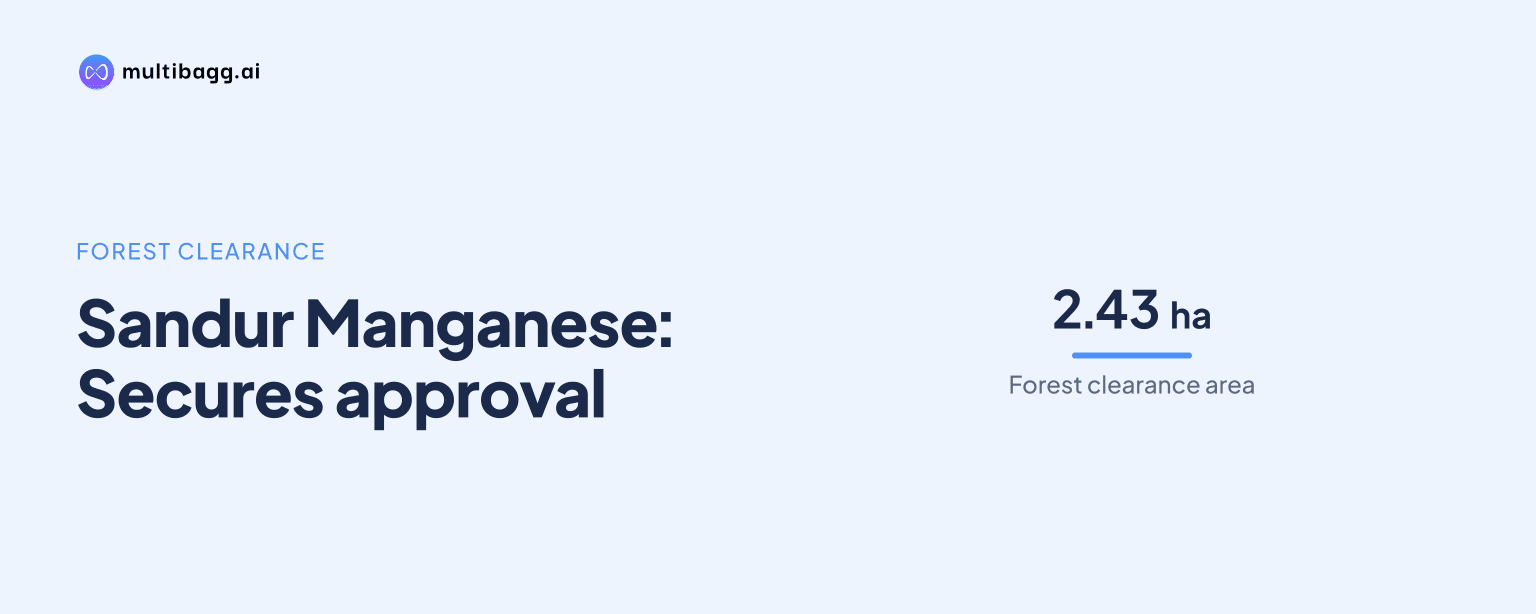
Sandur Manganese and Iron Ores Ltd has secured final approval to divert 2.4314 hectares of forest land in Karnataka for a downhill conveyor system linking its Kammathuru Iron Ore Mine to PMBR siding. The approval is important because the planned system is intended to move ore by conveyor instead of road and support the company’s expanded mining operations.
Know Sandur Manganese & Iron Ores inside out
Results, valuation, peers and who's buying, in one view.
What approval has Sandur Manganese received?
Sandur Manganese has received final approval from the Ministry of Environment, Forest and Climate Change for diversion of 2.4314 hectares of forest land in the Deogiri Swamimalai Forest Block. The land falls in Sandur Taluk, Bellary District, Karnataka, and the approval is for establishing a Downhill Conveyor Pipe System, or DCS.
The proposed conveyor will run from the Kammathuru Iron Ore Mine, identified as ML No. 2678, to PMBR siding. The clearance has been granted in favour of the company and remains subject to compliance with the conditions specified in the approval. The disclosed information does not set out the full list of conditions or a commissioning date for the system.
The project is part of the company’s broader plan to improve the logistics link between its mining operations and railway infrastructure. Sandur Manganese had said earlier that the DCS, once operational after Stage-II forest clearance, could substantially reduce road traffic and allow the clearing of close to 1 million tonnes of ore.
The final forest-land diversion approval addresses a key regulatory requirement for the conveyor route. It does not by itself indicate that construction is complete, but it permits the company to establish the system subject to the stated conditions.
How does the conveyor fit Sandur Manganese’s expansion plans?
Sandur Manganese’s conveyor project is linked to mining-capacity approvals obtained over several years. On 25 April 2023, the company received environmental clearance to raise iron ore production at ML No. 2678 from 1.60 million tonnes per annum to 4.50 million tonnes per annum, while retaining manganese ore production at 0.55 million tonnes per annum.
That 2023 clearance also covered a proposed 7.0 million tonnes per annum ore beneficiation plant, a 1.2-kilometre downhill conveyor system and a 0.15 million tonnes per annum crushing and screening plant for iron ore and manganese ore. The total excavation approved under that proposal was 26.42 million tonnes per annum, including iron ore run-of-mine, manganese ore run-of-mine, topsoil and waste.
More recently, the company reported completion of strategic expansion projects for manganese and iron ore in April 2025. It said it had obtained environmental clearance and other approvals to enhance manganese ore production to 0.599 million tonnes per annum and iron ore production to 4.45 million tonnes per annum.
The differing iron ore figures reflect disclosures relating to the company’s expansion plans and approvals. The 2023 environmental-clearance disclosure specifically refers to 4.50 million tonnes per annum at ML No. 2678, while the April 2025 update referred to an enhancement to 4.45 million tonnes per annum. The company’s latest forest-diversion approval concerns transport infrastructure rather than a separate mining-production limit.
Got a follow-up? Ask IRIS
What other environmental approvals does Sandur Manganese hold?
Sandur Manganese has also obtained environmental clearance for its Ramghad Manganese and Iron Ore Mines. The Ministry granted the clearance through a communication dated 1 September 2024 for iron ore production of 0.216 million tonnes per annum while retaining existing manganese ore production of 0.05 million tonnes per annum.
The Ramghad clearance permits total excavation of 1.297 million tonnes per annum, including waste. It also allows handling of 0.327 million tonnes of already stocked incidental iron ore during the first two years. These permissions apply to the Ramghad mines and are distinct from the Kammathuru conveyor project and the ML No. 2678 expansion.
Earlier, on 30 March 2022, the Ministry granted environmental clearance under the EIA Notification, 2006 for a proposed change in plant configuration and product mix at the company’s metal and ferro-alloy plant. The facility is located at Vyasanakere, Hanumanahalli Village, Hosapete Taluk, Vijaynagar District, Karnataka.
How could the approval affect operations and investors?
Sandur Manganese has stated that the downhill conveyor is intended to reduce road traffic and facilitate the clearing of close to 1 million tonnes of ore. A direct conveyor connection to PMBR siding could improve the movement of ore from the Kammathuru mine towards rail transport, compared with reliance on road movement for the relevant route.
For operations, the approval removes a disclosed forest-clearance hurdle for the conveyor system. Its practical effect will depend on construction, compliance with the approval conditions, commissioning and the availability of associated railway-siding infrastructure. None of these subsequent milestones or timelines were provided in the disclosure.
For investors, the development is relevant because the conveyor supports logistics for a mine where the company has secured higher production approvals. The supplied information notes that the company gained sharply after the final clearance, but it does not provide a share-price level, percentage move, trading date or trading volume. Those data points cannot be assessed from the available announcement.
The clearance also has a local operational dimension. By targeting lower road traffic for ore transport, the project could change the route through which material is moved from the mine. However, the disclosure does not quantify the expected reduction in truck trips, project cost, construction employment or environmental impact beyond the approved forest-land area.
Conclusion
The final approval to divert 2.4314 hectares of forest land gives Sandur Manganese an important permission for the conveyor system from Kammathuru Iron Ore Mine to PMBR siding. It complements the company’s earlier mining and environmental clearances, including the 2023 approval for iron ore production of 4.50 million tonnes per annum at ML No. 2678 and the Ramghad mine approval granted in September 2024.
The next matters to watch are the company’s compliance with the forest-clearance conditions, progress on building the downhill conveyor and the timing of its commissioning. Sandur Manganese has indicated that the system could reduce road traffic and help clear close to 1 million tonnes of ore, but no operating start date has been disclosed.