










Sandur Manganese Gets 9.42 MTPA Iron Ore Clearance
Key highlights
- Sandur Manganese received environmental clearance on 11 November 2026 to increase iron ore capacity from 7.85 MTPA to 9.42 MTPA.
- The approved iron ore increase is 1.57 MTPA, while manganese ore capacity falls from 1.34 MTPA to 0.733 MTPA.
- The 7.00 MTPA beneficiation plant will be reconfigured into two 3.5 MTPA units without changing total capacity.
- Sandur Manganese's ₹285 crore beneficiation project is targeted for commissioning in Q2 FY28.
powered by IRIS
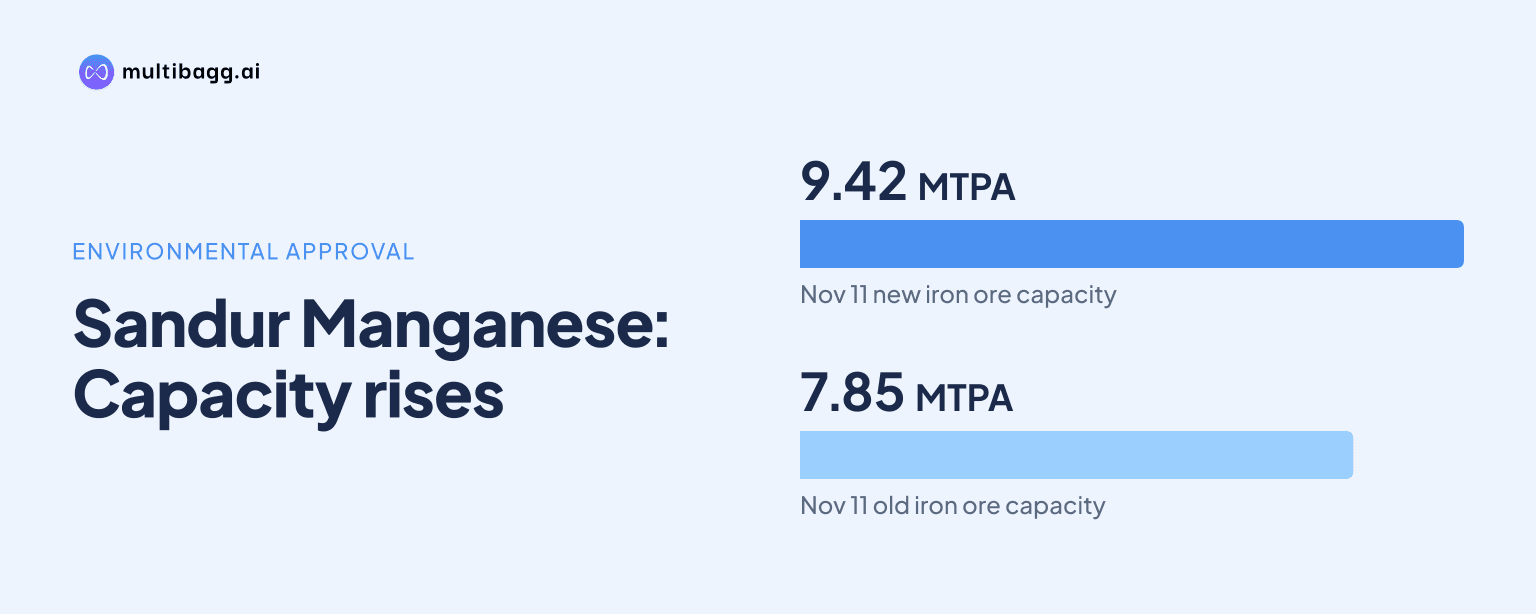
The Sandur Manganese & Iron Ores Ltd received environmental clearance on 11 November 2026 to raise iron ore run-of-mine capacity to 9.42 MTPA from 7.85 MTPA, an increase of 1.57 MTPA. The approval creates additional production headroom, although Sandur Manganese must secure further regulatory permissions before operating at the enhanced level.
Know Sandur Manganese & Iron Ores inside out
Results, valuation, peers and who's buying, in one view.
What did Sandur Manganese receive environmental clearance for?
Sandur Manganese received clearance from the Ministry of Environment, Forest and Climate Change for changes at its iron ore and manganese ore mine under Mining Lease No. 2678 in Karnataka. The approval applies to the company’s 1,860.10-hectare lease area in Deogiri village of Ballari district, where it mines and processes iron ore and manganese ore.
The key change is an increase in permitted iron ore run-of-mine capacity from 7.85 million tonnes per annum, or MTPA, to 9.42 MTPA. This represents a 20% rise in iron ore capacity and increases the company’s overall permitted run-of-mine output, after accounting for the manganese revision, from 9.19 MTPA to about 10.15 MTPA.
The clearance simultaneously lowers manganese ore capacity from 1.34 MTPA to 0.733 MTPA. Sandur Manganese indicated that the revised manganese capacity aligns with current production levels. Therefore, the regulatory change is primarily an iron ore expansion rather than a broad increase across both mined commodities.
The ministry’s clearance also permits the company to reconfigure its beneficiation plant from one 7.00 MTPA unit into two 3.5 MTPA units. The aggregate beneficiation capacity remains unchanged at 7.00 MTPA, and there is no change to the approved 1.2-kilometre downhill conveyor system.
When can Sandur Manganese use the higher iron ore capacity?
Sandur Manganese cannot begin operating at the higher production level until it obtains further regulatory approvals. The company said it would initiate the required approval process following the environmental clearance dated 11 November 2026.
This distinction matters because environmental clearance permits the proposed capacity change but does not itself confirm immediate production at 9.42 MTPA. The timing of additional approvals, operational readiness and commissioning activities will determine when the expanded capacity can be utilised.
The proposal to raise run-of-mine output and split the beneficiation configuration had already appeared in the company’s November investor presentation. The plant reconfiguration is linked to a beneficiation project that has been underway since the first quarter of FY27 and is targeted for commissioning in the second quarter of FY28.
In August 2026, Sandur Manganese announced a ₹285 crore investment in a new beneficiation plant. The company said the project was intended to improve ore quality and optimise sales realisations. That announced investment provides the operational context for the approved configuration of two 3.5 MTPA beneficiation units.
How does the clearance change Sandur Manganese's operating profile?
The clearance gives Sandur Manganese 1.57 MTPA of additional iron ore production capacity while reducing permitted manganese ore capacity by 0.607 MTPA. Iron ore is therefore expected to be the main contributor to any future increase in mine volumes, subject to the pending approvals.
Beneficiation is an important part of the operating chain because it processes mined ore before sale. While the reconfiguration does not raise total approved beneficiation capacity beyond 7.00 MTPA, two units of 3.5 MTPA each may support the planned operating arrangement at the mine. The source does not state that the reconfiguration will increase current beneficiation throughput.
Sandur Manganese’s recent financial performance provides context for the expansion plan. In Q1 FY27, it reported consolidated net profit of ₹228 crore, up 36% year-on-year, while total income increased 21% to ₹1,390 crore. Standalone net profit for the quarter rose 25% to ₹161 crore.
The company’s reported trailing-12-month revenue was ₹5,603 crore and earnings were ₹839 crore, with a market capitalisation of ₹8,380 crore in the supplied fundamental statistics. These figures are not directly comparable with the company’s FY26 estimates, but they indicate the scale of the mining business to which the additional iron ore capacity relates.
Got a follow-up? Ask IRIS
What are the important numbers in the Sandur Manganese approval?
The most relevant figures are the permitted iron ore increase, the manganese capacity reduction, the unchanged total beneficiation capacity and the lease area covered by the clearance. The following table summarises the announced regulatory and project details.
The source also included scenario-based estimates for FY26 financial metrics, rather than company guidance. Those estimates suggested potential revenue growth of 3% to 7% from a FY26 base of ₹5,088 crore if higher-rate operations occur for six to nine months in the following 12 months. They explicitly depend on further approvals and acknowledge that lower manganese capacity could offset part of the iron ore volume benefit.
Why does the environmental clearance matter to investors?
The clearance matters because it removes one regulatory step for a larger iron ore operating plan. It gives Sandur Manganese a defined capacity pathway at its existing lease rather than announcing a new mining area. However, investors should distinguish between approved capacity and actual output, since the company has not said that enhanced operations have begun.
The proposed iron ore increase arrives alongside a beneficiation investment and follows a profitable first quarter of FY27. Higher volumes can affect mining economics through greater use of fixed infrastructure, but the financial result will also depend on ore grades, realisations, costs, plant commissioning and the outstanding permissions. None of these outcomes is confirmed by the environmental clearance alone.
For customers and industry participants, the approval identifies potential future iron ore supply from an existing Ballari mining operation. For local operations, the approved changes remain within the 1,860.10-hectare lease and retain the previously approved conveyor arrangement. The company has not disclosed a revised production start date for the enhanced level.
Conclusion
Sandur Manganese has received environmental clearance to lift iron ore run-of-mine capacity to 9.42 MTPA, while revising manganese capacity down to 0.733 MTPA and restructuring its 7.00 MTPA beneficiation plant into two units. The approval strengthens the company’s permitted iron ore capacity within its existing Ballari lease, but it does not establish immediate higher production.
The next disclosed operational milestone is the planned commissioning of the ₹285 crore beneficiation project in Q2 FY28. Before then, the main point to watch is progress on the further regulatory approvals that Sandur Manganese has said are necessary to operate at the enhanced mining level.