










Sanjivani export mix shifts as India-subcontinent share nearly halves
Key highlights
- Exports accounted for 93.1% of Sanjivani's H1FY27 revenue, while domestic sales accounted for 6.9%.
- Latin America's revenue mix increased to 40.7% in H1FY27 from 33.9% in H1FY26.
- India & Subcontinent revenue mix fell to 11.5% in H1FY27 from 22.6% in H1FY26.
- Management guides for FY27 base-business revenue of Rs 80 crore to Rs 85 crore.
powered by IRIS
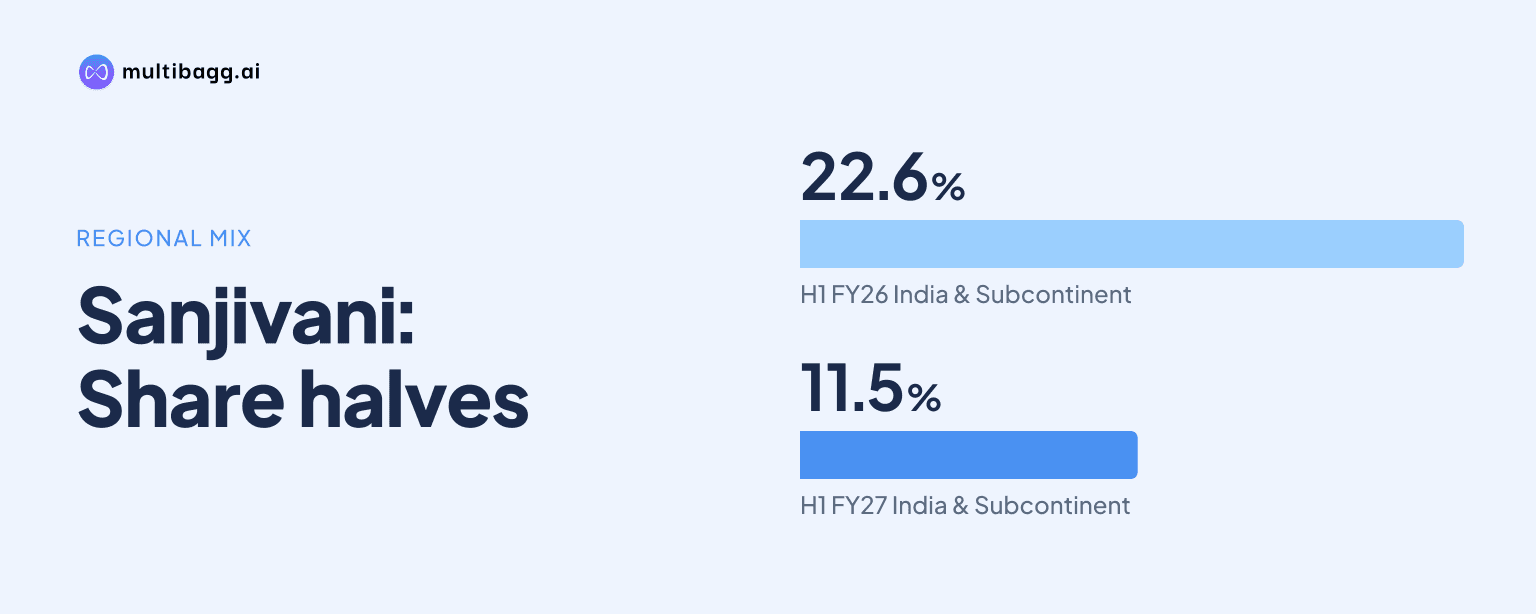
Sanjivani Parenteral Ltd.'s India & Subcontinent revenue mix fell to 11.5% in H1FY27 from 22.6% in H1FY26, while exports represented 93.1% of H1FY27 revenue and Latin America rose to 40.7%. The change increased the weight of Latin America, Middle East & Africa and CIS in Sanjivani's reported revenue profile.
Know Sanjivani Paranteral inside out
Results, valuation, peers and who's buying, in one view.
How export-dependent was Sanjivani in H1FY27?
Sanjivani derived 93.1% of H1FY27 revenue from exports, with domestic revenue accounting for the remaining 6.9%. This split means that conditions in overseas markets were the main driver of the revenue mix reported for the first half of FY27. Sanjivani says it operates across 25 export countries spanning Latin America, Middle East & Africa, the Commonwealth of Independent States, or CIS, and Southeast Asia.
The 93.1% export share puts the regional mix changes into context because movement in an overseas market has more bearing on revenue composition than movement in the 6.9% domestic business. Sanjivani's manufacturing footprint includes liquid injectables, vials, tablets and capsules, while its standalone annual tablet capacity is 720 million units and capsule capacity is 72 million units.
Sanjivani also identifies approvals linked to export-market access. Its DIGEMID approval in Peru supports Latin American exports, while the Dehradun oral-solids plant holds Drug Department Administration certification for Nepal. The presentation does not disclose sales by country, customer or product for H1FY27.
Which regions changed Sanjivani's revenue mix?
Latin America and CIS gained share in H1FY27, while India & Subcontinent recorded the largest decline. Latin America's share increased by 6.8 percentage points to 40.7% from 33.9%, placing it just below Middle East & Africa at 40.8%. CIS increased by 3.9 percentage points to 7.0%, while Middle East & Africa rose by 0.4 percentage points from 40.4%.
India & Subcontinent declined by 11.1 percentage points, taking its H1FY27 contribution to about half its 22.6% level in H1FY26. Meanwhile, the combined share of Latin America and Middle East & Africa increased to 81.5% from 74.3%. The reported mix therefore shifted from India & Subcontinent toward the two largest overseas regions, with CIS also adding share.
Does the new mix reduce Sanjivani's regional concentration?
Sanjivani says no single region has a lopsided effect, although Latin America and Middle East & Africa together represented 81.5% of H1FY27 revenue, compared with 74.3% in H1FY26. Neither region individually accounted for a majority, as Middle East & Africa represented 40.8% and Latin America represented 40.7%.
The presentation attributes its diversification to operations in 25 export countries and says Sanjivani plans to add countries while growing in existing markets. However, the disclosed H1FY27 data are by region rather than by country. They do not show revenue distribution within Latin America, Middle East & Africa or CIS, or identify the countries behind the 6.8-percentage-point Latin America increase.
There is also an unreconciled presentation detail. Sanjivani says around 93.1% of H1FY27 revenue came from core CIS, Middle East & Africa and Latin America markets, but the listed shares for those three regions total 88.5%. Separately, 93.1% is shown as total export revenue, and the presentation does not explain the difference.
Got a follow-up? Ask IRIS
How is Sanjivani responding to export logistics pressure?
Sanjivani says export recovery is expected to continue through alternate shipping routes and improving global demand. Management expects earnings before interest, tax, depreciation and amortisation, or EBITDA, margin of 16% to 17% in FY27, supported by United States dollar strength despite logistics-cost pressure.
The presentation does not name specific shipping lanes, ports or routes, and it does not quantify the cost of logistics disruption. It therefore establishes alternate shipping routes as the stated response mechanism, but does not provide a measure of their financial effect. Middle East & Africa's revenue mix remained broadly stable at 40.8% in H1FY27 versus 40.4% in H1FY26.
Sanjivani's geographic strategy focuses on strengthening its position in CIS, Middle East & Africa and Latin America across its 25-country network. Tablet and capsule dossiers have been filed across markets, and management says approvals are expected to expand the oral-formulations portfolio and support entry into new markets.
What does Sanjivani expect from its FY27 growth plans?
Management guides for FY27 base-business revenue of Rs 80 crore to Rs 85 crore, compared with FY26 standalone revenue of Rs 64.8 crore. It also guides for Rs 35 crore to Rs 37 crore from the Pune intravenous, or IV-fluid, business, supported by expected utilisation rising from 40% to about 70% during FY27.
Management expects FY27 growth of 10% to 12% for injectables, 7% to 8% for tablets and 8% to 9% for nutraceuticals. Its strategy includes broadening beyond an antibiotics-led portfolio into central nervous system, cardiovascular, anti-diabetic and gastro therapies. These are management expectations rather than reported H1FY27 outcomes.
The Pune SPL Infusion plant has annual capacity of 60 million bottles and was commercial from December 2025. Sanjivani expects the IV-fluid business to reach operating breakeven during FY27 as utilisation increases. Its Prague nutraceutical facility, operated through a 45% joint venture, began commercial batches in 2025.
Conclusion
Sanjivani's H1FY27 figures show a revenue mix increasingly weighted toward Latin America, Middle East & Africa and CIS as India & Subcontinent declined from 22.6% to 11.5%. With exports accounting for 93.1% of revenue, the 6.8-percentage-point rise in Latin America and the 3.9-percentage-point increase in CIS are material shifts in the reported regional profile.
The next disclosures to watch are whether alternate shipping routes support management's expected export recovery, whether Pune IV-fluid utilisation reaches about 70% in FY27, and whether dossier approvals expand the 25-country footprint. Clarification of the difference between the stated 93.1% core-market contribution and the 88.5% sum of the three listed regional shares would also improve interpretation of regional concentration.