










Sanjivani H1 profit rose as operating cash stayed negative
Key highlights
- Sanjivani reported standalone H1FY27 profit after tax of Rs 4.51 crore, compared with Rs 3.37 crore in H1FY26.
- Sanjivani’s standalone operating cash flow was negative Rs 2.02 crore in H1FY27, versus negative Rs 2.46 crore in H1FY26.
- Sanjivani’s short-term loans and advances rose by Rs 7.87 crore year on year to Rs 17.29 crore at H1FY27.
- Sanjivani’s long-term and current borrowings totalled Rs 13.31 crore at H1FY27, compared with Rs 6.70 crore a year earlier.
powered by IRIS
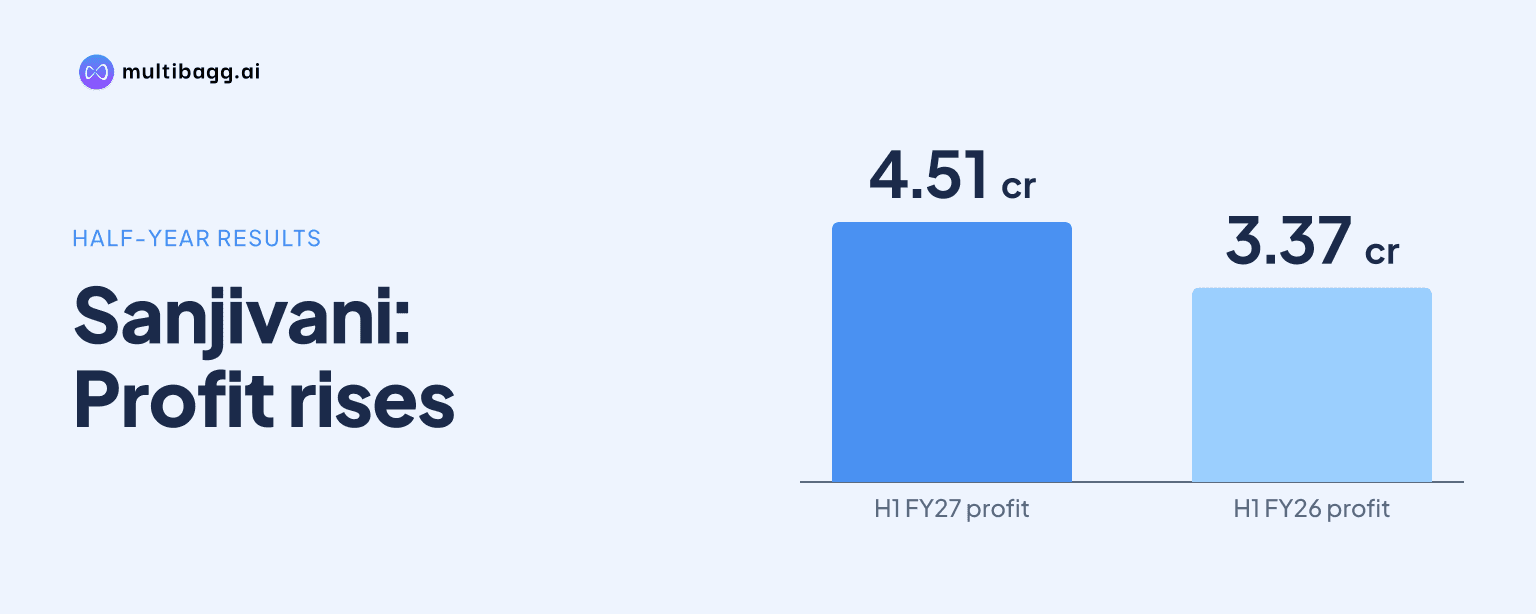
Sanjivani Paranterals Ltd. reported standalone H1FY27 profit after tax of Rs 4.51 crore, up from Rs 3.37 crore a year earlier, while cash flow from operations remained negative at Rs 2.02 crore. The profit increase coincided with a Rs 7.87 crore year-on-year rise in short-term loans and advances to Rs 17.29 crore.
Know Sanjivani Paranteral inside out
Results, valuation, peers and who's buying, in one view.
Why did Sanjivani’s H1FY27 profit increase?
Sanjivani’s standalone profit increased as revenue, total income and earnings before interest, tax, depreciation and amortisation (EBITDA) rose in H1FY27. Revenue from operations reached Rs 38.76 crore, compared with Rs 33.39 crore in H1FY26, while total income increased to Rs 39.24 crore from Rs 33.59 crore. Profit after tax rose by Rs 1.14 crore to Rs 4.51 crore, and basic earnings per share increased to Rs 3.67 from Rs 2.74.
EBITDA, including other income, rose to Rs 7.06 crore from Rs 5.10 crore, and the EBITDA margin on total income increased to 18.2% from 15.25%. Other income was Rs 48 lakh in H1FY27, compared with Rs 20 lakh a year earlier. Raw-material expenses also rose to Rs 24.01 crore from Rs 21.45 crore, while other expenses increased to Rs 5.05 crore from Rs 4.03 crore.
At the consolidated level, Sanjivani reported H1FY27 revenue from operations of Rs 49.17 crore and profit after tax of Rs 6.64 crore, compared with Rs 33.39 crore and Rs 3.37 crore in H1FY26. Consolidated EBITDA was Rs 10.87 crore, with a 22.2% margin on total income, versus Rs 5.09 crore and 15.2%. Management attributed the move to a multi-vertical platform to the Pune intravenous-fluid plant and high-margin shipments.
Did Sanjivani convert H1FY27 profit into operating cash?
No, Sanjivani recorded negative standalone operating cash flow of Rs 2.02 crore in H1FY27 despite reporting Rs 4.51 crore of profit after tax. The presentation gives only three broad cash-flow categories and does not provide a reconciliation between profit and operating cash flow. It therefore does not quantify how receivables, inventory, advances, payables or other current liabilities affected the outflow.
The operating cash outflow narrowed from Rs 2.46 crore in H1FY26 and Rs 5.08 crore in H1FY25. Cash used in investing activities was Rs 84 lakh in H1FY27, compared with Rs 1.95 crore in H1FY26. Financing activities generated Rs 3.74 crore in H1FY27, below Rs 4.27 crore a year earlier.
In H1FY27, the Rs 3.74 crore financing inflow exceeded the combined Rs 2.86 crore of operating and investing outflows. The same relationship applied in H1FY26, when Rs 4.27 crore of financing inflow exceeded Rs 4.41 crore of combined operating and investing outflows only marginally short of covering them. The presentation does not specify the purpose of individual financing receipts or investing payments.
Got a follow-up? Ask IRIS
What changed in Sanjivani’s working-capital balances?
Sanjivani’s current assets increased to Rs 51.05 crore in H1FY27 from Rs 32.38 crore in H1FY26, led by short-term loans and advances, trade receivables and inventory. Short-term loans and advances rose to Rs 17.29 crore from Rs 9.42 crore. Trade receivables increased to Rs 16.40 crore from Rs 13.03 crore, while inventories rose to Rs 9.47 crore from Rs 6.00 crore.
The Rs 7.87 crore increase in short-term loans and advances was the largest movement among the specified current-asset lines. Receivables rose by Rs 3.37 crore and inventories by Rs 3.47 crore. Other current assets increased to Rs 5.45 crore from Rs 3.26 crore, while cash and bank balances rose to Rs 2.44 crore from Rs 67 lakh.
Current liabilities also rose, reaching Rs 14.03 crore from Rs 7.20 crore. Other current liabilities increased to Rs 5.68 crore from Rs 2.74 crore, trade payables rose to Rs 4.36 crore from Rs 2.19 crore, and short-term provisions reached Rs 1.71 crore from Rs 65 lakh. These balance-sheet movements occurred alongside negative operating cash flow, but Sanjivani does not assign a specific cash-flow effect to each line.
How did Sanjivani’s borrowings and funding position change?
Sanjivani’s long-term borrowings rose to Rs 11.03 crore at H1FY27 from Rs 5.08 crore at H1FY26, while current borrowings increased to Rs 2.28 crore from Rs 1.62 crore. The two borrowing categories totalled Rs 13.31 crore, compared with Rs 6.70 crore a year earlier. Total liabilities increased to Rs 79.69 crore from Rs 58.38 crore.
Net worth was Rs 52.89 crore at H1FY27, up from Rs 44.83 crore at H1FY26, as reserves increased to Rs 40.61 crore from Rs 32.55 crore. Fixed assets rose to Rs 23.37 crore from Rs 21.28 crore. The presentation describes the Pune intravenous-fluid capital expenditure as debt-funded and says it is entering its revenue phase, without providing a separate H1FY27 leverage ratio.
For FY26, Sanjivani reported standalone debt-to-equity of 0.19 times, compared with 0.15 times in FY25 and 0.03 times in FY24. The FY26 standalone current ratio was 2.24 times, compared with 1.86 times in FY25, while interest cover was 18.1 times versus 18.5 times. Sanjivani separately reported FY26 consolidated debt-to-equity of 0.28 times and a consolidated current ratio of 1.38 times.
Conclusion
Sanjivani’s H1FY27 standalone results show a divergence between reported earnings and operating cash flow. Profit after tax increased to Rs 4.51 crore and EBITDA margin rose to 18.2%, but operating cash flow remained negative at Rs 2.02 crore. Meanwhile, current assets increased by Rs 18.67 crore, including the Rs 7.87 crore rise in short-term loans and advances, and borrowings rose to Rs 13.31 crore.
The next disclosed marker is management’s FY27 revenue ambition of about Rs 122 crore, comprising approximately Rs 80 crore to Rs 85 crore from the base business and Rs 35 crore to Rs 37 crore from intravenous fluids. Management expects intravenous-fluid utilisation to move from 40% to 70% through FY27. Subsequent disclosures will indicate whether the revenue ramp is accompanied by operating cash generation and changes in advances, receivables and inventory.