










SEM targets FY28 breakeven as Q4 customer programmes ramp
Key highlights
- SEM reported approximately Rs 23 crore of revenue in Q2 FY27 and around Rs 37 crore in H1 FY27.
- Management corrected SEM's Q2-over-Q1 measure to about 80% revenue growth, versus an initially quoted 26% volume increase.
- SEM expects most current customer programmes to begin supplies in Q4 FY27 after Q3 FY27 product validation.
- Management identified revenue above about Rs 150 crore as SEM's likely breakeven level and expects to outperform it in FY28.
powered by IRIS
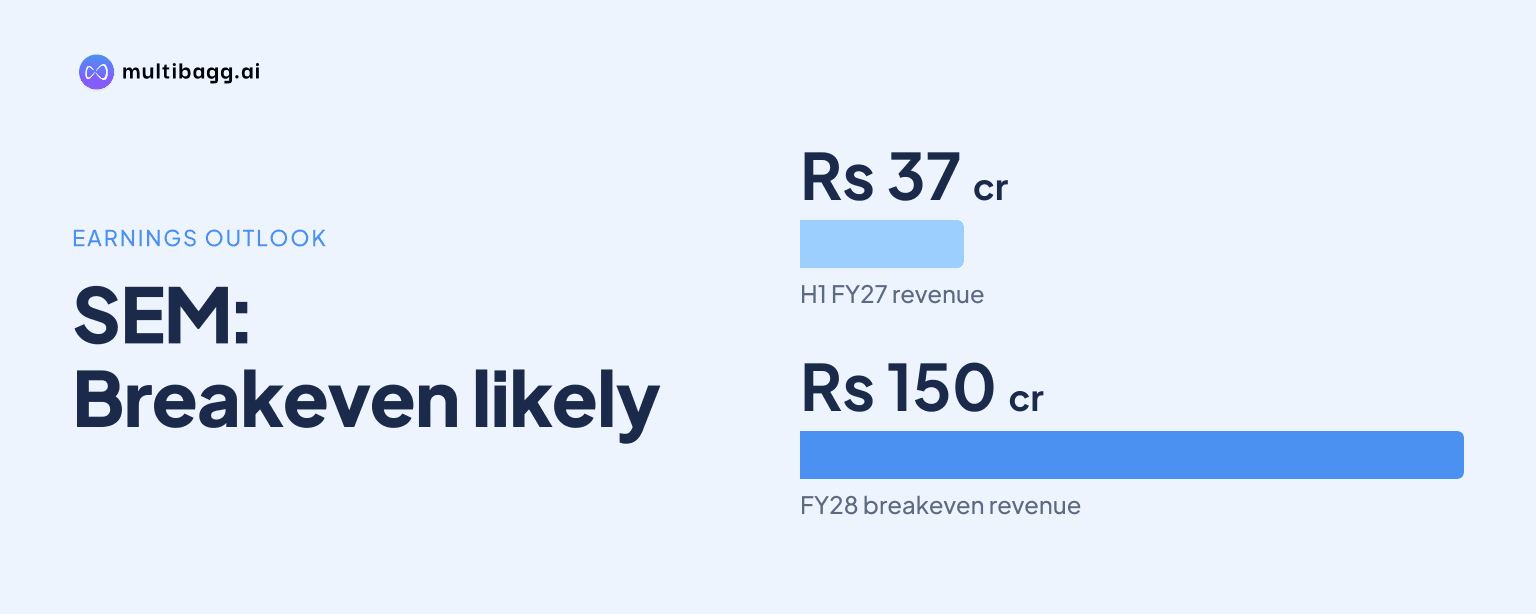
Sterling E-Mobility Solutions Limited, or SEM, reported approximately Rs 23 crore of revenue in Q2 FY27, and management said confirmed customer programmes due from Q4 FY27 could help it exceed the roughly Rs 150 crore annual revenue level identified for breakeven in FY28. The outcome depends on customer production targets and execution at newly commissioned lines.
Know Sterling Tools inside out
Results, valuation, peers and who's buying, in one view.
How fast did SEM revenue grow in Q2 FY27?
SEM said revenue grew about 80% in Q2 FY27 over Q1 FY27 after management corrected an earlier response that had referred to 26% volume growth. The correction matters because SEM is shifting from lower-value two-wheeler and three-wheeler applications to higher-value heavy commercial vehicle applications, making volume growth an incomplete measure of revenue expansion.
SEM recorded about Rs 23 crore of revenue in Q2 FY27, taking H1 FY27 revenue to around Rs 37 crore. Q2 therefore represented more than half of the reported H1 FY27 revenue, although SEM described both figures as approximate and did not provide a separate audited Q1 FY27 revenue figure during the call. Management attributed the quarterly increase primarily to higher volumes and additions of new customers.
The Q2 FY27 result followed progress in commercial vehicle and light commercial vehicle segments, where SEM is seeking higher-value applications. This differs from Sterling Tools Limited's stand-alone fasteners business, whose Q2 FY27 revenue rose around 32% year on year; SEM's cited 80% growth was sequential revenue growth, so the two measures are not directly comparable.
When does SEM expect new customer business to begin?
SEM expects most programmes it is working on to go live in Q4 FY27, following product validation with customers in Q3 FY27. Management said the relevant machines were installed in Q2 FY27, creating a sequence of installation in Q2, final validation in Q3 and supply commencement from Q4.
SEM said production lines for onboard chargers and multifunction units, which were scheduled for commissioning in Q2 FY27, were commissioned as planned. These electric-mobility products are part of SEM's push into higher-value applications in commercial vehicles and light commercial vehicles.
Management said SEM has confirmed business from several customers beginning in Q4 FY27 and extending through most of FY28. However, it made the outlook conditional on customers meeting their own production targets. SEM identified operational execution and supply-chain delivery as the remaining challenges in meeting planned volumes, rather than new-product development.
What revenue level does SEM need to break even?
SEM needs revenue above about Rs 150 crore to reach breakeven, according to management. It described SEM's losses as substantially operational in nature, while adding that fixed costs also form part of the loss base. Management identified higher revenue, rather than a disclosed fixed-cost reduction, as the route to breakeven.
Management confirmed that the roughly Rs 150 crore threshold is the point at which SEM would probably achieve breakeven. With H1 FY27 revenue at around Rs 37 crore, the disclosed first-half level was below that annual threshold. The call did not disclose SEM's quarterly loss, fixed-cost amount or a detailed margin bridge, so the conversion of higher revenue into profit cannot be calculated from the transcript.
When asked whether SEM could pass the threshold by Q2 of the following year, management instead said it expected to outperform that number in FY28. That is a management expectation rather than formal financial guidance, and it is an annual-period objective rather than a quarterly revenue forecast. SEM did not state a specific FY28 revenue target above Rs 150 crore.
Got a follow-up? Ask IRIS
Why is SEM concentrating on commercial-vehicle applications?
SEM is concentrating on commercial vehicles because management said it is moving from lower-value two-wheeler and three-wheeler products to much higher-value heavy commercial vehicle applications. That mix shift was why management withdrew the initially quoted 26% Q2-over-Q1 volume-growth figure as an appropriate representation of revenue growth and replaced it with about 80% revenue growth.
SEM also cited encouraging progress in commercial vehicle and light commercial vehicle segments while saying its priorities are increasing volumes, broadening its customer base and strengthening its position in higher-value electric-mobility solutions. These priorities place the proposed scale-up in product applications and customer programmes rather than in a disclosed price increase or separately stated market-share target.
SEM's ramp sits alongside Sterling Tools' FY27 spending plan. Sterling Tools said its consolidated capital expenditure would be about Rs 150 crore, including about Rs 20 crore for SEM and roughly Rs 10 crore for Sterling Tech-Mobility Limited, or STML. Management said the group plan covers fasteners, direct-current contactors and motor control units, rather than constituting a SEM-only investment programme.
What could delay SEM's route to FY28 breakeven?
Customer production volumes, final validations and supply-chain execution could delay SEM's route to FY28 breakeven. Management said it did not see much challenge beyond operational and supply-chain matters if customers meet their production targets, but that condition leaves the Q4 FY27 ramp partly dependent on vehicle makers' actual output.
Sterling Tools is also funding growth while increasing FY27 capital expenditure. Management said debt had risen for two principal reasons: a Rs 40 crore investment in SEM and STML during the year, and a higher debt-funded component of the approximately Rs 150 crore group capital-expenditure plan. The transcript did not break out how much of the Rs 40 crore subsidiary investment went specifically to SEM.
SEM's progress should be separated from STML's earlier commercial stage. STML began commercial supplies of high-voltage direct-current contactors and relays in Q2 FY27, whereas SEM already recorded around Rs 37 crore of H1 FY27 revenue and is preparing programmes for supply from Q4 FY27. The two businesses therefore have different starting points within Sterling Tools' mobility expansion.
Conclusion
SEM's approximately Rs 23 crore of Q2 FY27 revenue, about 80% sequential revenue growth and confirmed Q4 FY27 customer programmes indicate that its scale-up is moving from equipment installation to validation and supply. Management's case for FY28 breakeven rests on revenue exceeding roughly Rs 150 crore, supported by a shift toward higher-value commercial-vehicle applications rather than a disclosed cost-cutting plan.
The next markers are final customer validation in Q3 FY27, programme launches from Q4 FY27 and whether customer production targets support confirmed business through most of FY28. Management's FY27 plan includes about Rs 20 crore of SEM capital expenditure, while its stated FY28 objective is to outperform the roughly Rs 150 crore revenue level associated with breakeven.