










Sterling Tools raises FY27 capex to Rs 150 crore for expansion
Key highlights
- Sterling Tools plans about Rs 150 crore of consolidated FY27 capex, including roughly Rs 120 crore for fasteners.
- Management said Rs 120 crore of fasteners capex could support about Rs 150 crore of additional revenue capacity.
- Fasteners volume grew almost 28% in the first half, with value growth at a broadly similar pace.
- Debt rose after a Rs 40 crore investment in SEM and STML, expanded capex and higher working-capital needs.
powered by IRIS
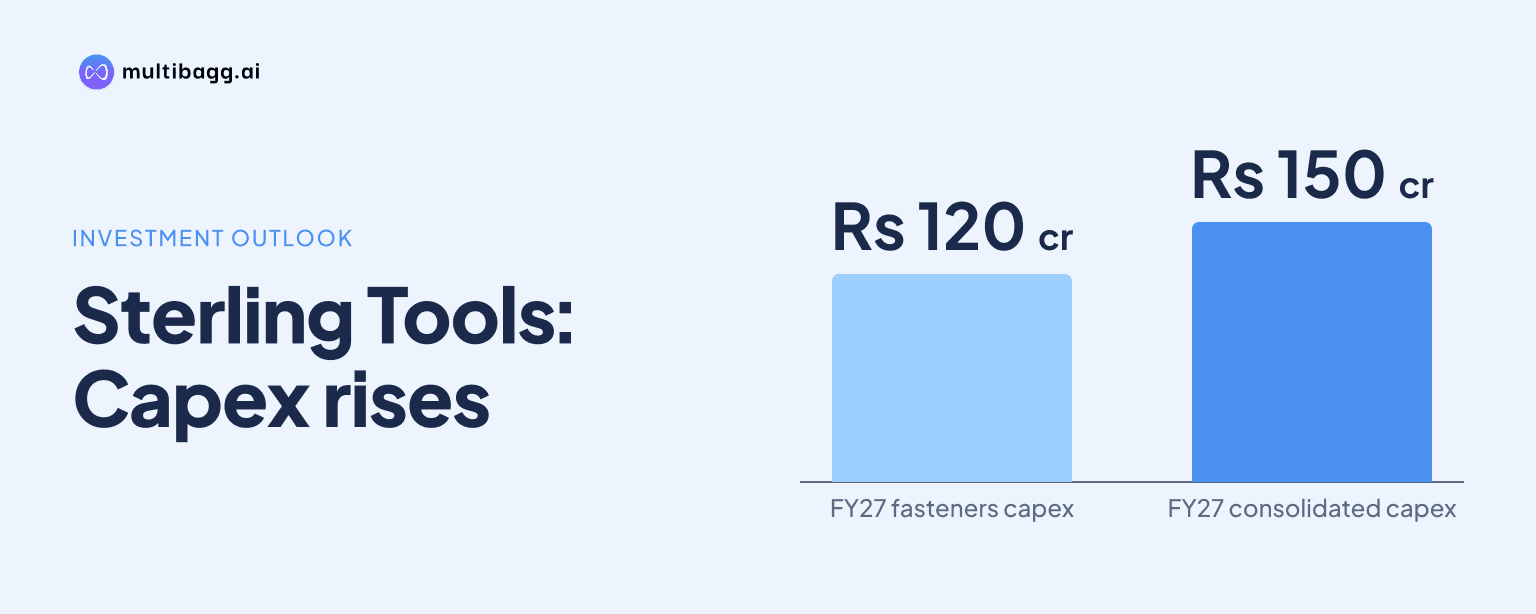
Sterling Tools Limited has raised its consolidated FY27 capital-expenditure plan to about Rs 150 crore, including roughly Rs 120 crore for fasteners that management said could create about Rs 150 crore of additional revenue capacity. The spending is being planned around customer traction and a six-to-18-month lag before equipment can contribute to revenue.
Know Sterling Tools inside out
Results, valuation, peers and who's buying, in one view.
Why did Sterling Tools raise its FY27 capex plan?
Sterling Tools raised FY27 capital expenditure, or capex, to prepare for customer requirements over the next 12 to 24 months rather than solely for current production. On the October 28, 2026 call, management said the standalone fasteners capex plan had increased from an initial Rs 80 crore to about Rs 120 crore, taking consolidated capex to about Rs 150 crore.
Management said equipment can take six to 18 months to be installed and converted into possible revenue. It said the revised FY27 plan reflects customer traction, revenue growth, communications and commitments with certain customers, and the time needed to execute those commitments. The investment is consequently intended to support opportunities in FY28 and FY29 as well as current fasteners demand.
The revision follows almost 28% first-half volume growth in the fasteners business. Management said value growth was broadly similar to volume growth, indicating that inflation-related price increases had made only a nominal contribution to revenue at that stage. It also said Sterling Tools was gaining market share, without quantifying the increase.
How is Sterling Tools allocating Rs 150 crore of capex?
Sterling Tools plans to allocate about Rs 120 crore of the Rs 150 crore consolidated programme to standalone fasteners, with around Rs 20 crore for SEM and about Rs 10 crore for STML. Fasteners therefore account for four-fifths of the planned FY27 outlay, while SEM and STML together represent about one-fifth.
The fasteners spending will cover more than equipment installed on the shop floor. Management said capex also includes infrastructure such as buildings and power backup, meaning every rupee of the Rs 120 crore allocation will not translate directly or immediately into productive output.
Management’s value-based estimate is that about Rs 120 crore of fasteners capex could provide roughly Rs 150 crore of additional revenue capacity. That is an indicative capacity calculation rather than a revenue forecast or a stated FY27 sales target, and depends on asset installation, customer demand and the stated six-to-18-month conversion period.
What demand supports Sterling Tools’ fasteners expansion?
Sterling Tools said the fasteners expansion is supported mainly by existing customers and a larger share of their spending, rather than by winning major new original equipment manufacturers, or OEMs. Management named Tata, Leyland, Volvo, Mahindra, Daimler Benz and Swaraj Mazda among incumbent commercial-vehicle customers whose production had increased across the segment.
Management said it already works with nearly all significant customers in its fasteners market. The route to higher revenue is new-product development and greater content with current OEMs, rather than major customer additions. It noted that Volkswagen and other import-based groups have purchasing structures that limit the immediate opportunity.
Sterling Tools’ near-term plan remains automotive and automotive adjacencies, with no plan to enter structural or construction fasteners. It is building railway business incrementally and said it would consider a more strategic approach after understanding that segment better. Management’s first long-term fasteners target is Rs 1,000 crore of revenue as soon as possible, without giving a date.
Got a follow-up? Ask IRIS
What could affect returns from Sterling Tools’ capex?
Input inflation and customer price negotiations could affect the financial outcome from incremental capacity. Management said tungsten-carbide prices had risen by more than 300% over the preceding 12 months, while steel, power, diesel, tool steel and labour costs had also increased. It said fasteners earnings before interest, tax, depreciation and amortisation, or EBITDA, had generally been about 15% to 16%, but could face marginal pressure during the year.
Management expects customer price recovery to be reflected in the third and fourth quarters, with some increases potentially applied retrospectively. In the second quarter, standalone other expenses were about Rs 87 crore, compared with about Rs 77 crore in the preceding quarter and around Rs 67 crore to Rs 68 crore in the comparable prior-year quarter. Management attributed the absolute increase to 28% volume growth and inflation in consumables, tooling and other inputs, while saying the percentage of sales was stable.
Debt rose for three stated reasons: a Rs 40 crore investment in SEM and STML, the larger Rs 150 crore capex programme funded with a higher debt component, and higher working-capital needs as revenue increased by more than 30%. Management also said Sterling Tools had raised raw-material inventory because steel mills were fully booked in a buoyant market.
How do SEM and STML fit Sterling Tools’ investment plan?
SEM and STML account for about Rs 30 crore of the Rs 150 crore consolidated capex plan, but their commercial timelines differ from fasteners. SEM reported Rs 37 crore of first-half revenue, and management said it would probably reach breakeven once revenue exceeded Rs 150 crore. Management expects SEM to outperform that revenue level in FY28 after rebuilding the business following the FY26 disruption.
For SEM, management said newly installed machines would undergo customer validation in the third quarter, with supplies due to begin in the fourth quarter. It said several customer programmes were confirmed for the fourth quarter and most of the following year, subject to customer production targets and Sterling Tools’ operational and supply-chain execution.
STML began operations only in the second quarter. Management said contactor and relay gross margins were in line with its projections in that quarter, but said a clearer assessment of gross and EBITDA margins would come after the business ramps up in the last quarter of the year. It added that product validation and testing can take 12 to 18 months, although much of that work had already been completed.
Conclusion
Sterling Tools has increased standalone fasteners capex from the initial Rs 80 crore plan to about Rs 120 crore, lifting consolidated FY27 capex to around Rs 150 crore. Management’s estimate of about Rs 150 crore of added fasteners revenue capacity connects the investment to existing-customer demand, but the outcome depends on installation, customer production and the six-to-18-month implementation cycle.
The next disclosed markers are the fourth-quarter start of supply for validated SEM programmes, expected customer price recovery in the third and fourth quarters, and STML’s last-quarter ramp-up. Management’s plan also leaves debt funding, the Rs 40 crore subsidiary investment, elevated raw-material inventory and tungsten-carbide inflation of more than 300% as factors to monitor.