










Sterling Tools Expects H2 Recoveries to Ease Margin Pressure
Key highlights
- Sterling Tools reported Q2 FY27 revenue growth of 32.4%, while EBITDA increased 8.2%.
- Sterling Tools said some FY27 input costs increased by more than 300%.
- Sterling Tools expects H2 FY27 OEM recoveries, with some settlements potentially retrospective.
- Sterling Tools plans about Rs 120 crore of stand-alone fastener capital expenditure, which could add roughly Rs 150 crore of revenue capacity.
powered by IRIS
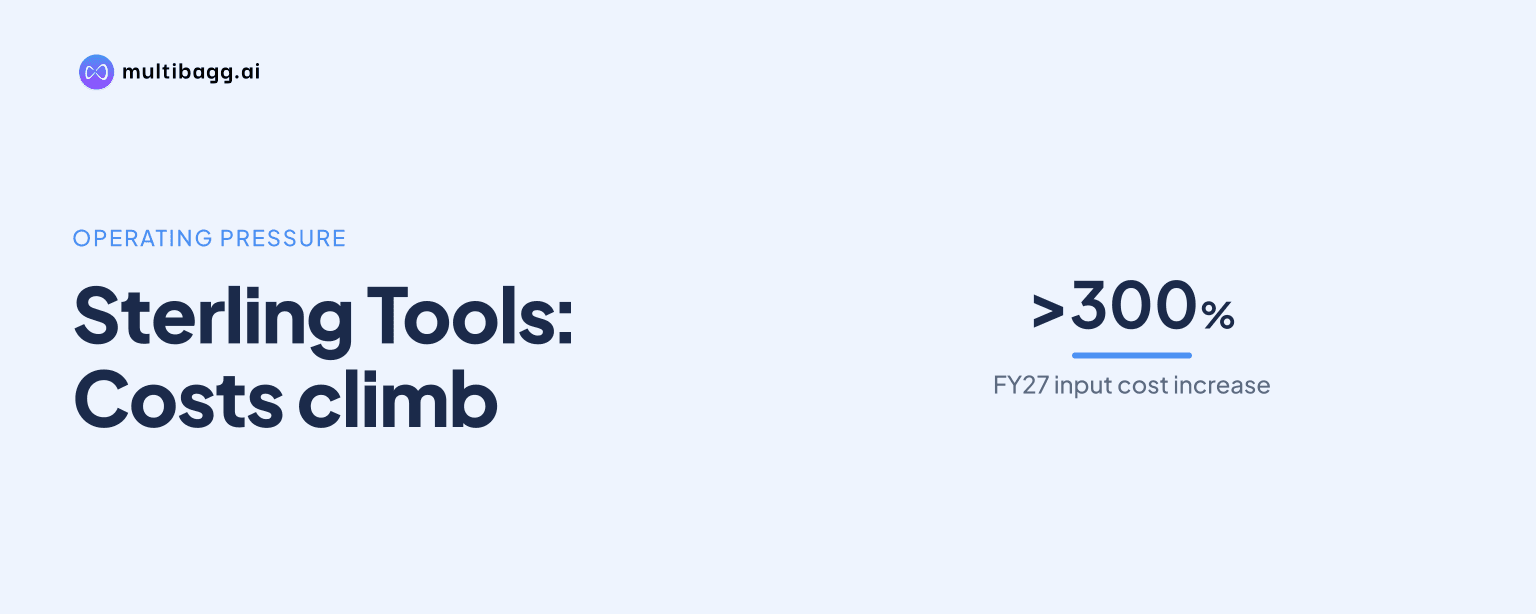
Sterling Tools Limited expects original equipment manufacturer, or OEM, price recoveries in the second half of FY27 to ease fastener margin pressure after some input costs rose by more than 300%; Q2 FY27 revenue grew 32.4%, while earnings before interest, tax, depreciation and amortisation, or EBITDA, increased 8.2%.
Know Sterling Tools inside out
Results, valuation, peers and who's buying, in one view.
Why did Sterling Tools' EBITDA growth lag revenue in Q2 FY27?
Sterling Tools said exceptional inflation in manufacturing inputs caused Q2 FY27 EBITDA to grow 8.2%, below revenue growth of 32.4%. Management attributed the difference to costs rather than weaker sales, describing FY27 as an exceptional year for manufacturers facing broad-based input-price increases.
Some commodity costs rose by as much as 300%, while other inputs increased by 30%, 40% or 50%, management said. The cost burden extended beyond steel, which is ordinarily subject to customer pass-through arrangements, to power, diesel, carbide, tool steel and employee costs following minimum-wage increases.
Stand-alone other expenses rose to about Rs 87 crore in the current quarter from about Rs 77 crore in the preceding quarter and about Rs 67 crore to Rs 68 crore in the comparable quarter a year earlier. Management said the increase reflected inflation as well as almost 28% volume growth in the first half, while expenses as a percentage of sales remained stable.
Comparisons with earlier profitability also need to account for an exceptional gain of Rs 9.5 crore in Q2 FY26 and H1 FY26. Sterling Tools said it exhausted most of its lower-cost inventory in Q1 FY27, meaning higher-priced materials reached production before all customer pricing adjustments had been settled.
How will Sterling Tools recover fastener cost increases from OEMs?
Sterling Tools expects OEM price recoveries in H2 FY27, with some settlements potentially taking retrospective effect. Management said negotiations cover both steel and the unusual inflation across other manufacturing inputs, although it did not quantify the value already recovered or still under discussion.
The recovery process takes time because pricing is being negotiated with long-standing customers, management said. Some price increases have already come through, while others remain under negotiation, and Sterling Tools expects substantial compensation going forward from the unsettled portion.
Management confirmed an analyst's understanding that price pass-through should occur in H2 FY27. It also cautioned that EBITDA margin would remain under pressure during FY27, separating the prospect of later recoveries from any assurance that the full-year margin will match an earlier period.
The timing is central to the margin outlook because fastener costs increased before all new prices were agreed. Management said the outcome still depends on input-price movements and the broader operating environment, even though its pricing arrangements provide for the pass-through of higher input costs.
Can Sterling Tools return to its historical fastener EBITDA margin?
Sterling Tools said fastener EBITDA margins have generally hovered between 15% and 16%, but management could not yet say whether FY27 would close at the same level as the previous year. The unresolved timing and scale of customer compensation leave the full-year outcome uncertain.
When asked whether quarterly fastener EBITDA margin could return to about 15% by Q4 FY27, management said it hoped that would happen. That statement was an expectation rather than formal guidance, based on the progress of OEM negotiations and the pressure from steel and non-steel inputs.
Commercial-vehicle growth has come from incumbent customers rather than new OEM wins. Management identified Tata, Leyland, Volvo, Mahindra, Daimler Benz and Swaraj Mazda as existing customers whose production ramp-up supported demand, and said it had seen neither volume nor pricing pressure after a competitor was acquired by an Italian company.
Got a follow-up? Ask IRIS
What fastener capacity is Sterling Tools adding?
Sterling Tools has increased its stand-alone fastener capital-expenditure plan from Rs 80 crore to about Rs 120 crore as it plans for demand in FY28 and FY29. Management said the spending reflects customer traction and the lag between ordering equipment and generating revenue.
The company said about Rs 120 crore of fastener capital expenditure could create roughly Rs 150 crore of additional revenue capacity in value terms. It cautioned that the programme includes shop-floor capacity, buildings, power backup and other infrastructure, so spending does not convert immediately or uniformly into revenue.
At the consolidated level, Sterling Tools plans about Rs 150 crore of capital expenditure, including Rs 20 crore for Sterling E-Mobility Solutions, or SEM, and about Rs 10 crore for Sterling Tech-Mobility, or STML. Management said debt increased partly because of a Rs 40 crore investment in the two subsidiaries and the higher debt component used to fund the broader capital plan.
Working-capital funding has also increased as revenue rose by more than 30% and Sterling Tools chose to carry more raw-material inventory. Management said steel mills were fully booked in a buoyant market, prompting the company to hold higher inventory to support material availability.
How do SEM and STML affect Sterling Tools' FY27 outlook?
SEM generated about Rs 23 crore of revenue in Q2 FY27 and about Rs 37 crore in H1 FY27. Management said Q2 revenue growth over Q1 was about 80%, after correcting an earlier 26% figure that referred to volume growth rather than revenue growth.
The higher value came partly from a shift away from lower-value two-wheeler and three-wheeler applications toward heavy commercial-vehicle products. Management said SEM could reach break-even when revenue exceeds Rs 150 crore and expects the business to outperform that revenue threshold in FY28.
SEM commissioned production lines for onboard chargers and multifunction units in Q2 FY27. Management said Q3 FY27 would be used for final customer validation, with supply programmes expected to start in Q4 FY27 and confirmed customer business extending through most of the following year, subject to customer production targets.
STML began commercial supplies of high-voltage direct-current contactors and relays in Q2 FY27. Management said gross margins were already in line with its projection for the following year, but said clearer visibility on gross and EBITDA margins would follow only after the business ramps up in the final quarter of FY27.
Conclusion
Sterling Tools' 32.4% Q2 FY27 revenue growth did not translate proportionately into EBITDA because input-cost inflation reached production before all OEM recoveries were completed. Management has identified negotiated price increases, including potentially retrospective settlements, as the mechanism that could reduce fastener margin pressure in H2 FY27, while retaining uncertainty over the full-year margin outcome.
The next disclosures to watch are the progress and extent of OEM settlements in Q3 and Q4 FY27, along with management's hoped-for return to about 15% quarterly fastener EBITDA margin in Q4. SEM's Q3 customer validation and Q4 supply start, plus STML's final-quarter commercial ramp-up, will also show how the newer businesses progress toward their stated scale targets.