










Senco expects gold-metal loans to lift reported operating cash flow
Key highlights
- Senco said gold-metal loans were 17% of working-capital borrowings in Q2.
- Management expects gold-metal loans to rise and cash-credit borrowing to decline within three to four months.
- Senco reported H1 PAT of Rs 188 crore, up 22%, with a PAT margin of 3.7%.
- Senco's 2030 vision includes Rs 20,000 crore revenue, an 8% margin and a 15% studded-jewellery ratio.
powered by IRIS
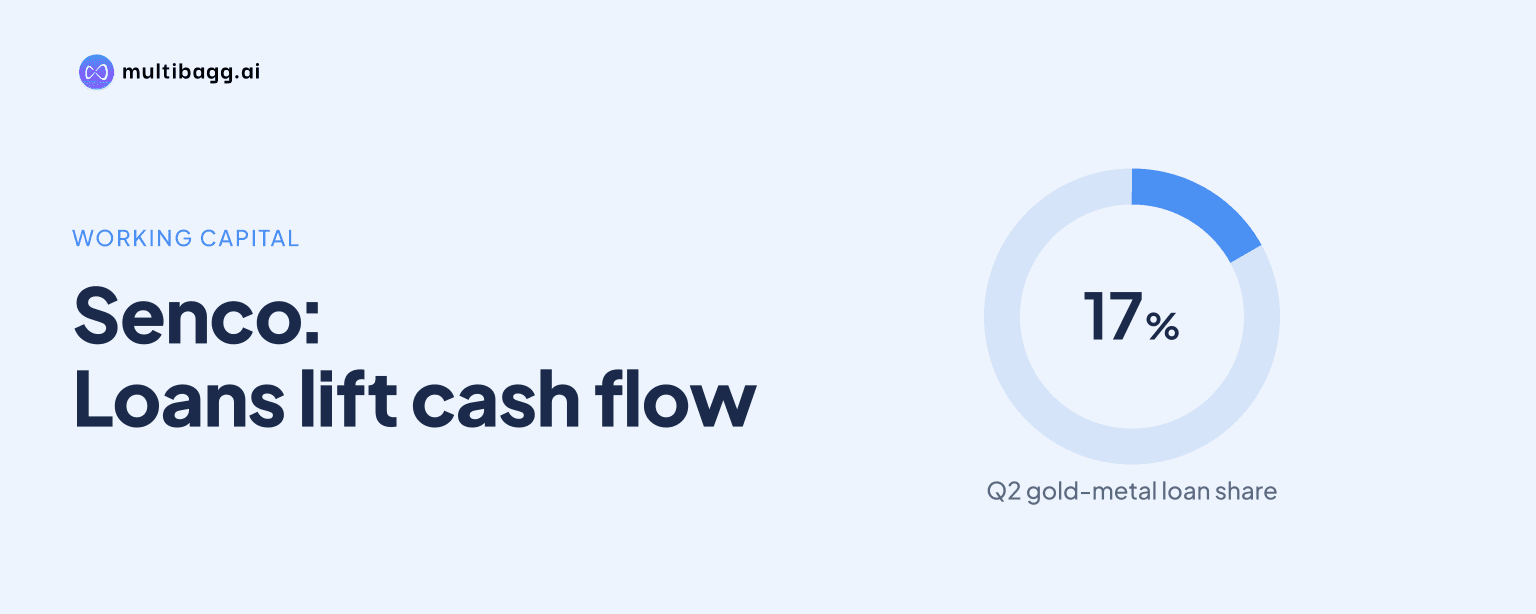
Senco said gold-metal loans accounted for 17% of working-capital borrowings in Q2, and management expects that share to increase within three to four months as availability stabilises, improving reported operating cash flow. The company said its interim reliance on cash credit reflected funding uncertainty rather than a stated liquidity shortage.
Know Senco Gold inside out
Results, valuation, peers and who's buying, in one view.
Why did Senco's operating cash flow appear negative?
Senco said the reported operating cash flow, or OCF, effect primarily came from a change in incremental borrowing from gold-metal loans, or GML, to cash credit, or CC. Management described OCF as an accounting measure and said that much of the company’s liquidity is invested in inventory, which it called the business’s main liquid asset. It said there was no liquidity pressure.
The funding shift followed uncertainty from March and April about GML availability amid discussion of possible controls on gold imports. Management also cited goods and services tax, or GST, issues that banks faced during the Q1 Akshaya Tritiya period in relation to gold imports. Senco said these developments made it use CC for incremental borrowing, affecting the accounting presentation of OCF.
Management did not disclose the absolute value of CC borrowings, total working-capital borrowings or inventory during this exchange. It also did not set an OCF target or a target for OCF conversion from earnings before interest, tax, depreciation and amortisation, or EBITDA. Its explanation instead focused on the expected reversal of the funding mix as GML availability normalises.
What happened to Senco's gold-metal loan mix in Q2?
Senco said GML fell to 17% of working-capital borrowings in Q2 because availability was uncertain from April and May. Management said the uncertainty had eased during Q2 and expected GML to increase while CC borrowing declined over the following three to four months. This is a management expectation rather than a reported funding outcome.
The 17% position was below the level Senco had previously discussed. Management said it had indicated around two years earlier that it intended to lift GML to about 70% of borrowing. It did not provide a revised medium-term GML target in this call, but linked a higher GML share directly to an improvement in reported OCF.
The distinction between GML and CC matters because management identified the mix, rather than a stated fall in access to liquidity, as the cause of the OCF presentation. The company’s next reported borrowing disclosure will show whether the 17% GML share has moved higher and whether CC has reduced as management forecast.
How does Senco link funding to cash generation?
Senco said OCF should improve as GML borrowing rises and CC borrowing falls. Management told an analyst that the business is not run solely on an accounting measurement and that inventory represents a major use of liquidity. It did not quantify how much GML would need to replace CC to change OCF or give a timetable beyond the three-to-four-month expectation.
The company’s explanation is therefore about the classification and timing of working-capital funding, not a claim that inventory requirements have disappeared. Jewellery retail requires inventory financing, and Senco said its incremental borrowing had been through CC rather than GML during the period of uncertainty. A recovery in GML availability would change that borrowing route, according to management.
Senco’s broader expansion plan adds context to the funding question. Management said it sees average sales per store having potential to nearly double over the next three to four years, while part of its planned revenue growth would come from additional outlets. That growth plan could continue to require working capital, making the composition of GML and CC an ongoing operational disclosure to monitor.
Got a follow-up? Ask IRIS
What other factors affected Senco's reported profitability?
Senco said hedge-related accounting affected the presentation of other income and other expenses across Q1 and Q2. Management said the net impact of hedging positions over the two quarters was around Rs 18 crore, with hedge-related other expense appearing in Q1 and other income in Q2. It said the statutory accounts and their notes provide the relevant net view.
Management said customer-acquisition spending and offers affected gross margin and EBITDA, while hedge positions were used to manage cash flow and liquidity risk. In Q2, management said other income was primarily related to gains on hedging positions. It characterised such gains as dependent on business strategy and risk-management policy, rather than as a recurring operating-income stream.
For H1, Senco said profit after tax, or PAT, was Rs 188 crore, up 22%, and PAT margin was 3.7%. Management said this was below its H1 guided range of 4% to 4.5%. It also cited an H1 EBITDA margin of 7.6%, while explaining that hedge-related income and expense needed to be considered together to understand the period’s presentation.
What is Senco's plan beyond the funding normalisation?
Senco’s stated 2030 vision is revenue of Rs 20,000 crore, an 8% margin and a studded-jewellery ratio of 15%. Management said growth would be pursued in East, North, West and Central India, with limited expansion in the South. It said higher studded-jewellery sales would contribute to EBITDA improvement.
Management identified Everlite, its lightweight everyday-wear brand associated with Wamiqa Gabbi, and its Melorra collaboration as parts of its effort to expand product design and acquire younger customers. It said Melorra could function as a flanker brand for a new generation of consumers, alongside Senco’s own digital and e-commerce initiatives.
In a scenario of stable gold prices, Senco said it has historically modelled 10% to 12% same-store sales growth and 4% to 5% growth from new stores, implying growth of about 15% to 16%. Management also said 40% to 45% of store customers are typically new customers, while 55% to 60% are repeat buyers. These are management assumptions and observations, not financial guidance for the next quarter.
Conclusion
Senco’s central explanation is that reported OCF was affected by temporary funding composition: uncertainty around GML availability pushed incremental borrowing toward CC. The key reported number is the 17% GML share of Q2 working-capital borrowings, compared with the company’s earlier aspiration of about 70%. Separately, H1 PAT reached Rs 188 crore, but the 3.7% PAT margin was below management’s 4% to 4.5% range.
The next development to watch is management’s stated three-to-four-month plan for GML to rise and CC to fall, because that is the mechanism Senco says will improve reported OCF. Investors can also track progress toward the Rs 20,000 crore 2030 revenue vision, 8% margin target and 15% studded-jewellery ratio, alongside future disclosure of funding composition and hedge-related accounting effects.