










Senco Gold guides at least 25% Q3 growth after festive sales
Key highlights
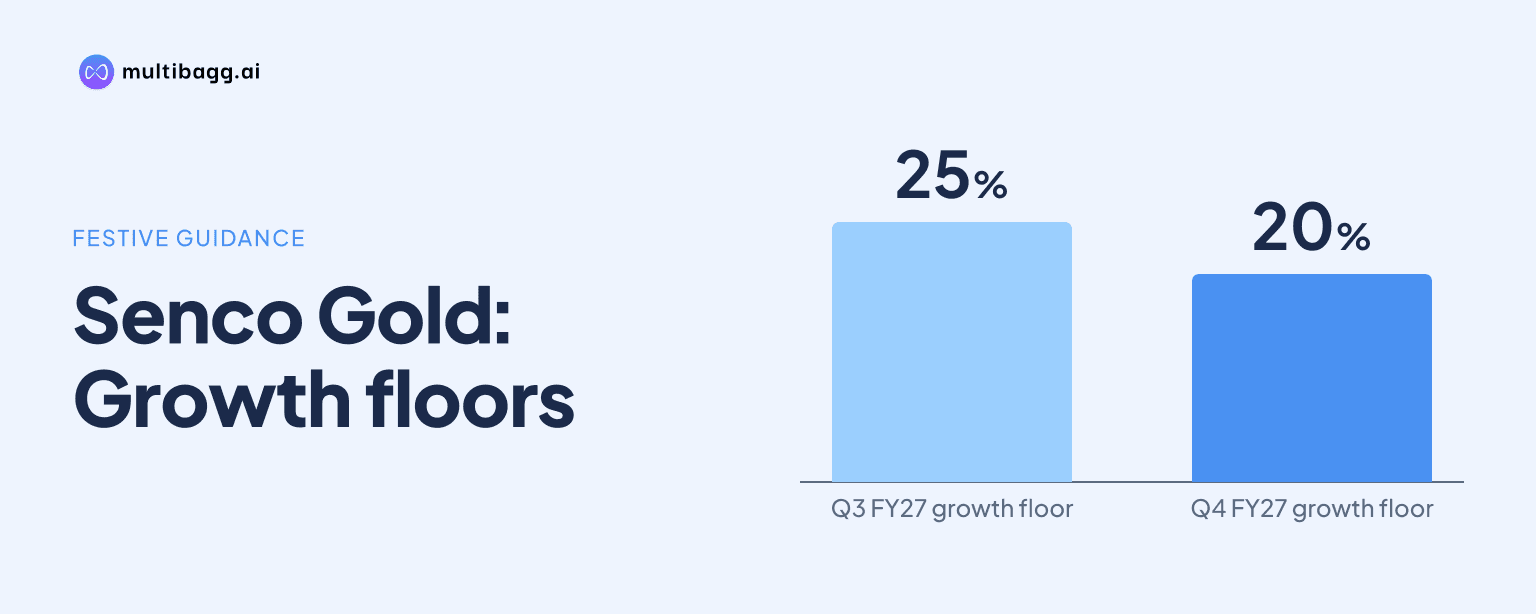
- Senco Gold guided for at least 25% year-on-year growth in Q3 FY27 and at least 20% in Q4 FY27.
- Senco Gold's turnover exceeded Rs 2,400 crore between October 1 and November 11, with revenue growth of about 25% to 26%.
- Senco Gold's Q2 FY27 consolidated revenue grew 34% year on year, while H1 FY27 revenue grew 52%.
- Senco Gold had opened 24 stores in FY27 by mid-November, above its initial 18 to 20 store target.
powered by IRIS
Senco Gold Limited expects at least 25% year-on-year revenue growth in Q3 FY27 after turnover exceeded Rs 2,400 crore from October 1 to November 11, 2026, management said on November 16. Revenue rose about 25% to 26% in those 41 festive days, while same-store sales growth was about 17%.
Know Senco Gold inside out
Results, valuation, peers and who's buying, in one view.
What is Senco Gold's Q3 FY27 growth outlook?
Senco Gold has guided for at least 25% year-on-year growth in Q3 FY27 and at least 20% growth in Q4 FY27. Management issued the outlook after reporting more than Rs 2,000 crore of sales after H1 and a favourable Dhanteras trading period, but it did not provide a full-quarter revenue target in rupees.
The October 1 to November 11 update provides the basis for that view, although it covers only 41 days of Q3. Turnover exceeded Rs 2,400 crore, revenue grew about 25% to 26%, and same-store sales growth, or SSSG, was about 17%. That indicates existing stores contributed materially alongside the 10 new stores opened during the festive period.
Management linked the remaining seasonal opportunity to weddings from November through February. It said footfall remained firm after the festive period, even as the average jewellery weight bought by consumers was 10% to 12% lower than a year earlier. Senco Gold said it is responding with lightweight designs, including products intended to retain a substantial visual appearance at lower gold weight.
How does festive sales growth compare with Q2 and H1?
Senco Gold's 25% to 26% festive-period revenue growth was below its 34% growth in Q2 FY27 and 52% growth in H1 FY27. Q2 retail revenue grew about 29%, while Q2 SSSG was 19%, compared with about 17% in the first 41 festive days. The lower early-Q3 growth rate nevertheless aligns with management's at-least-25% quarterly target.
H1 sales exceeded Rs 5,000 crore and trailing 12-month sales exceeded Rs 10,000 crore, according to management. The festive sales mix was more gold-led: bars and coins represented about 7% of sales, while the stud ratio, or studded jewellery's share of sales, was about 9.5% to 10%, below the H1 ratio of about 11.6%.
Management expects the stud ratio to return to about 12% during December through February as wedding demand and diamond promotions increase. That would be a change from the Dhanteras mix because Senco Gold has said a higher stud ratio is one route to improving earnings before interest, tax, depreciation and amortisation, or EBITDA, margins over time.
Why did Senco Gold's Q2 margin decline despite sales growth?
Senco Gold reported a 4.4% EBITDA margin in Q2 FY27, while management said H1 EBITDA margin was 7.6%, within its 7.5% to 7.8% guided range. Management attributed the Q2 outcome to deeper discounts and customer schemes, franchise inventory preparation, old-gold exchanges and the effect of hedging in a falling gold-price phase.
Old-gold exchange exceeded about 51% of total business in Q2, and management estimated that the activity reduced margin by 20 to 40 basis points, or 0.2 to 0.4 percentage points. It cited handling costs, melting losses and opportunity costs, while characterising the programme as a longer-term customer and industry initiative.
Competitive offers were another stated factor. Management said unorganised jewellers were creating price pressure and noted that East India, including West Bengal, Bihar, Jharkhand and Odisha, accounts for about 80% of revenue. An investor challenged Senco Gold's margin consistency on the call; management acknowledged the concern and said it expected the Q2 EBITDA divergence to correct in Q3.
Profit after tax, or PAT, rose 22% in H1 FY27 to Rs 188 crore from Rs 153 crore a year earlier, while H1 PAT margin was 3.7%. Management retained its 7.5% to 7.8% EBITDA-margin guidance rather than raising it, and said market capture and customer acquisition sometimes require spending beyond a stable-growth scenario.
Got a follow-up? Ask IRIS
How is Senco Gold expanding stores and customers?
Senco Gold had opened 24 stores in FY27 by mid-November, surpassing its initial full-year target of 18 to 20 stores. The total included 14 openings in H1 and 10 from October 1 to mid-November. Management plans to add another three to four stores in the following three to four months.
Inventory rose by about Rs 200 crore from March 2026, which management associated with seven company-owned, company-operated stores. Alongside company-operated outlets, Senco Gold is expanding franchises to reach Tier 2, Tier 3 and Tier 4 towns and cities, with a stated focus on East, North, West and Central India and a more limited presence in the South.
Festive-period new customer acquisition increased 30%, management said. In its usual customer mix, it estimates that 40% to 45% of shoppers are new customers and 55% to 60% are repeat buyers. In a stable gold-price scenario, management models 10% to 12% SSSG and 4% to 5% growth from new stores, for total growth of about 15% to 16%.
How do hedging and funding affect Senco Gold's results?
Senco Gold said Q2 other income primarily reflected gains on hedging positions used to manage price and cash-flow risk linked to Flexi Gold and MariGold customer schemes. Management described the Rs 99.9 crore net figure as dependent on its risk-management strategy and as one-off, rather than recurring operating income.
Management said the net hedging impact across Q1 and Q2 was about Rs 18 crore, with Q1 recorded in other expenses and Q2 in other income. It also cited customs-duty gains of about Rs 16 crore in Q1 and Rs 30 crore in Q2, or Rs 46 crore in H1, equal to about 90 basis points of H1 EBITDA by management's calculation.
Gold metal loans represented 17% of working-capital borrowings, based on an analyst's figure raised during the call. Management said availability had stabilised after uncertainty in April and May and expected the gold-metal-loan proportion to rise over the next three to four months as cash-credit borrowing declines. Customer advances under Flexi Gold and MariGold were about Rs 700 crore to Rs 800 crore.
Conclusion
Senco Gold's Q3 outlook rests on an early festive run rate of 25% to 26% growth and turnover above Rs 2,400 crore in 41 days. The pace is lower than the 34% Q2 and 52% H1 growth rates, but it includes 17% SSSG, 24 store openings in FY27 and a 30% increase in festive new-customer acquisition.
The next results will show whether the sales momentum produces the Q3 margin correction management expects. Key disclosed markers are a potential return of the stud ratio to about 12% in December through February, three to four further store openings, a planned increase in gold metal loans over the next three to four months, and management's at-least-20% Q4 FY27 growth target.