










Senco Gold Limited says Q2 margin fell to 4.4% on spending
Key highlights
- Senco Gold reported a 4.4% EBITDA margin in Q2 FY27, compared with 7.6% in H1 FY27.
- Consolidated revenue rose 34% year on year in Q2 FY27 and 52% in H1 FY27.
- Old-gold exchange exceeded about 51% of Q2 business and reduced margin by an estimated 20 to 40 basis points.
- Senco Gold reported Rs 99.9 crore of net hedging-related other income in Q2 FY27.
powered by IRIS
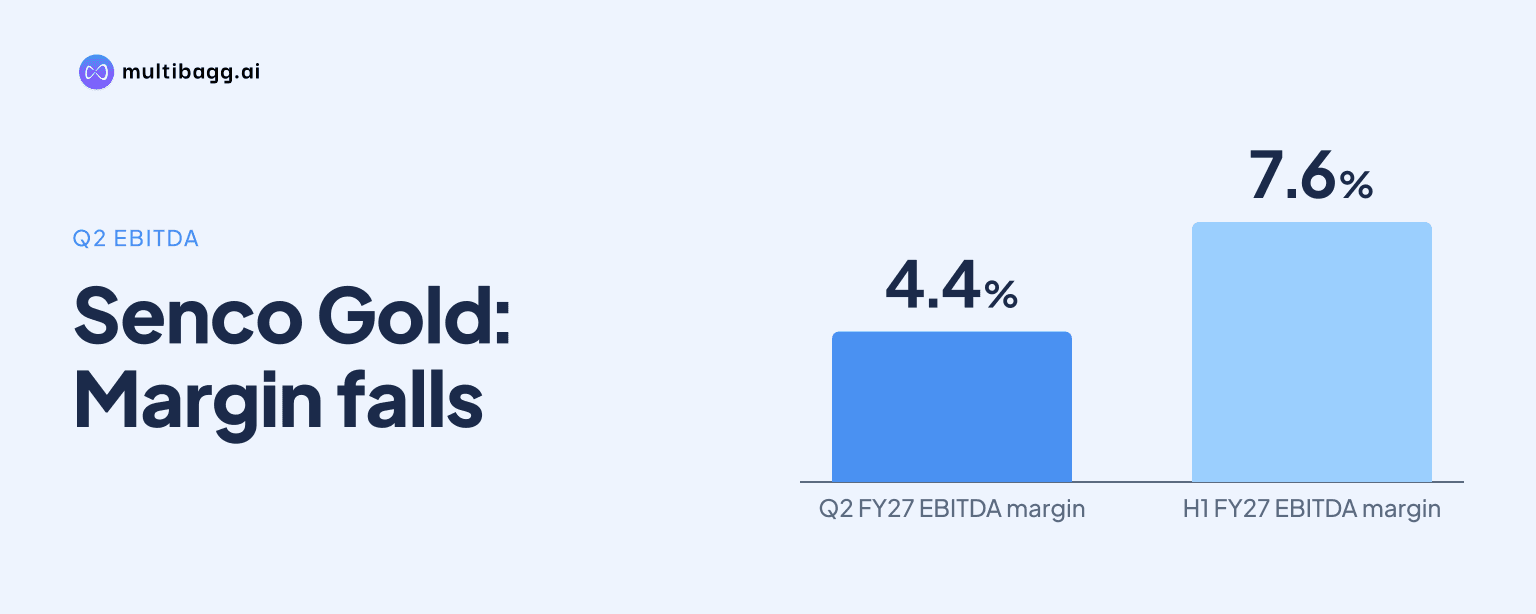
Senco Gold Limited said its Q2 FY27 earnings before interest, tax, depreciation and amortisation, or EBITDA, margin fell to 4.4% as discounting, customer-acquisition spending, old-gold exchange and festive inventory building pressured operating profitability, while Rs 99.9 crore of hedging-related other income affected reported profit. Management retained its 7.5%-7.8% full-year margin guidance.
Know Senco Gold inside out
Results, valuation, peers and who's buying, in one view.
Why did Senco Gold's Q2 FY27 EBITDA margin fall to 4.4%?
Senco Gold said Q2 FY27 EBITDA margin fell to 4.4% because it spent more on customer acquisition through discounts, schemes, marketing and offers during a traditionally softer period after Akshaya Tritiya and Poila Baisakh. Consolidated revenue nevertheless rose 34% year on year in Q2, while retail revenue increased about 29% and same-store sales growth reached 19% by value.
Management said competitive discounting by unorganised jewellers was a factor in its decision to use offers to sustain growth. It noted that East India, defined on the call as West Bengal, Bihar, Jharkhand and Odisha, contributes about 80% of revenue. Management did not quantify the separate financial effect of competition, but said market conditions differed by region.
Old-gold exchange also reduced profitability, according to management. Old gold exceeded about 51% of total Q2 business, and management estimated handling costs, melting losses and opportunity costs cut margin by 20 to 40 basis points. A basis point is one-hundredth of a percentage point, meaning the stated effect was 0.2% to 0.4% of margin.
Festive inventory preparation added another pressure. Inventory increased by about Rs 200 crore from March 2026, including stock associated with seven company-owned, company-operated, or COCO, stores. Management also cited inventory built for franchisees and channel sales before the festive season, saying this mix can reduce margin in the period of inventory build-up.
How did hedging change Senco Gold's reported Q2 profit?
Senco Gold said the sharp increase in other income primarily reflected gains and unrealised losses from hedging positions used to manage cash flow and liquidity risk. Management identified a net hedging-related other-income figure of Rs 99.9 crore in Q2, while an analyst on the call said other income had increased to Rs 122.1 crore from Rs 17.7 crore.
Management described the hedging outcome as one-off and dependent on business strategy and risk management rather than recurring operating income. It said income from fixed deposits and securities placed with banks as margin is normally about Rs 35 crore to Rs 40 crore annually, distinguishing that recurring source from the Q2 hedge-related movement.
The hedge positions were linked to customer offers including Flexi Gold and MariGold, management said. Customer advances under these programmes were about Rs 700 crore to Rs 800 crore, which exposes the business to changes in gold prices. Management said it used hedging to offset risks arising from pricing commitments and therefore argued that hedge outcomes should be considered alongside gross-margin effects from customer offers.
Accounting presentation further complicated period comparisons. Management said hedge-related effects appeared in other expenses in Q1 and other income in Q2, with a net impact of about Rs 18 crore across the two quarters. This means the Q2 other-income line alone does not show the entire first-half hedge effect, based on management's explanation.
Got a follow-up? Ask IRIS
What margin and hedging targets has Senco Gold set?
Senco Gold retained its FY27 EBITDA-margin guidance of 7.5% to 7.8%, citing a reported 7.6% H1 FY27 margin despite the 4.4% Q2 result. Management said it expects the Q2 EBITDA divergence to correct in Q3, but it did not provide a specific Q3 EBITDA-margin forecast.
H1 profit after tax rose about 22% to Rs 188 crore from Rs 153 crore a year earlier, while the H1 profit-after-tax margin was 3.7%. Management acknowledged that this was below its stated 4% to 4.5% H1 profit-after-tax margin guidance. It attributed the difference to customer acquisition, market investment, competitive offers and gold-price risk management.
Management also disclosed customs-duty gains of about Rs 16 crore in Q1 and Rs 30 crore in Q2, totalling Rs 46 crore in H1. It said this amount represented roughly 90 basis points of H1 EBITDA, signalling that reported first-half profitability included a material duty-related benefit.
Senco Gold said its board-guided policy currently places hedging at about 50%, although management also described the Q2 ratio as around 40% to 50% during a period of falling gold prices. It intends to raise the level toward 65% to 70% over time once gold prices stabilise, while declining to disclose detailed hedge mechanics on the call.
Can product mix and store growth support Senco Gold's margin plan?
Senco Gold said increasing diamond-studded jewellery is part of its route toward higher margin. The H1 stud ratio, measuring studded jewellery as a share of sales, was about 11.6%. It fell to roughly 9.5% to 10% during Dhanteras, when demand shifted toward gold jewellery, bars and coins, which accounted for about 7% of festive-period sales.
Management expects the stud ratio to return to about 12% during December through February and has set a longer-term vision of about 15%. It also said average jewellery weight during the recent season was 10% to 12% lower than a year earlier as customers chose lighter pieces, even though ticket sizes increased. Demand for nine-carat and 14-carat jewellery was described as rising.
The company opened 14 stores in H1 and a further 10 from 1 October to mid-November, taking FY27 openings to 24 against its original target of 18 to 20. Management plans to add another three to four stores over the next three to four months. It said franchise expansion is part of its strategy, though franchise and channel inventory can influence near-term margin mix.
For the 41 days from 1 October to 11 November, Senco Gold reported turnover above Rs 2,400 crore, revenue growth of about 25% to 26%, same-store sales growth of about 17% and diamond-jewellery sales growth of about 26%. Management said festive-period new customer acquisition rose 30%, compared with its usual customer mix of 40% to 45% new buyers and 55% to 60% repeat buyers.
Conclusion
Senco Gold's Q2 FY27 result shows that the 4.4% EBITDA margin reflected a combination of commercial spending and product-channel factors, including discounting, old-gold exchange above 51% of business and inventory preparation. Reported profitability was also affected by Rs 99.9 crore of hedging-related other income, which management linked to the pricing and liquidity risks created by customer schemes.
The next test is Q3 FY27, when management expects the Q2 margin divergence to correct and has forecast at least 25% year-on-year revenue growth. Investors can watch whether the stud ratio returns toward 12%, whether hedging moves above its current roughly 50% level after gold-price stabilisation, and whether the planned three to four further store openings are completed.