










Senco targets Rs 20,000 crore through store productivity
Key highlights
- Senco’s 2030 vision is Rs 20,000 crore of revenue, an 8% EBITDA margin and a roughly 15% stud ratio.
- Senco said average sales per existing store could nearly double within three to four years.
- Senco opened 24 stores in FY27 at the time of the call, against its stated target of 18-20.
- East India contributes about 80% of Senco revenue, driving expansion into North, West and Central India.
powered by IRIS
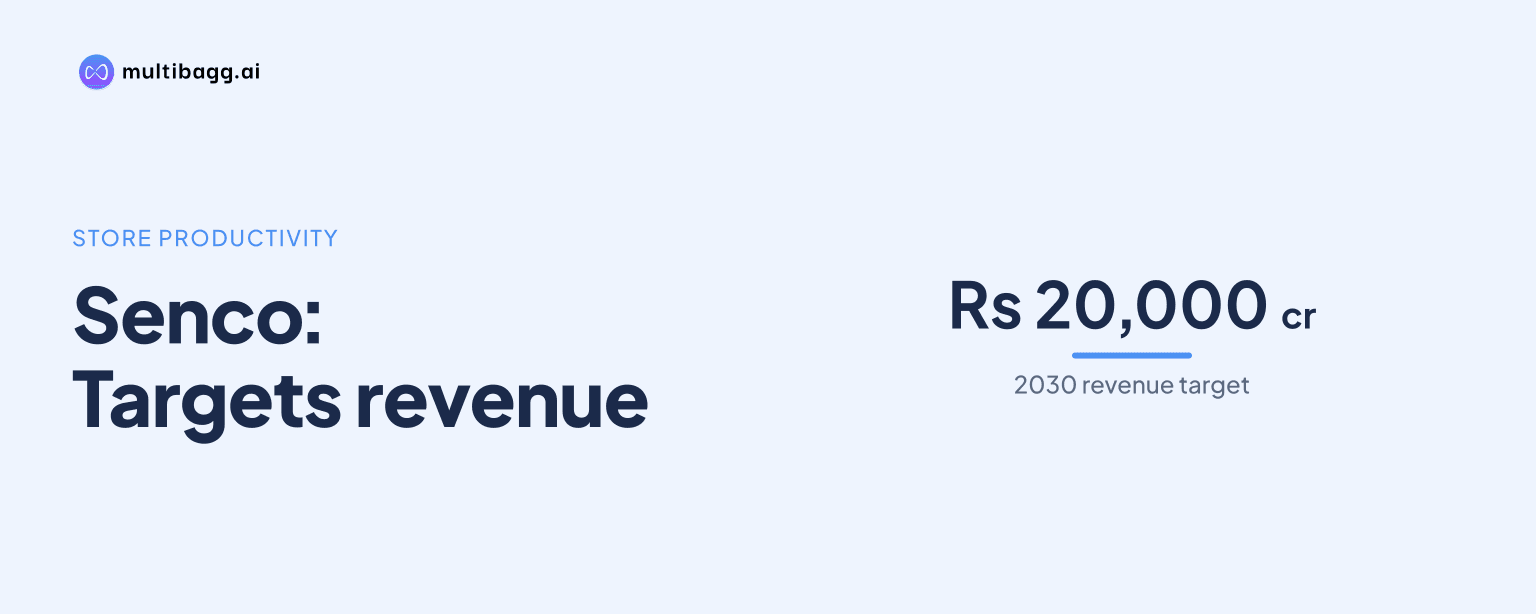
Senco’s 2030 roadmap targets Rs 20,000 crore of revenue, an 8% earnings before interest, taxes, depreciation and amortisation (EBITDA) margin and a roughly 15% stud ratio, with management saying average sales per existing store could nearly double within three to four years. The plan relies on store productivity, expansion beyond East India and younger-customer product lines.
Know Senco Gold inside out
Results, valuation, peers and who's buying, in one view.
What is Senco’s Rs 20,000 crore roadmap?
Senco plans to move from more than Rs 10,000 crore of trailing-12-month sales to Rs 20,000 crore by combining existing-store productivity, selective network additions and a higher-value product mix. Management said H1 FY27 sales had crossed Rs 5,000 crore, while the 2030 vision includes an 8% EBITDA margin and a stud ratio of about 15%.
Management did not provide a year-by-year sales bridge to the target. It identified three mechanisms instead: lifting sales at current stores, opening stores across regions and increasing studded-jewellery sales. In a stable gold-price environment, management’s model assumes 10%-12% same-store sales growth plus 4%-5% from new stores, for a sustainable growth rate of around 15%-16%.
How will Senco expand beyond East India?
Senco intends to grow across East, North, West and Central India, with a limited presence in South India, rather than depend solely on its eastern network. Management said East India accounts for about 80% of revenue, making the development of regions outside that base material to the Rs 20,000 crore strategy.
The company described Delhi National Capital Region as the “crown” of its pan-India strategy and cited Borivali and Vashi as western locations. Senco is also opening stores in tier 2, tier 3 and tier 4 eastern towns and cities. Management said stores outside Bengal have substantial sales potential and could supply a major part of future revenue beyond the current 80% eastern contribution.
Network growth is intended to supplement, rather than replace, store-level expansion. Senco opened 14 stores in H1 FY27 and 10 more after 1 October, taking additions to 24 against its FY27 target of 18-20 stores. Management also planned another three or four openings over the following three to four months and said franchise operations would help it penetrate smaller locations.
Can existing Senco stores generate most growth?
Yes. Management said a major share of the move from Rs 10,000 crore to Rs 20,000 crore should come from existing stores, whose average sales could nearly double over three to four years. The roadmap therefore depends more on improving productivity across the established base than on adding a large number of new outlets.
Senco’s customer mix is one factor management cited for this potential. It said 40%-45% of store customers are new and 55%-60% are repeat buyers, while festive-period new-customer acquisition rose 30% across markets. Management expects new-customer additions to support both mature stores and locations entered outside its historical markets.
Recent trading figures show that the productivity plan starts from a growing base. Retail revenue rose about 29% year on year in Q2 FY27 and value same-store sales growth was 19%. From 1 October to 11 November, a 41-day Dhanteras-period update reported turnover above Rs 2,400 crore, revenue growth of about 25%-26% and same-store sales growth of about 17%.
Got a follow-up? Ask IRIS
How does Senco plan to lift its stud mix and margin?
Senco expects a higher stud ratio to help deliver its 8% EBITDA-margin ambition, with management targeting a ratio of 15% and above over time. The H1 FY27 stud ratio was about 11.6%, although it declined to roughly 9.5%-10% during Dhanteras as bars and coins, at about 7% of sales, changed the sales mix.
Management expects the stud ratio to return to around 12% during December to February, when wedding-season and Valentine’s Day diamond promotions are planned. Its product approach includes lightweight and studded collections, new designs and the Everlite everyday-wear range, for which Wamiqa Gabbi is the brand face.
Near-term factors have affected margins. Management retained its 7.5%-7.8% EBITDA-margin guidance despite a Q2 FY27 EBITDA margin of 4.4%, citing discounts, customer schemes, festive inventory and old-gold exchange. Old-gold exchange represented about 51% of total business and carries a stated margin cost of 20-40 basis points, where 100 basis points equal one percentage point.
Which customer and product shifts underpin Senco’s plan?
Senco is targeting younger and more price-conscious buyers through lower-carat, lighter and digitally oriented offerings. Management said the average weight range sold during the season was 10%-12% lower than a year earlier even as ticket sizes rose, indicating that customers were selecting lighter pieces amid higher gold prices.
Management said demand is rising for nine-carat and 14-carat jewellery in plain-gold, diamond, lab-grown-diamond and gemstone formats. Senco has also launched titanium jewellery incorporating gold and diamonds. These categories are intended to address affordability for younger and middle-aged customers while broadening the offer beyond conventional gold purchases.
The Melorra collaboration is another mechanism for customer acquisition. Management described it as a route to design innovation, lightweight and studded jewellery, omnichannel activity and younger consumers, while maintaining Senco’s heritage-focused positioning. It expects Melorra to serve as a flanker brand as its products and customer base develop.
Conclusion
Senco’s Rs 20,000 crore plan depends on changing both where it grows and what it sells: more revenue from outside East India, higher sales from the existing network and greater participation by lightweight, lower-carat and studded jewellery. H1 FY27 sales above Rs 5,000 crore and Q2 value same-store sales growth of 19% provide the reported starting point, while the 15% stud-ratio and 8% EBITDA-margin objectives remain management ambitions.
The next measures of execution are Senco’s planned three or four store openings over the following three to four months, the expected recovery of stud ratio toward 12% in December to February and the contribution from non-East markets. Management also guided for at least 25% year-on-year growth in Q3 FY27 and at least 20% in Q4 FY27, following sales above Rs 2,000 crore in the first 45 days after H1.