










Shanti Gold targets 7,900 kg capacity after Marol commissioning
Key highlights
- Marol began commercial production in June 2026 and adds about 4,000 kg of annual installed capacity.
- Shanti Gold targets 7,900 kg of annual installed capacity after the 1,200 kg Jaipur addition.
- Q2FY27 volume rose 25.4% to 535.5 kg from 427.0 kg in Q2FY26.
- H1FY27 revenue from operations increased 102.3% to Rs 1,462.3 crore.
powered by IRIS
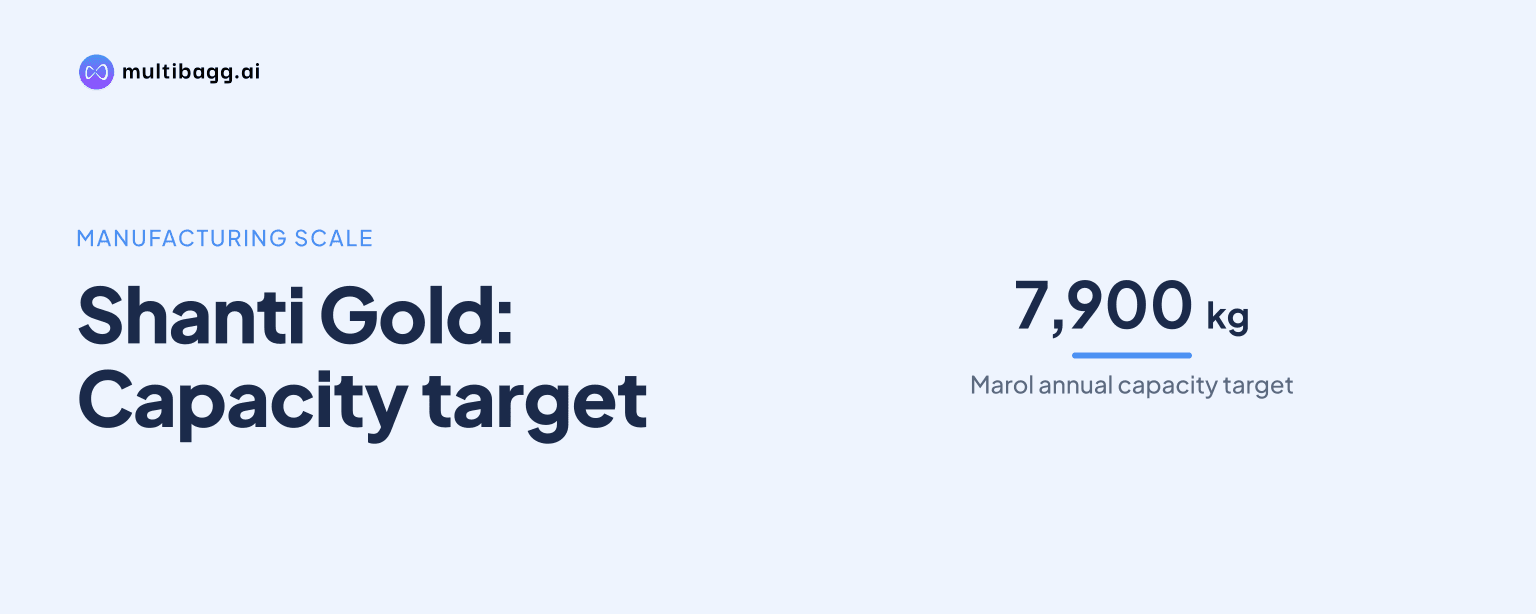
SHANTI GOLD International Ltd. targets 7,900 kg of annual installed jewellery capacity after its June 2026 Marol commissioning raised Mumbai capacity to about 6,700 kg and its under-construction Jaipur facility adds 1,200 kg. Shanti Gold links the expansion to Turkish jewellery, mangalsutras, Cuban bracelets and machine-made plain gold.
Know Shanti Gold International inside out
Results, valuation, peers and who's buying, in one view.
What capacity will Shanti Gold have after the Jaipur plant is completed?
Shanti Gold is targeting total installed capacity of 7,900 kg per annum after the Jaipur facility adds 1,200 kg to the approximately 6,700 kg annual capacity at its two Mumbai facilities. The plan changes the manufacturing base from the 2,700 kg Andheri facility to three facilities, subject to completion of the Jaipur project.
The immediate addition came from Marol, where commercial production began in June 2026 and added about 4,000 kg per annum. Andheri occupies 13,449 square feet and Marol spans 14,590 square feet, while the Jaipur project is planned on 50,000 square feet of land at Mahindra World City, Jaipur.
How is Marol changing Shanti Gold's product range?
Shanti Gold says the Marol facility is intended to support Turkish jewellery, mangalsutras and Cuban bracelets alongside its 4,000 kg annual capacity addition. The company showcased Turkish jewellery collections at the IIJS Bharat 2026 trade show and says Turkish artisans were brought in to provide direct craftsmanship and authentic domestic styling rather than imitations.
The three additions have different stated positions: Turkish jewellery is the flagship new line, mangalsutras expand the traditional wedding offering, and Cuban bracelets target contemporary urban retail demand. They extend a portfolio that already includes bangles, rings, necklaces and jewellery sets for wedding, festive and everyday wear.
The Jaipur project represents a separate product step through machine-made plain gold jewellery. Shanti Gold describes plain gold as a high-volume line and a new growth vertical beyond its casting jewellery range, and says letters of intent, or LOIs, have been secured from prospective buyers. The presentation does not identify those buyers, give order quantities or state a commissioning date for Jaipur.
Got a follow-up? Ask IRIS
What manufacturing system supports Shanti Gold's expansion?
Shanti Gold operates a 12-step in-house process from computer-aided design (CAD) and computer-aided manufacturing (CAM) wax printing through casting, stone setting, polishing, hallmarking, packing and dispatch. It says its integrated operations cover design, casting, polishing and hallmarking, supported by 3D printing, laser soldering and induction melting.
Product development is supported by 76 CAD designers and more than 400 new designs each month, according to the presentation. That design pipeline supports the Turkish, mangalsutra and Cuban bracelet categories, although the source does not provide output, revenue or sales volumes by product line.
Quality control includes a dedicated quality control and tagging team of 34 employees. Shanti Gold says all its gold jewellery products are hallmarked by the Bureau of Indian Standards (BIS), while raw-material checks include X-ray fluorescence testing or fire assay for 22-karat and 18-karat gold. Its stated controls also include batch-wise tracking, daily stock reconciliation, barcode tracking, radio-frequency identification tracking and enterprise resource planning-based monitoring.
How does the expansion align with Shanti Gold's recent volumes?
Shanti Gold reported second-quarter fiscal year 2027 (Q2FY27) volume of 535.5 kg, up 25.4% from 427.0 kg in Q2FY26, while revenue from operations rose 73.4% to Rs 746.0 crore from Rs 430.1 crore. The presentation's volume trend rounds Q2FY27 volume to 536 kg, compared with 522 kg in Q1FY27.
For the first half of fiscal year 2027 (H1FY27), volume rose 41.0% to 1,057.6 kg from 750.0 kg in H1FY26, while revenue from operations increased 102.3% to Rs 1,462.3 crore from Rs 722.9 crore. Domestic revenue accounted for 94% of H1FY27 revenue and international revenue for 6%. Management's plan identifies Jaipur as a North India distribution hub and calls for a stronger presence across four international markets, including the United States and United Arab Emirates corridors.
Conclusion
Shanti Gold's stated strategy combines the June 2026 commissioning of Marol, adding about 4,000 kg a year, with a proposed 1,200 kg Jaipur addition that would take installed capacity to 7,900 kg. The larger manufacturing base is paired with Turkish jewellery, mangalsutras and Cuban bracelets at Marol, followed by machine-made plain gold jewellery at Jaipur.
The next disclosed milestone is completion of the Jaipur facility, which remains under construction on 50,000 square feet at Mahindra World City and has no commissioning date in the presentation. Investors can watch for progress on the 1,200 kg addition, conversion of the disclosed LOIs into orders, and evidence of how the new products and North India distribution plan affect volumes after the 1,057.6 kg reported in H1FY27.