










Shanti Gold retains Rs 3,200-3,500 crore FY27 guidance
Key highlights
- Shanti Gold retained FY27 revenue guidance of Rs 3,200 crore to Rs 3,500 crore.
- H1 FY27 revenue from operations rose 102.3% year on year to Rs 1,462.3 crore.
- H1 FY27 volume increased 41.0% year on year to 1,057.6 kilograms.
- Shanti Gold raised about Rs 99.83 crore through a rights issue for working-capital requirements.
powered by IRIS
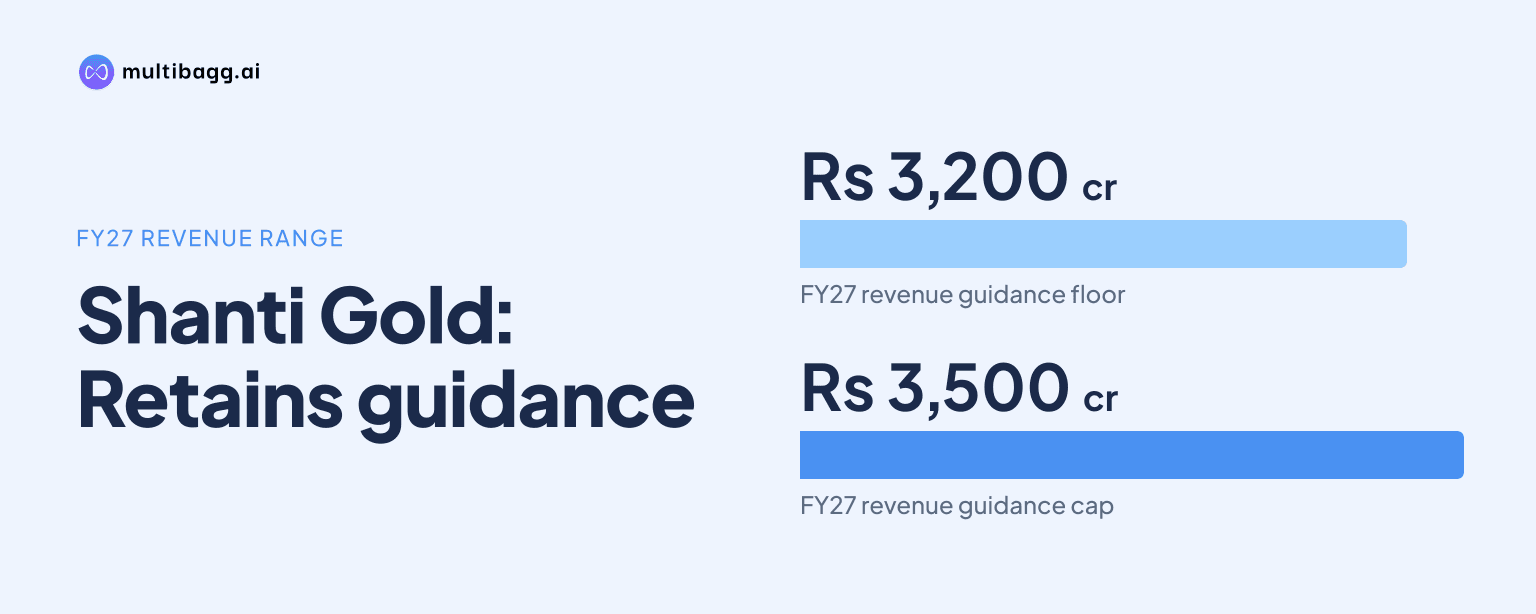
Shanti Gold International Limited retained its Rs 3,200 crore to Rs 3,500 crore FY27 revenue guidance after revenue from operations rose 102.3% year on year to Rs 1,462.3 crore in H1 FY27. Management cited 41.0% volume growth to 1,057.6 kilograms, added Marol capacity and festive-season demand from retail partners.
Know Shanti Gold International inside out
Results, valuation, peers and who's buying, in one view.
Why did Shanti Gold retain its FY27 revenue guidance?
Shanti Gold retained its FY27 guidance because management said volume growth, capacity utilisation, customer additions and working-capital discipline support revenue of about Rs 3,200 crore to Rs 3,500 crore. Management said this range would represent 60% growth over FY26, while cautioning that forward-looking statements are subject to risks and uncertainties.
H1 FY27 revenue from operations of Rs 1,462.3 crore, compared with Rs 722.9 crore in H1 FY26, was the operating basis management gave for retaining the range. Volumes rose 41.0% year on year to 1,057.6 kilograms, and management said the extended Marol manufacturing facility helped it meet sustained retail-partner demand.
The retained target requires H2 FY27 revenue of Rs 1,737.7 crore at the lower end and Rs 2,037.7 crore at the upper end, based on the reported H1 result of Rs 1,462.3 crore. Management said Dhanteras, Diwali and the following wedding season are important demand periods because jewellery retailers build inventory before these occasions.
What drove Shanti Gold’s H1 FY27 revenue growth?
Shanti Gold said customer acquisition, deeper penetration with existing customers, manufacturing-capacity expansion and a wider product portfolio drove H1 FY27 revenue growth of 102.3%. Management also cited increasing formalisation in the jewellery industry and a greater preference for organised manufacturers among retail chains.
The September quarter showed continued growth, though its revenue growth rate was lower than the H1 rate. Q2 FY27 revenue from operations was Rs 746 crore, up 73.4% from Rs 430 crore in Q2 FY26, while volume increased 25.4% to 535.5 kilograms.
Shanti Gold said it has broadened its offering in designer and Turkish jewellery while strengthening relationships with existing customers and adding retail clients. Management described quality, finishing, authenticity, traceability and reliable delivery at scale as requirements from organised retail chains and large jewellery players.
How is the Marol facility supporting Shanti Gold’s target?
The extended Marol facility is supporting Shanti Gold’s FY27 target by adding manufacturing capacity and operational flexibility, according to management. Operations at the facility commenced during H1 FY27, enabling the company to serve a wider range of customer requirements and support higher volumes.
Management directly linked the added Marol capacity to H1 FY27 volume of 1,057.6 kilograms, up 41.0% year on year. In Q2 FY27, volume rose 25.4% to 535.5 kilograms, while revenue increased 73.4% to Rs 746 crore, showing that higher output was accompanied by higher sales.
Shanti Gold also plans a Jaipur facility intended to manufacture machine-made plain gold jewellery and strengthen its presence in North India. On the November 4, 2026 earnings call, management did not disclose an opening date, capacity number or targeted revenue contribution for the Jaipur project.
Got a follow-up? Ask IRIS
What do Shanti Gold’s Q2 and H1 earnings show?
Shanti Gold’s Q2 and H1 results show revenue and volume growing faster than earnings measures during FY27. Q2 revenue rose 73.4% to Rs 746 crore and H1 revenue rose 102.3% to Rs 1,462.3 crore, while earnings before interest, tax, depreciation and amortisation, or EBITDA, rose 15.6% and 29.2%, respectively.
For H1 FY27, EBITDA was Rs 114 crore compared with Rs 88.2 crore in H1 FY26, and profit after tax was Rs 80 crore compared with Rs 60.4 crore. Management said its strategy is to pursue market share rather than optimise for short-term margins, supported by investment in manufacturing capability, product development and customer relationships.
How will Shanti Gold fund inventory and expansion?
Shanti Gold said its expansion requires working capital because jewellery manufacturing is inventory intensive. During Q2 FY27, it raised about Rs 99.83 crore through a rights issue, and management said the proceeds would be deployed towards working-capital requirements as the business scales.
Management said inventory could remain elevated for a couple of quarters because of product launches, the operational Marol facility and the planned Jaipur facility. It said inventory build-up must be supported by market expansion, with funding expected to come through a mix of equity and debt.
Shanti Gold said its debt-to-equity ratio was 0.5 times at the time of the November 4, 2026 call and that management would be comfortable up to 1 time. Management said it may use additional borrowing if working-capital needs require it and referred to an advanced-gold vertical as a future plan, without giving a financing commitment or timetable.
Conclusion
Shanti Gold’s decision to retain Rs 3,200 crore to Rs 3,500 crore of FY27 revenue guidance is grounded in H1 revenue of Rs 1,462.3 crore, up 102.3%, and volume of 1,057.6 kilograms, up 41.0%. The Marol facility added capacity to meet demand, but the guidance also depends on generating Rs 1,737.7 crore to Rs 2,037.7 crore in H2 FY27.
The next measures to watch are festive and wedding-season retail demand, inventory and working-capital funding as volumes rise, and progress on the planned Jaipur facility for machine-made plain gold jewellery. Management also said its Dubai office had received approvals and may begin generating volumes once operations settle, but it gave no timetable or quantified contribution target.