










Shanti Gold plans equity-debt mix for inventory expansion
Key highlights
- Shanti Gold said debt-equity was 0.5x and management is comfortable planning for up to 1x.
- Shanti Gold raised Rs 99.83 crore through a Q2 FY27 rights issue for working-capital needs.
- H1 FY27 revenue rose 102.3% to Rs 1,462.3 crore while volume increased 41.0% to 1,057.6 kilograms.
- Shanti Gold said GML represented 15% to 20% of stock profile and could reach 30%.
powered by IRIS
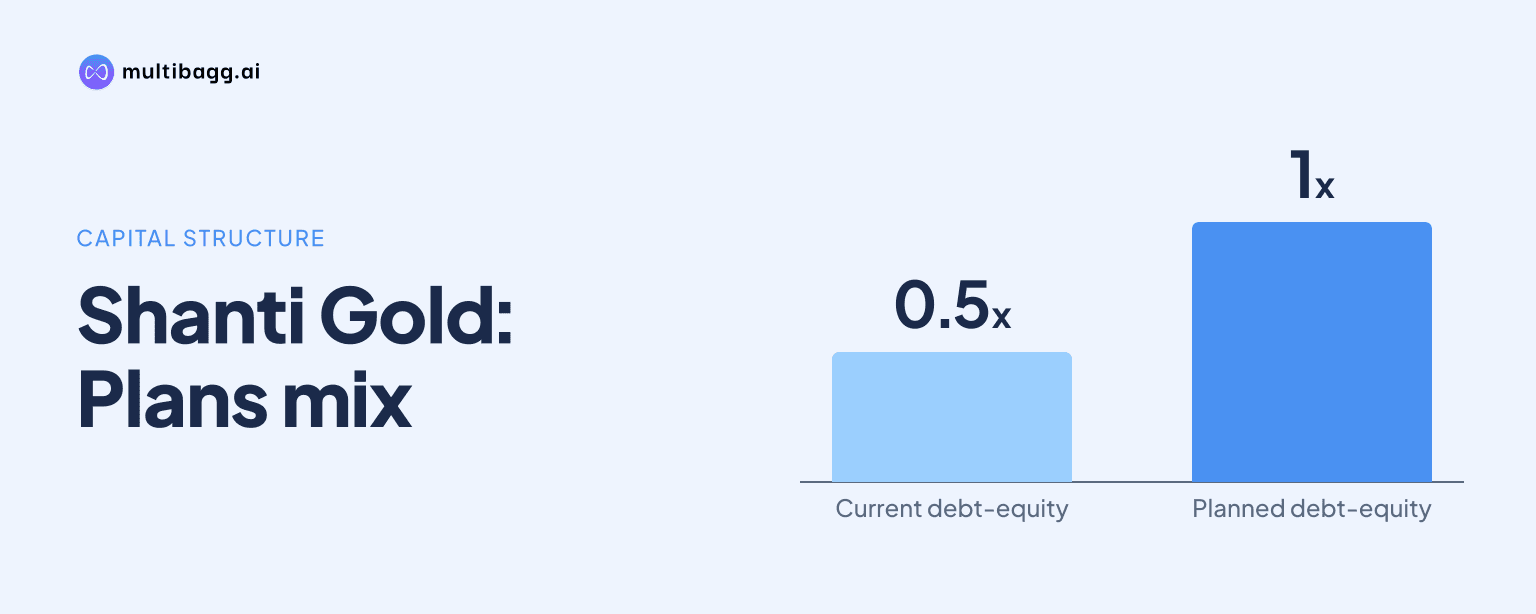
Shanti Gold International Limited plans to fund inventory needed for new facilities, product launches and market expansion through equity and debt, with management comfortable taking debt-equity from 0.5x to up to 1x. The framework follows a Rs 99.83 crore Q2 FY27 rights issue and management’s expectation of inventory build-up for a couple of quarters.
Know Shanti Gold International inside out
Results, valuation, peers and who's buying, in one view.
Why is Shanti Gold increasing inventory?
Shanti Gold is increasing inventory because its growth programme requires more gold and working capital for product launches, factory expansion and new markets. Chief Financial Officer Shriram Iyengar said inventory would remain elevated for a couple of quarters as the company establishes the operations and market presence linked to its expanded manufacturing base.
The funding need follows substantial operating growth in H1 FY27. Revenue from operations rose 102.3% year on year to Rs 1,462.3 crore, while volume increased 41.0% to 1,057.6 kilograms. In Q2 FY27, revenue grew 73.4% to Rs 746 crore and volume increased 25.4% to 535.5 kilograms. Management attributed this growth to customer acquisition, greater penetration with existing customers, added capacity and a broader product portfolio.
The Marol facility had commenced operations by the Q2 and H1 FY27 call and had added manufacturing capacity and flexibility, according to management. Shanti Gold is also preparing a Jaipur facility intended to produce machine-made plain gold jewellery and strengthen its North India presence. Management said interior work was under way and the facility could start in January or February, creating another initial requirement for inventory.
How will Shanti Gold fund higher working capital?
Shanti Gold plans to fund higher working capital through a balanced mix of equity and debt. Management said the Rs 99.83 crore rights issue completed during Q2 FY27 was being deployed towards working-capital requirements, while further debt could be raised if available funds did not meet business needs.
Management linked the rise in short-term borrowings during H1 FY27 to inventory needed after the Marol factory started operations. Iyengar said the company had raised both debt and equity in the first half to support its growth trajectory, describing jewellery manufacturing as a working-capital-intensive business in which more capital can support more gold purchases and output.
Shanti Gold also identified advance gold as a potential financing option in the future. Separately, management described Gold Metal Loan, or GML, as a tool it uses to hedge inventory. Neither mechanism was presented as a committed funding amount, and management did not give a timetable or value for further debt, advance gold or GML financing.
What debt-equity ratio can Shanti Gold reach?
Shanti Gold said it was at 0.5x debt-equity at the time of the Q2 and H1 FY27 call and that management was comfortable planning for a level of up to 1x. Iyengar said the 0.5x ratio gave the company room to borrow more if inventory and other working-capital needs increased.
The 1x level is a management comfort threshold rather than a commitment to increase debt to that point. Iyengar said Shanti Gold might not necessarily reach 1x, but management considered the ratio manageable under the current situation. The framework reflects the company’s plan to build scale through factories, product coverage and market expansion rather than a disclosed borrowing target.
GML represented roughly 15% to 20% of Shanti Gold’s stock profile at the time of the call. Management said it could be comfortable increasing GML to 30% of stock levels, subject to market support and availability. The company did not disclose its total debt, borrowing cost, maturity profile or a target date for moving either debt-equity or GML exposure higher.
Got a follow-up? Ask IRIS
What growth plan is driving Shanti Gold’s funding needs?
Shanti Gold’s funding plan supports management’s FY27 revenue guidance of about Rs 3,200 crore to Rs 3,500 crore, which management said would represent 60% growth over FY26. Management said it intended to pursue this outcome through volume growth, capacity utilisation, customer additions and execution while maintaining working-capital discipline.
Revenue and volume expanded faster than profit measures during H1 FY27. Earnings before interest, tax, depreciation and amortisation, or EBITDA, increased 29.2% year on year to Rs 114 crore, while profit after tax rose 32.5% to Rs 80 crore. By comparison, revenue rose 102.3% and volume rose 41.0%, indicating that sales growth outpaced EBITDA and profit growth in the first half.
In Q2 FY27, EBITDA rose 15.6% to Rs 42.5 crore and profit after tax increased 13.5% to Rs 29.6 crore, versus revenue growth of 73.4%. Management said its strategy was to gain market share rather than optimise short-term margins. It stated a broad EBITDA margin range of 5% to 7% under current market dynamics, noting that product mix can vary between higher-volume, lower-margin and lower-volume, higher-margin products.
How do new markets increase Shanti Gold’s capital requirement?
Shanti Gold said its domestic expansion requires inventory to support a wider customer and product offering. Management said the company had expanded from South India into western, northern and eastern markets, while the Jaipur facility is intended to reinforce the North India presence. It also said larger retailers seek suppliers with substantial inventory, design availability and support, directly linking stock holding with customer acquisition.
International expansion is another part of the plan. Management said the Dubai office had received approvals and that export volumes could begin once conditions settled. Export revenue had doubled to Rs 82 crore, according to management, while export share had increased from 4% to 6%; management expected the share to settle between 6% and 7% in FY27.
Seasonality also affects working-capital needs. Management said retailers build inventory before Dhanteras, Diwali and the wedding season, and reported healthy traction from retail partners ahead of these occasions in H2 FY27. Supplying festive demand, additional geographies and new jewellery categories is the operational rationale management gave for supporting a larger inventory base with equity and debt.
Conclusion
Shanti Gold’s disclosed capital-structure plan combines the Rs 99.83 crore rights issue, existing borrowing headroom and potential use of GML or advance gold to fund inventory-led growth. The company’s 0.5x debt-equity position and management’s comfort level of up to 1x provide the stated framework as Marol ramps up, Jaipur is prepared and product and market coverage broaden.
The next developments to watch are the possible January or February start of the Jaipur facility, progress at the Dubai office and delivery against FY27 revenue guidance of Rs 3,200 crore to Rs 3,500 crore. Management also expects inventory holding for a couple of quarters, making future disclosures on working capital, borrowings and the debt-equity ratio relevant to the execution of this plan.