










Shanti Gold Q2 revenue rose 73% while EBITDA margin fell
Key highlights
- Shanti Gold's Q2FY27 revenue from operations rose 73.45% year on year to Rs 745.95 crore.
- Shanti Gold's Q2FY27 EBITDA margin was 5.70%, versus 8.55% in Q2FY26 and 9.97% in Q1FY27.
- Shanti Gold's Q2FY27 volume increased 25.4% year on year to 535.5 kg.
- Shanti Gold raised Rs 99.83 crore through a rights issue during Q2FY27.
powered by IRIS
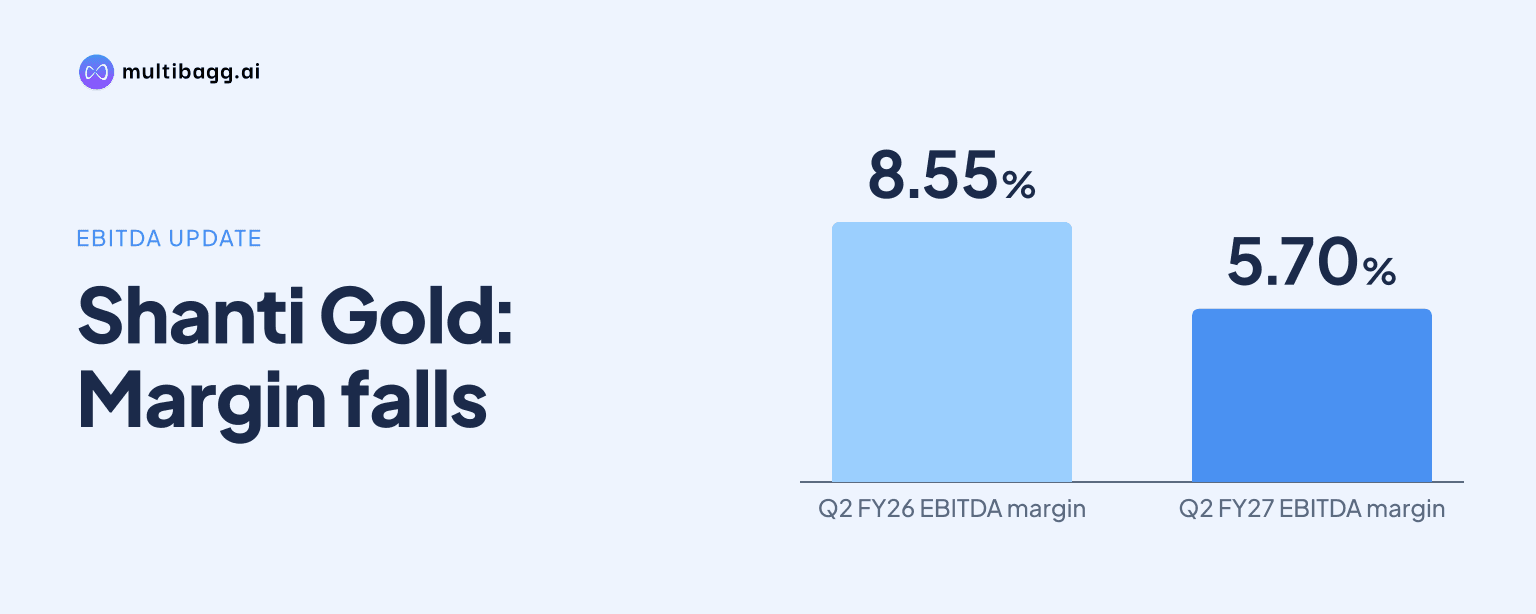
Shanti Gold International Ltd. reported Q2FY27 revenue from operations of Rs 745.95 crore, up 73.45% from Q2FY26, while earnings before interest, tax, depreciation and amortisation (EBITDA) margin fell to 5.70% from 8.55%. Volume rose 25.4% to 535.5 kg, but EBITDA increased 15.56% to Rs 42.52 crore.
Know Shanti Gold International inside out
Results, valuation, peers and who's buying, in one view.
What drove Shanti Gold's Q2FY27 revenue growth?
Shanti Gold's Q2FY27 revenue growth coincided with higher jewellery volume, which rose to 535.5 kg from 427.0 kg in Q2FY26. Revenue from operations increased by Rs 315.87 crore year on year, from Rs 430.08 crore to Rs 745.95 crore, while volume increased by 108.5 kg over the same comparison.
Domestic sales remained Shanti Gold's principal channel in Q2FY27, accounting for 93% of revenue, with international sales contributing 7%. The presentation does not provide rupee revenue by geography, but the disclosed split shows that the quarterly sales increase was predominantly linked to the domestic business.
Sequentially, revenue increased from Rs 716.38 crore in Q1FY27 to Rs 745.95 crore in Q2FY27, a rise of Rs 29.57 crore. The quarterly volume trend similarly rose from 522 kg in Q1FY27 to 536 kg in Q2FY27, although the performance-highlights page gives the quarter's volume as 535.5 kg.
How did Shanti Gold's Q2FY27 profitability change?
Shanti Gold's Q2FY27 profitability rose in rupee terms but declined as a proportion of revenue. EBITDA was Rs 42.52 crore, 15.56% above Rs 36.79 crore in Q2FY26, while the EBITDA margin fell by 2.85 percentage points to 5.70% from 8.55%.
Gross profit increased 17.2% to Rs 48.50 crore in Q2FY27 from Rs 41.30 crore a year earlier, but gross margin fell to 6.50% from 9.61%. Profit after tax (PAT) rose 13.50% to Rs 29.56 crore, while PAT margin declined to 3.96% from 6.06% in Q2FY26.
The sequential change was sharper than the year-on-year comparison. Despite revenue increasing by Rs 29.57 crore from Q1FY27, gross profit fell by Rs 29.50 crore and EBITDA declined by Rs 28.93 crore; EBITDA margin decreased from 9.97% to 5.70%.
Basic earnings per share were Rs 3.99 in Q2FY27, compared with Rs 7.30 in Q2FY26 and Rs 7.00 in Q1FY27. The Q2FY27 presentation also reports profit before tax of Rs 38.07 crore, up 12.59% from Rs 33.82 crore a year earlier, which was below the Rs 65.26 crore reported in Q1FY27.
What do Shanti Gold's quarterly costs show?
Shanti Gold reported cost of materials consumed of Rs 859.56 crore in Q2FY27, compared with Rs 482.37 crore in Q2FY26 and Rs 625.26 crore in Q1FY27. Changes in inventories were negative Rs 162.08 crore in Q2FY27, versus negative Rs 93.63 crore a year earlier and positive Rs 13.11 crore in the preceding quarter.
Employee benefit expenses were Rs 2.26 crore in Q2FY27, compared with Rs 1.71 crore in Q2FY26 and Rs 2.20 crore in Q1FY27. Other expenses were Rs 3.69 crore, above Rs 2.84 crore a year earlier but below Rs 4.36 crore in Q1FY27.
The presentation does not assign a specific reason for the Q2FY27 margin decline. It reports the material-consumption, inventory-change, employee-cost and other-expense lines that bridge revenue of Rs 745.95 crore to EBITDA of Rs 42.52 crore, without management commentary on the movement.
Below EBITDA, other income was Rs 6.00 crore in Q2FY27, up from Rs 2.67 crore in Q2FY26, while finance costs doubled to Rs 8.48 crore from Rs 4.22 crore. Depreciation increased to Rs 1.96 crore from Rs 1.43 crore, and tax expense was Rs 8.51 crore compared with Rs 7.77 crore a year earlier.
Got a follow-up? Ask IRIS
How did Shanti Gold perform in H1FY27?
Shanti Gold's H1FY27 revenue more than doubled year on year, while its EBITDA and PAT margins were lower than in H1FY26. Revenue from operations was Rs 1,462.33 crore, up 102.30% from Rs 722.85 crore, and volume rose 41.0% to 1,057.6 kg from 750.0 kg.
H1FY27 EBITDA increased 29.22% to Rs 113.97 crore from Rs 88.20 crore, but EBITDA margin declined to 7.79% from 12.20%. PAT rose 32.52% to Rs 80.04 crore from Rs 60.40 crore, while PAT margin decreased to 5.47% from 8.36%.
Domestic revenue represented 94% of Shanti Gold's H1FY27 sales and international revenue represented 6%. Basic earnings per share were Rs 10.96, compared with Rs 11.40 in H1FY26, despite the increase in first-half PAT.
The first-half margin result was also below Shanti Gold's FY26 level. FY26 EBITDA margin was 9.86% on revenue of Rs 2,018.71 crore, compared with 8.13% in FY25, whereas the H1FY27 EBITDA margin was 7.79%.
What expansion plans and funding did Shanti Gold disclose?
Shanti Gold disclosed that its Marol, Mumbai facility was commissioned in June 2026 and added 4,000 kg per annum of capacity. It also listed an upcoming Jaipur facility with 1,200 kg per annum capacity, intended to support North India expansion as a distribution hub.
Management also outlined an entry into machine-made plain gold jewellery, described as a new growth vertical beyond cubic zirconia casting jewellery. Its export plan includes strengthening its presence across four international markets, participating in global trade exhibitions, and focusing on the United States and United Arab Emirates corridors.
During Q2FY27, Shanti Gold raised Rs 99.83 crore through a rights issue of 46,43,471 equity shares. The shares had a face value of Rs 10 each and were issued at Rs 215 per share.
As of September 30, 2026, total equity was Rs 777.44 crore, compared with Rs 598.39 crore on March 31, 2026. Current borrowings were Rs 403.99 crore at September 30, 2026, up from Rs 198.33 crore at the March 31, 2026 balance-sheet date, while inventories increased to Rs 530.97 crore from Rs 347.49 crore.
Conclusion
Shanti Gold delivered rapid Q2FY27 sales growth, with revenue up 73.45% and volume up 25.4%, but operating profit did not grow at the same rate. Gross margin, EBITDA margin and PAT margin were lower both year on year and sequentially, while the H1FY27 result showed the same gap between revenue growth and profit-margin performance.
The next items to watch are utilisation of the 4,000 kg-per-annum Marol capacity commissioned in June 2026, progress on the planned 1,200 kg-per-annum Jaipur facility, and implementation of the machine-made jewellery and export plans. Future disclosures on gross margin, EBITDA margin, inventory changes, current borrowings and the domestic-international revenue mix will show how these initiatives coincide with operating results.