










Sharda Motor Industries Limited reports $326.2m order pipeline
Key highlights
- Sharda Motor disclosed 14 new-vertical programmes with combined lifetime value of US$326.2 million.
- FY26 announcements contributed US$163.8 million of lifetime value across eight disclosed programmes.
- The largest programme is a US$41.7 million lightweighting control-arms order scheduled for Q1 FY28.
- The final listed production start is a US$19.5 million electric-vehicle control-arm assembly in Q4 FY28.
powered by IRIS
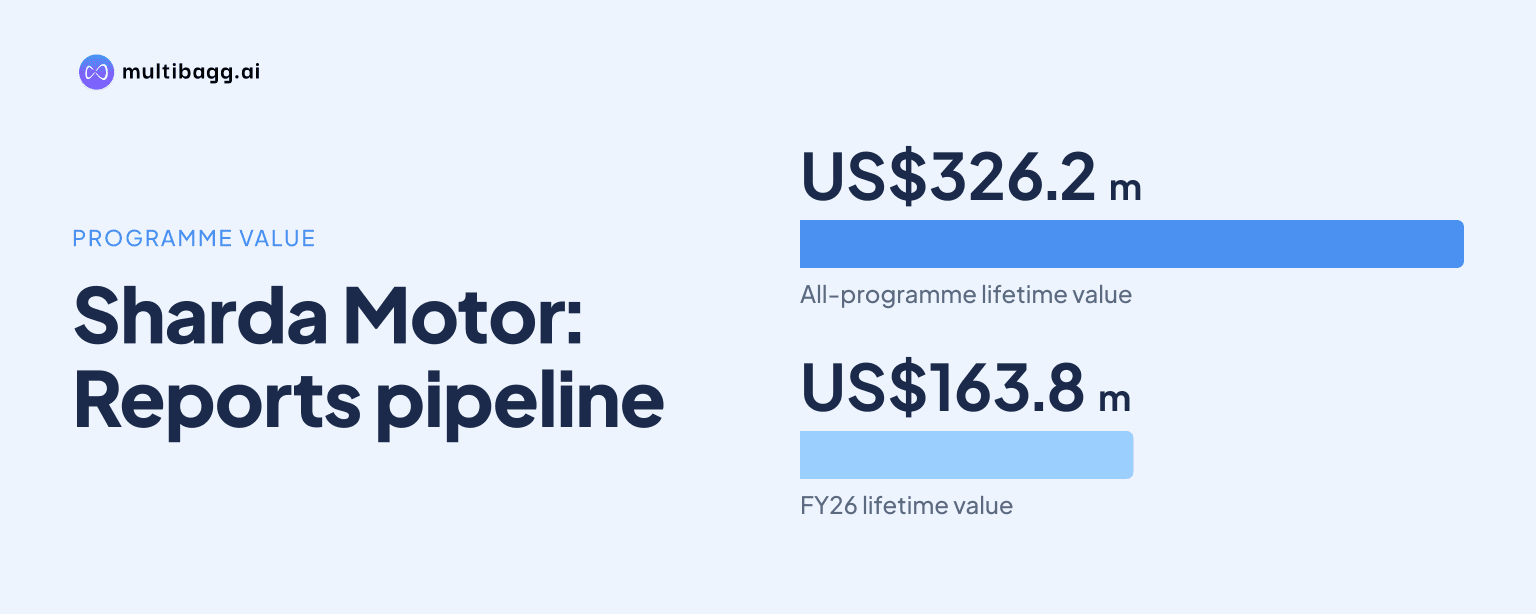
Sharda Motor Industries Limited has disclosed 14 new-vertical programmes with combined lifetime value of US$326.2 million, with start of production ranging from Q3 FY26 to Q4 FY28. The total is the sum of the company’s FY25, FY26 and FY27 order-update line items covering lightweighting, emission components, emission adjacencies and thermal management.
Know Sharda Motor Industries inside out
Results, valuation, peers and who's buying, in one view.
What is the disclosed lifetime value of Sharda Motor’s new-vertical orders?
Sharda Motor’s disclosed new-vertical orders total US$326.2 million in lifetime value across 14 programmes. This total comprises US$102.5 million from four FY25 announcements, US$163.8 million from eight FY26 announcements and US$59.9 million from two FY27 announcements.
FY26 is the largest announcement cohort, contributing US$163.8 million of lifetime value and US$32.7 million of annual value. Its disclosed lifetime value exceeds FY25’s US$102.5 million by US$61.3 million and FY27’s US$59.9 million by US$103.9 million; the presentation does not describe these annual values as booked revenue.
The largest single programme is a US$41.7 million lightweighting control-arms order for one of the fastest-growing passenger-vehicle companies, announced in FY26. It carries stated annual value of US$8.3 million and is scheduled to begin production in Q1 FY28, placing it among the later launches in the disclosed list.
Which Sharda Motor verticals account for the announced orders?
Lightweighting accounts for US$174.2 million of the US$326.2 million disclosed lifetime value, making it the largest labelled vertical in the order list. Global Business Vertical programmes account for US$94.1 million, while the Emission Business Vertical and Emission & Thermal Management entries account for US$17.5 million and US$40.4 million, respectively.
The lightweighting total covers FY25 control-arms programmes worth US$22 million and US$23 million, plus FY26 orders for control arms and links worth US$25 million, US$41.7 million, US$28 million and US$15 million. The FY27 electric-vehicle control-arm assembly adds US$19.5 million of lifetime value, with production scheduled for Q4 FY28.
Global Business Vertical orders include three emission-component programmes for a North American engine and genset manufacturer worth US$40 million, US$3.5 million and US$15 million. The same vertical also includes emission-adjacency orders worth US$24 million for a large heavy-industry emissions company and US$11.6 million for a leading North American agricultural-equipment original equipment manufacturer, or OEM.
The remaining two vertical labels widen the product set beyond those export-oriented and lightweighting programmes. A CEV adjacencies order in the Emission Business Vertical is worth US$17.5 million and started production in Q3 FY26, while a premium two-wheeler emission-system programme in Emission & Thermal Management has US$40.4 million of lifetime value and a Q1 FY28 production start.
When are Sharda Motor’s orders scheduled to start production?
Sharda Motor’s disclosed production timetable begins with programmes already started in Q3 FY26 and extends to Q4 FY28. Four entries are explicitly marked as having started production: the US$22 million control-arms order, the US$23 million control-arms order, the US$17.5 million CEV-adjacencies order and the US$25 million control-arms-and-links volume increase.
The US$40 million emission-components programme for a North American engine and genset manufacturer is scheduled for Q3 FY27. Two further Global Business Vertical programmes, each worth US$15 million in lifetime value, are also scheduled for Q3 FY27, alongside a US$15 million lightweighting control-arms programme for a passenger-vehicle customer.
Later production launches are concentrated in FY28. Lightweighting control arms worth US$41.7 million and lightweighting links worth US$28 million are scheduled for Q1 FY28, as is the US$40.4 million premium motorcycle emission-system programme and the US$11.6 million agricultural-equipment emission-adjacencies order.
The final listed launch is the US$19.5 million electric-vehicle control-arm assembly for an emerging passenger-vehicle company in India, scheduled for Q4 FY28. The company provides annual values and launch dates for these programmes, but does not provide a year-by-year revenue forecast or production volumes for the US$326.2 million portfolio.
Got a follow-up? Ask IRIS
How do the orders fit Sharda Motor’s export strategy?
Sharda Motor links its Global Business Vertical to target markets in the United States and Europe, where it indicates a combined US$1.82 billion market across five product categories. Commercial-vehicle emission components are the largest identified category at US$1.1 billion, followed by temperature-controlled tubes at US$310 million and genset emission and muffler systems at US$225 million.
The North American orders correspond to several of those target product areas. Emission components for the engine and genset customer amount to US$58.5 million across three disclosed programmes, while the agricultural-equipment emission-adjacencies order contributes US$11.6 million and starts production in Q1 FY28.
Management attributes the export opportunity to China+1 supply-chain considerations and new emission norms in the United States and Europe. The presentation also says Sharda Motor has a dedicated Global Business Team for export expansion and has made research and development investments in emission-control systems.
The domestic end-user mix provides context for the lightweighting programmes. Passenger vehicles accounted for 52% of FY26 consolidated revenue from operations, commercial vehicles accounted for 44%, and other end-user segments accounted for 4%; the presentation says this split reduces exposure to cyclicality specific to either vehicle segment.
What could change the size of Sharda Motor’s new verticals?
Sharda Motor identifies regulation, localisation and technology alliances as potential growth mechanisms, but it does not provide revenue guidance for the US$326.2 million disclosed order list. The presentation says Bharat Stage 7, or BS7, could increase content per engine depending on final regulations and OEM requirements, leaving that opportunity conditional on rules and customer specifications.
For lightweighting, management’s stated plan is to increase market share in control arms and axle assemblies and add content per car through new-age lightweighting processes. The current order list includes US$174.2 million in lightweighting lifetime value, including the US$41.7 million control-arms programme due to start in Q1 FY28.
For global business, management identifies Europe and the United States as priorities for commercial-vehicle emission components, temperature-controlled tubes, heat shields, and genset and tractor emission and muffler systems. It also outlines technical alliances and joint ventures for localisation and powertrain-agnostic products, without disclosing a counterparty, value or timetable for any such transaction.
Management additionally refers to domestic-focused acquisitions in powertrain-agnostic products and potential adjacent markets including drones, robotics and artificial-intelligence data centres. These are strategic priorities rather than announced orders, unlike the 14 programmes for which the presentation gives annual values, lifetime values and production timing.
Conclusion
The disclosed order list totals US$326.2 million of lifetime value across 14 programmes, led by US$174.2 million in lightweighting and US$94.1 million in Global Business Vertical work. FY26 supplied the largest announcement cohort at US$163.8 million, while the programmes cover passenger vehicles, gensets, heavy industry, agricultural equipment, CEV applications and premium motorcycles.
The next disclosed execution milestones are Q1 FY28 starts for the US$41.7 million control-arms programme, the US$28 million lightweighting-links programme and the US$40.4 million premium motorcycle emission system, followed by the US$19.5 million electric-vehicle control-arm assembly in Q4 FY28. Management’s stated BS7 content opportunity remains dependent on final regulation and OEM requirements.