










Sharda Q2 revenue rose 54% while gross profit grew 20%
Key highlights
- Sharda reported Q2 FY27 revenue of Rs 1,211.2 crore, up 54% year on year.
- Q2 FY27 gross profit was Rs 233.1 crore, up 20%, while value-added sales grew 27%.
- Q2 FY27 EBITDA was Rs 125.7 crore and EBITDA margin was 10.4%.
- H1 FY27 revenue was Rs 2,222.3 crore, up 44%, while gross profit rose 14% to Rs 437 crore.
powered by IRIS
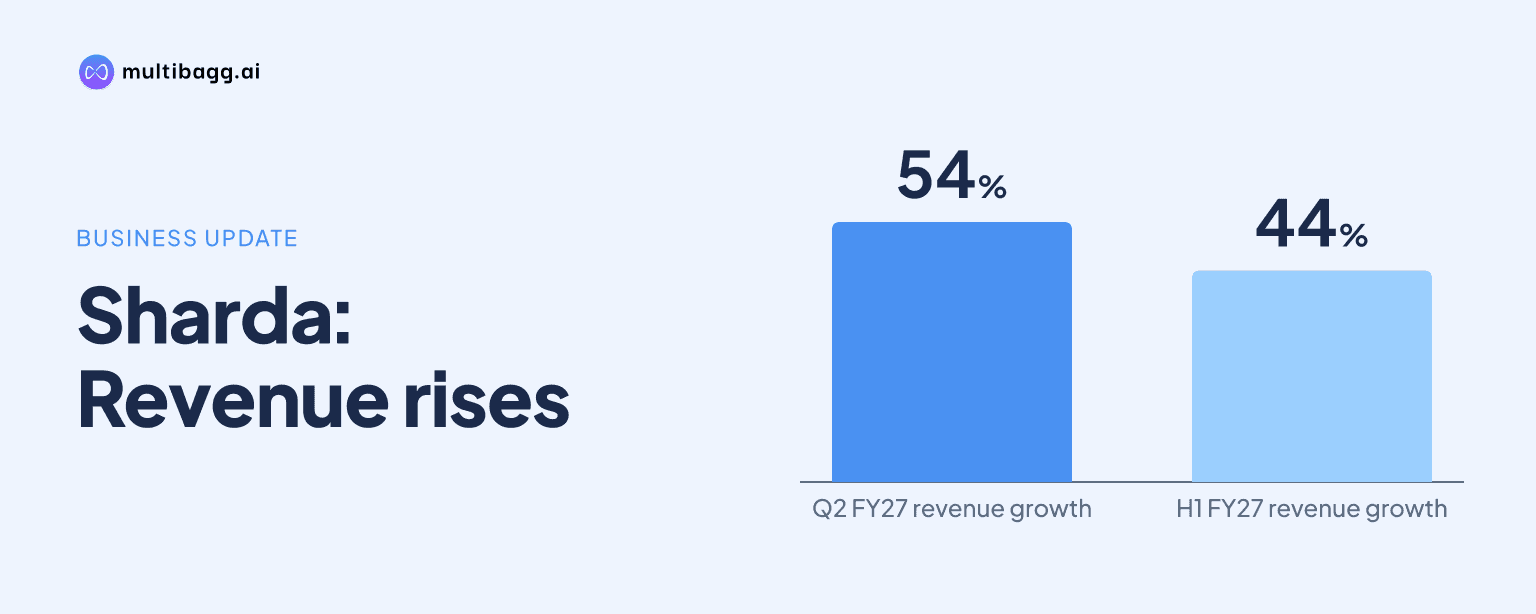
Sharda Motor Industries Limited reported Q2 FY27 consolidated revenue of Rs 1,211.2 crore, up 54% year on year, while gross profit grew 20% to Rs 233.1 crore in the quarter ended September 30, 2026. Sharda also reported 27% value-added-sales growth, but management did not quantify that metric or attribute the gross-profit gap to lightweighting start-up costs.
Know Sharda Motor Industries inside out
Results, valuation, peers and who's buying, in one view.
What did Sharda report in Q2 FY27?
Sharda reported revenue of Rs 1,211.2 crore in Q2 FY27, gross profit of Rs 233.1 crore and earnings before interest, tax, depreciation and amortisation, or EBITDA, of Rs 125.7 crore. Revenue increased 54% year on year, compared with 20% growth in gross profit and 24% growth in EBITDA, showing that profit measures grew more slowly than the top line.
EBITDA margin was 10.4% in Q2 FY27. Profit before tax before exceptional items was Rs 131.2 crore, compared with Rs 101.9 crore in the corresponding quarter of the prior year, after including Sharda's share of profit from joint ventures and associates. Profit after tax was Rs 99.4 crore for the September 2026 quarter.
Sharda began disclosing value-added-sales growth from Q2 FY27 to improve visibility on its growth. Management said it was still working on the rupee value and calculation methodology, so it did not provide the amount behind the 27% growth figure or historical data for direct reconciliation with revenue and gross profit.
Why did Sharda's gross profit grow slower than revenue?
Sharda did not give a specific cause for gross profit increasing 20% while revenue rose 54% in Q2 FY27. The supplied call transcript does not state that lightweighting start-up costs held back gross-profit conversion, nor does it disclose a start-up-cost amount, product-level gross profit or a margin impact from lightweighting programmes.
Management said material, people, logistics and other conversion costs remained areas of focus. It said Sharda was addressing these factors through sourcing efficiencies, localisation, productivity and appropriate commercial discussions with customers. These comments identify cost-management mechanisms, but do not assign a quantified effect to any one cost category during Q2 FY27.
The reported growth rates show value-added sales rose 27%, seven percentage points faster than gross profit, while revenue growth was 27 percentage points higher than value-added-sales growth. However, management's decision not to disclose the value-added-sales formula means the call does not establish the role of purchased materials, product mix or programme costs in the difference.
Sharda said its existing lightweighting control-arm and link programmes were moving through production and ramp-up in line with customer schedules. Its Chakan-3 lightweighting facility was also ramping up on those schedules. Those developments could affect the mix of activity, but the transcript does not quantify their contribution to Q2 revenue, gross profit or EBITDA.
How did H1 FY27 compare with the second quarter?
Sharda reported H1 FY27 revenue of Rs 2,222.3 crore, up 44% year on year, compared with Q2 revenue growth of 54%. Gross profit for the first half was Rs 437 crore, up 14%, while value-added sales grew 18%, both lower growth rates than the respective 20% and 27% reported in Q2.
H1 FY27 EBITDA was Rs 229 crore and its EBITDA margin was 10.3%, 0.1 percentage point below Q2's 10.4%. Profit before tax before exceptional items was Rs 246.3 crore, against Rs 209.6 crore in H1 FY26, and profit after tax was Rs 186 crore.
Q2 revenue of Rs 1,211.2 crore exceeded half of the Rs 2,222.3 crore reported for H1 FY27. The transcript does not provide Q1 standalone gross profit, value-added sales or EBITDA, so it does not support a calculation of quarter-on-quarter movement in those measures.
Got a follow-up? Ask IRIS
Which programmes could influence Sharda's H2 FY27 results?
Management said H2 FY27 growth would be supported by ramp-up in existing lightweighting orders, additional control-arm programmes, temperature-controlled tubes and North American export programmes. It said the timing of quarterly contribution would depend on customer production schedules and the pace of programme ramp-up, rather than giving a revenue or margin forecast.
In H1 FY27, Sharda won a control-arm order from an emerging Indian passenger-vehicle manufacturer with an annual business value of about $3.9 million and a lifetime value of $19.5 million. Start of production, or SOP, is planned for Q4 FY 2028. Management said its Donghee technology licensing relationship also covers subframes and torsion beams, and that Sharda had received several requests for quotation for subframes after a Q1 showcase.
Sharda also secured premium two-wheeler emission-system orders during H1 FY27 from a leading premium motorcycle manufacturer. Those orders carry annual business value of about $8.1 million and lifetime value of about $40.4 million, with SOP planned for Q1 FY 2028. Management said the programmes would use existing research, development, testing and manufacturing capabilities, with incremental spending mainly for product-specific tooling and development.
What regulatory dates and disclosures should readers track?
Management identified April 1, 2027 as the date when Corporate Average Fuel Efficiency 3, notified in September 2026, becomes applicable. It said the framework could lead original equipment manufacturers to use more efficient conventional engines, compressed natural gas, hybrids, electric powertrains and lightweighting to improve fleet fuel efficiency and carbon-dioxide performance.
Management also cited World Harmonised Light Vehicle Test Procedure, or WLTP, testing under Bharat Stage 6 from April 1, 2027 for M1 passenger vehicles and M2 vehicles up to 3.5 tonnes. A separate draft proposes WLTP requirements for M1 light commercial vehicles from April 1, 2028, and management said Sharda had already secured WLTP-related orders.
Draft Bharat Stage 7 standards propose an initial passenger-vehicle phase from April 2029, with later requirements to follow. Management said final notifications were awaited and it would not quantify incremental content at this stage. It also said Q3 FY27 faces a high comparison base because Q3 FY26 followed a goods and services tax-led demand recovery and the festive season.
Conclusion
Sharda's Q2 FY27 figures show a 54% increase in revenue to Rs 1,211.2 crore alongside 20% growth in gross profit to Rs 233.1 crore and 27% growth in value-added sales. The reported data establish that gross profit expanded more slowly than revenue and value-added sales, but management did not provide the value-added-sales calculation or a quantified explanation for the difference.
The next reported evidence will be H2 FY27 execution of lightweighting, control-arm, temperature-controlled-tube and North American export programmes, whose contribution depends on customer schedules. Readers can also watch for management's future disclosure of the value-added-sales amount and methodology, as well as the planned Q4 FY 2028 control-arm SOP and Q1 FY 2028 premium two-wheeler emissions SOP.