










SMIL targets Rs 6,000-Rs 18,000 lightweighting content
Key highlights
- Management targets Rs 6,000-Rs 18,000 of lightweighting content per vehicle, versus Rs 2,000-Rs 8,000 currently.
- The Donghee technology licensing agreement adds subframes and torsion beams to SMIL's control-arms and links portfolio.
- SMIL reports about 14% value market share in Indian passenger-vehicle and light-commercial-vehicle control arms and links.
- CAFE III applies to M1 passenger vehicles from FY28 to FY32, with its reference target moving from about 94.76 to 78.9 grams of carbon dioxide per kilometre.
powered by IRIS
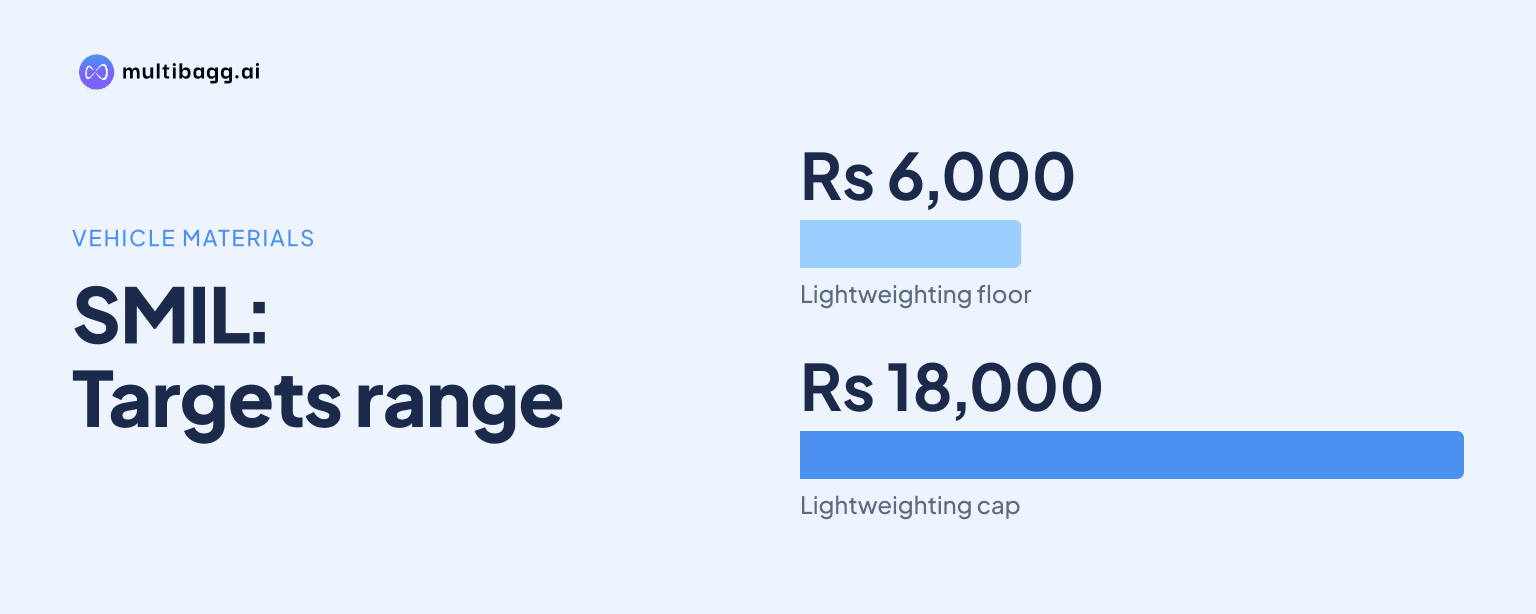
Sharda Motor Industries Limited (SMIL) has signed a technology licensing agreement with Donghee Industrial Co. Ltd. that adds subframes and torsion beams, and management targets Rs 6,000-Rs 18,000 of lightweighting content per vehicle versus the current Rs 2,000-Rs 8,000 range.
Know Sharda Motor Industries inside out
Results, valuation, peers and who's buying, in one view.
What does SMIL's Donghee agreement change?
SMIL's agreement expands its lightweighting offering beyond control arms and links by adding subframes and torsion beams. The presentation calls the arrangement a Technology Licensing Agreement, or TLA, with Donghee Industrial Co. Ltd. of the Republic of Korea, a supplier of chassis, lightweighting, body-in-white, fuel-tank and pedal-module technologies.
The stated purpose is to strengthen SMIL's established control-arms and links business with Donghee technology while creating opportunities in the two added product categories. SMIL's manufactured-parts list already includes upper and lower control arms, rear links, electric-vehicle links and front axle assemblies, while the presentation identifies subframes and torsion beams as the incremental range.
Donghee has 17 plants and six research and development centres across South Korea, Europe, China, the United States and Mexico, according to the presentation. It is a strategic partner of more than 20 global original equipment manufacturers, including Hyundai, Kia, Volkswagen and Stellantis, although the material discloses no production-start date, customer award or commercial value for the TLA.
How much lightweighting content per vehicle is SMIL targeting?
Management targets Rs 6,000-Rs 18,000 of SMIL lightweighting content per vehicle, compared with the current Rs 2,000-Rs 8,000 range. The target's lower end is Rs 4,000 above the current lower end and its upper end is Rs 10,000 above the current ceiling, reflecting the proposed addition of subframes and torsion beams to arms and links.
The stated ranges are a management portfolio-content objective rather than reported revenue per vehicle or a disclosed customer order. The presentation does not state how many vehicle programmes or original equipment manufacturers will use the new parts, meaning the revenue outcome depends on programme wins and adoption of the expanded product range.
SMIL reports about 14% value market share in India for passenger-vehicle and light-commercial-vehicle control arms and links. That reported position is the base business that the TLA is intended to reinforce, while no market-share figure is disclosed for subframes or torsion beams.
What capabilities support SMIL's expanded lightweighting portfolio?
SMIL has more than 50 stamping machines across Chennai, Nashik and Sanand, alongside direct-current welding, direct-current pulse welding, cold metal transfer welding and micro metal inert gas welding capabilities. The presentation also lists end-to-end testing facilities, including a hot-vibration laboratory, flow laboratory, semi-anechoic chamber, thermal laboratory, engine-testing laboratory and prototyping shop.
SMIL's gross tangible assets rose from Rs 361 crore in FY22 to Rs 579 crore in FY26, an increase of Rs 218 crore. Management says its fully backward-integrated manufacturing facilities are ready for incremental growth without capital expenditure, including two electric resistance welded, or ERW, tube-manufacturing facilities at SMIL-MWC serving the national market.
SMIL's Chennai research and development centre has more than 120 trained engineers working in design, computational fluid dynamics, finite element analysis and acoustics. The unit was established for emission systems in 2002 and emission-control systems in 2010, and it is certified to IATF 16949:2016, an automotive quality-management standard.
The company also has a design and development centre in Namyang, South Korea, established in 2011, with four trained engineers. The presentation says those engineers have more than 20 years of design, computational-fluid-dynamics and testing experience, supporting work with strategic customers and SMIL's India research and development team on exhaust systems.
Got a follow-up? Ask IRIS
Why is lightweighting relevant to SMIL's vehicle markets?
SMIL identifies tighter fuel-efficiency and carbon-dioxide rules, multiple powertrains and safety requirements as the mechanisms supporting lightweighting demand. Corporate Average Fuel Efficiency III, or CAFE III, applies to M1 passenger vehicles from FY28 to FY32, and its reference carbon-dioxide target tightens from about 94.76 grams per kilometre in FY28 to about 78.9 grams per kilometre in FY32.
The presentation links vehicle weight to electric-vehicle range, stating that a 10% weight reduction can improve range by 13.7%. It places entry-level electric-car range at 250-300 kilometres against an indicated ideal range of 400-500 kilometres, and notes that structural batteries could reduce weight by 10%.
SMIL says it supplies products for all powertrains, including leading electric-vehicle launches, and describes its lightweighting components as powertrain agnostic. In FY26, passenger vehicles accounted for 52% of consolidated revenue from operations, commercial vehicles for 44% and other segments for 4%; the approximately 14% market-share figure applies specifically to passenger-vehicle and light-commercial-vehicle control arms and links.
Lightweight materials can help balance weight reduction with crashworthiness, handling and stability, according to the presentation, which cites ultra-high-strength steel and aluminium. These stated benefits frame the relevance of new subframe and torsion-beam technologies, but the material does not quantify weight savings for any SMIL component or vehicle programme.
Conclusion
The Donghee TLA gives SMIL a defined route to extend its lightweighting portfolio from control arms and links into subframes and torsion beams. Management's Rs 6,000-Rs 18,000 content-per-vehicle target, compared with the current Rs 2,000-Rs 8,000 range, is the central disclosed outcome alongside an approximately 14% value share in relevant Indian arms and links and FY26 passenger-vehicle revenue exposure of 52%.
The next development to watch is conversion of the two new product categories into customer programmes and progress toward the stated content range, as the presentation gives neither timing nor order values. CAFE III's FY28-FY32 schedule for M1 passenger vehicles, including the reference carbon-dioxide reduction from about 94.76 to 78.9 grams per kilometre, is the disclosed regulatory timetable relevant to management's lightweighting rationale.