










Sharda Motor enters premium motorcycles with $40.4m order
Key highlights
- Sharda entered premium motorcycles with emission-systems orders worth approximately $40.4 million in lifetime business value.
- The motorcycle programme has approximately $8.1 million in peak annual business value and planned Q1 FY2028 SOP.
- Sharda secured approximately $61.5 million in combined lifetime business across new strategic areas in H1 FY27.
- Q2 FY27 consolidated revenue increased 54% year on year to Rs 1,211.2 crore.
powered by IRIS
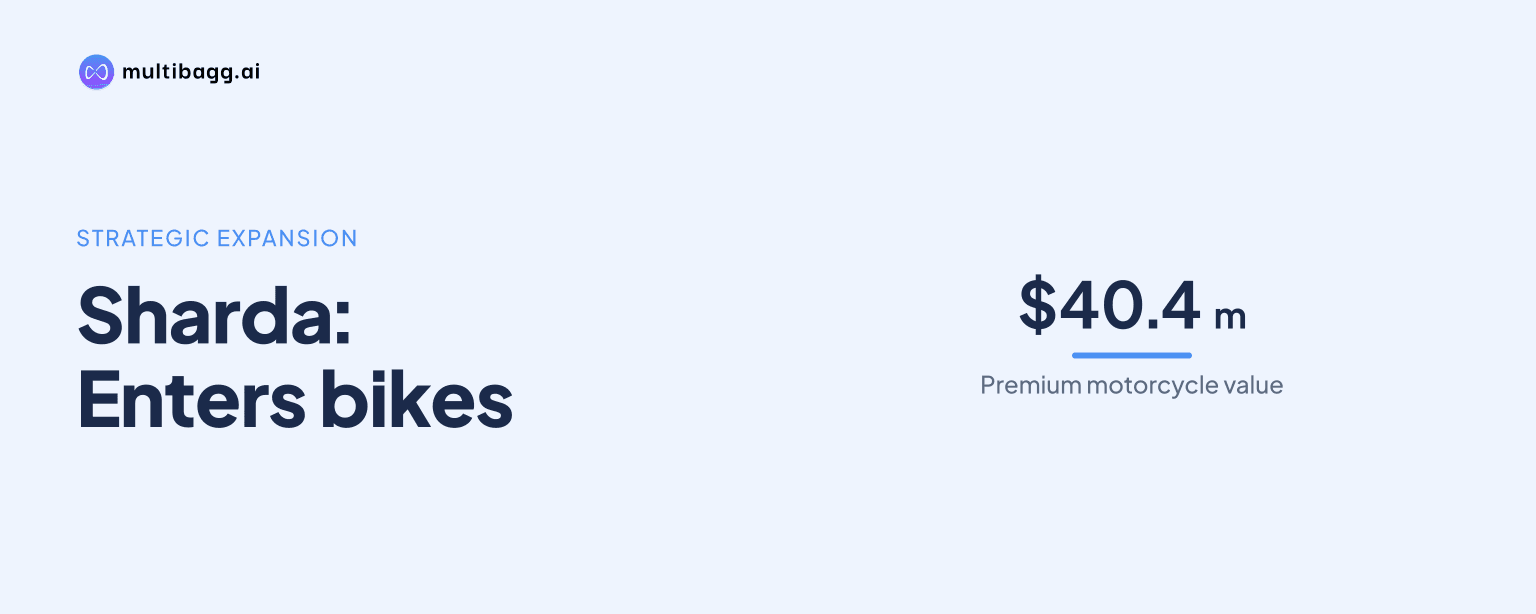
Sharda Motor entered the premium two-wheeler segment in H1 FY27 with emission-systems orders worth approximately $40.4 million in lifetime business value, carrying approximately $8.1 million in peak annual value and a planned Q1 FY2028 start of production. Management said the programme will use largely existing capabilities with controlled incremental investment.
Know Sharda Motor Industries inside out
Results, valuation, peers and who's buying, in one view.
What premium motorcycle order did Sharda secure?
Sharda secured emission-systems orders from a leading premium motorcycle manufacturer with approximately $8.1 million in combined peak annual business value and approximately $40.4 million in combined lifetime business value. Management described the award as Sharda’s entry into the premium two-wheeler segment, where engineering performance, quality and regulatory compliance are particularly important.
The motorcycle order was part of approximately $61.5 million in combined lifetime business secured during H1 FY27 in new strategic areas. Those areas included premium two-wheeler emission systems, powertrain-agnostic lightweighting and global business, making the $40.4 million motorcycle award the largest individually valued order disclosed in that group.
Sharda did not name the customer, specify the number of motorcycle platforms or disclose a contract duration. It did say that the lifetime-value figure and the $8.1 million annual figure cover combined orders, while the customer segment represents a new application area for its engineered emission-systems business.
When will Sharda’s motorcycle order begin generating revenue?
Sharda plans start of production, or SOP, for the premium motorcycle emission-systems order in Q1 FY2028. The programme therefore was not identified as a contributor to Q2 FY27 revenue of Rs 1,211.2 crore for the quarter ended September 30.
Management said annual business values presented for its orders represent peak annual business rather than revenue immediately earned at SOP. Ashwani Maheshwari, Deputy Managing Director, said customer programmes typically take about 1.5 years to two years after SOP to reach peak value, although actual timing depends on the individual programme and customer production schedules.
Sharda said incremental investment for the motorcycle award will be controlled and directed primarily to product-specific tooling and development. The company plans to use its existing research and development, testing and manufacturing capabilities, but did not disclose a rupee capital-expenditure amount or the facility that will supply the systems.
How does the motorcycle award fit Sharda’s strategy?
Sharda said the motorcycle order supports its plan to expand across products, vehicle segments and geographies while retaining engineered emission systems as a core business. Its other emission-related development areas include multi-fuel applications, Worldwide Harmonised Light Vehicles Test Procedure, or WLTP, products, temperature-controlled tubes and other emission adjacencies.
Lightweighting is the company’s second stated strategic pillar because management describes it as powertrain-agnostic. In H1 FY27, Sharda secured a control-arm order from a new strategic Indian passenger-vehicle customer with approximately $3.9 million in annual business value and approximately $19.5 million in lifetime value, with SOP currently planned for Q4 FY2028.
The control-arm order is smaller than the motorcycle award on disclosed lifetime value, but it broadens Sharda’s portfolio beyond emission systems. Management said its technology licensing agreement and relationship with Donghee extends the lightweighting range into subframes and torsion beams, and Sharda had received several requests for quotations, or RFQs, for subframes after a joint technology showcase in Q1.
Sharda also reported two additional patent applications during the quarter, taking cumulative filings to 26, and two additional grants, taking granted patents to six. The engineering team is working on development, testing, validation, localisation and manufacturing resilience across emission systems, thermal management and lightweighting.
Got a follow-up? Ask IRIS
How did Sharda perform before the new programme starts?
Sharda reported consolidated Q2 FY27 revenue of Rs 1,211.2 crore, up 54% year on year, while earnings before interest, tax, depreciation and amortisation, or EBITDA, increased 24% to Rs 125.7 crore. Gross profit rose 20% to Rs 233.1 crore and EBITDA margin was 10.4%.
For H1 FY27, revenue rose 44% year on year to Rs 2,222.3 crore and EBITDA rose 14.8% to Rs 229 crore. The H1 EBITDA margin was 10.3%, slightly below the 10.4% recorded in Q2 FY27, while profit before tax before exceptional items increased to Rs 246.3 crore from Rs 209.6 crore and profit after tax reached Rs 186 crore.
Management began disclosing value-added-sales growth in Q2 FY27, reporting a 27% increase against the 20% rise in gross profit. It attributed the difference to startup costs on lightweighting programmes in ramp-up, product mix and non-indexed commodities; management said exports had not yet contributed to this growth.
What factors could affect Sharda’s execution and future demand?
Sharda said demand was healthy across passenger vehicles, commercial vehicles, two-wheelers and three-wheelers during Q2 FY27, while maintaining a measured outlook. Management expects year-on-year industry growth in Q3 FY27 to be affected by a high Q3 FY26 base following goods and services tax-led demand recovery and the festive season.
Management said H2 FY27 growth should be supported by the ramp-up of existing lightweighting orders, additional control-arm programmes, temperature-controlled tubes and North American export programmes. It cautioned that the exact quarterly contribution will depend on customer production schedules and the pace of each programme’s ramp-up.
Regulation is also relevant to Sharda’s technology plans. Corporate Average Fuel Economy 3 was notified in September 2026 and becomes applicable from April 1, 2027, while WLTP testing under Bharat Stage 6 applies from April 1, 2027 to M1 passenger vehicles and M2 vehicles up to 3.5 tonnes.
Sharda said it has already secured WLTP-related orders and is working with customers on system development, validation and readiness. Draft Bharat Stage 7 standards propose an initial passenger-vehicle phase from April 2029, but management said final notifications are awaited and did not quantify any potential increase in emission-system content.
Conclusion
The premium motorcycle order gives Sharda a disclosed $40.4 million lifetime entry into a new customer segment, while management expects to fulfil it through existing research, testing and manufacturing capabilities plus controlled tooling and development spending. It complements H1 FY27 strategic orders across lightweighting and global business, as Q2 revenue increased 54% to Rs 1,211.2 crore.
The next milestone is the planned Q1 FY2028 SOP for the motorcycle programme, followed by customer-led ramp-up toward its approximately $8.1 million peak annual value. Investors can also watch the planned Q3 FY27 SOP for North American genset orders, the Uttarakhand plant’s scheduled SOP and progress in converting subframe RFQs into confirmed orders.