










Sharda Motor sets Q3 FY27 start for $94m export pipeline
Key highlights
- Sharda plans to begin North American genset program SOP in Q3 FY27.
- Sharda values current global export orders at about $94 million over their lifetimes.
- Exports did not contribute to the quarter’s 27% value-added sales growth.
- Sharda says programs typically take 1.5 to two years after SOP to reach peak annual value.
powered by IRIS
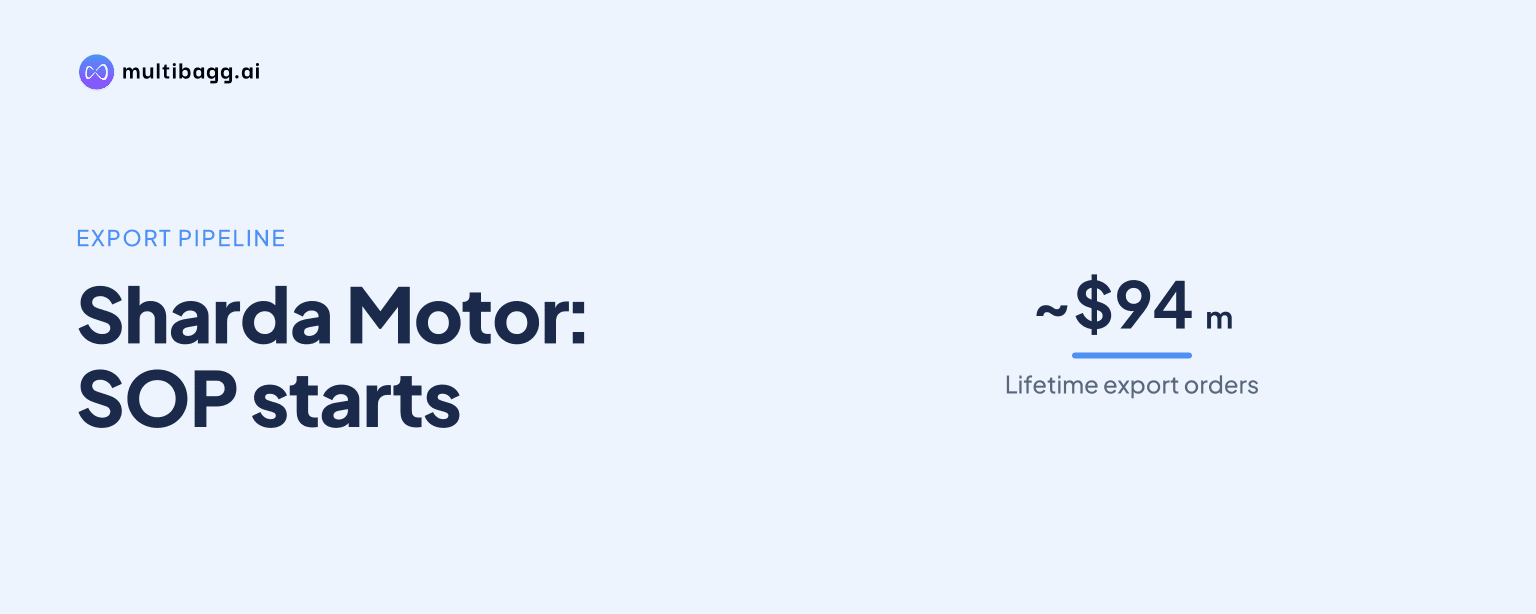
Sharda Motor expects North American genset export programs to begin start of production in Q3 FY27, with current global orders carrying about $94 million in lifetime value. Management said exports have not contributed to the current quarter’s 27% year-on-year value-added sales growth, making the scheduled launches an additional potential revenue source.
Know Sharda Motor Industries inside out
Results, valuation, peers and who's buying, in one view.
When will Sharda’s North American export programs begin?
Sharda said it is fully on target to begin start of production, or SOP, for North American genset manufacturing orders in Q3 FY27. Management described SOP as startup production rather than immediate peak output: the line must be installed, production part approval process, or PPAP, requirements completed, and shipments started before volumes can ramp. The company said no delay or postponement had been communicated by the specific customer as it approached the Q3 FY27 SOP point.
The schedule includes previously announced orders for a North American engine and genset manufacturer, as well as work for a large heavy-industrial emission company. During H1 FY27, Sharda said both export programs were progressing in line with their announced schedules. Management nevertheless identified changing trade policies, tariffs and customer investment planning as global uncertainties, and said production and investment plans would remain flexible as customer requirements evolve.
What does Sharda’s $94 million export pipeline include?
Sharda said its current export order base has combined peak annual business value of almost $17.8 million and lifetime value of around $94 million. Management identified three customer groups in that base: a North American genset manufacturer, a leading North American agriculture-equipment original equipment manufacturer, or OEM, and a large heavy-industry emission company. Lifetime value represents the aggregate value assigned to programs over their lives, not sales expected in a single year.
In H1 FY27, Sharda also secured incremental global orders for engineered tubes supplied to a global agriculture-equipment manufacturer and low-pressure tubes for a global construction and mining-equipment manufacturer. Its overseas focus includes the Americas and Europe, with products for engine and genset applications, commercial-vehicle emissions, agriculture equipment and temperature-controlled tubes. Management said existing customers have further wallet-share potential after Sharda executes the programs already awarded.
Why have exports not lifted Sharda’s current growth?
Sharda said exports are still to kick in and did not drive the 27% year-on-year value-added sales growth discussed for the current quarter. Management attributed the increase to growth in the established emission segment and additional revenue from lightweighting programs that had entered SOP. The distinction means the Q3 FY27 export launch is not evidence of revenue already included in the reported growth rate.
Gross profit grew about 20% in the same quarter, compared with 27% growth in value-added sales. Management said recently started lightweighting programs were in their startup and ramp-up phases, carrying associated costs, while product mix and non-indexed commodities also affected the relationship between the two measures. Management expects benefits from the newer programs to become more visible as they mature and scale, but did not quantify an export revenue or margin contribution.
Got a follow-up? Ask IRIS
How quickly can Sharda’s new programs reach peak value?
Sharda said awarded programs typically take about 1.5 to two years from SOP to reach disclosed peak annual business value, although the timing depends on the individual customer’s production schedule. That framework applies to the Q3 FY27 genset launches and means the $17.8 million peak annual export figure should not be read as immediate sales at startup. Management confirmed that a program beginning SOP in Q3 FY26 could still be ramping during Q2 FY27.
Management expects H2 FY27 growth support from ramping existing lightweighting orders, additional control-arm programs, temperature-controlled tubes and North American export programs. It also said the precise quarterly contribution will depend on customer schedules and the pace of each ramp-up. A control-arm order secured in H1 FY27 has annual business value of about $3.9 million, lifetime value of $19.5 million and an SOP planned for Q4 FY28, showing that order wins can have materially later production starts.
What could affect Sharda’s export opportunity after Q3 FY27?
Sharda said it is seeing good request-for-quotation, or RFQ, traction in its selected export segments, but conversion depends on which opportunities it chooses to pursue. Management said successful delivery of current orders could provide greater access to customer wallet share. It added that announced orders can stem from a new product, a cost-advantage strategy, regulatory requirements, or a combination of those factors.
On regulation, management said Sharda is developing a Euro 7 product with an OEM for that customer’s exports and is also undertaking joint development for Bharat Stage 7, or BS7. Draft BS7 standards propose an initial passenger-vehicle phase from April 2029, while final notification remains awaited. Management did not quantify incremental content from BS7 and said the content-per-vehicle impact of Worldwide Harmonised Light Vehicle Test Procedure, or WLTP, upgrades is marginal.
Conclusion
Sharda’s export plan is moving from awarded orders toward execution, with North American genset SOP scheduled for Q3 FY27 and management citing about $94 million of lifetime value in its current global order base. The near-term financial context is that exports have not yet contributed to the quarter’s 27% value-added sales growth, which management attributed to emission products and lightweighting programs.
The next developments to watch are Q3 FY27 startup and shipment progress, customer production schedules, and whether deliveries lead to more RFQs and wallet-share gains. Management expects North American exports to support H2 FY27 growth, but has not given a quarterly revenue contribution, while tariffs, trade-policy changes and customer investment decisions remain unresolved variables.