










Sheel Biotech reports 198,502 organic-programme farmers
Key highlights
- Sheel Biotech reports organic-platform coverage of 198,502 farmers across 141,709 hectares in 15 states.
- Sheel Biotech says it has more than 9 years of government organic-programme execution.
- Sheel Biotech lists 5 government schemes for its organic-programme capability.
- Sheel Biotech describes a 4-stage model: adoption, training, certification and marketing support.
powered by IRIS
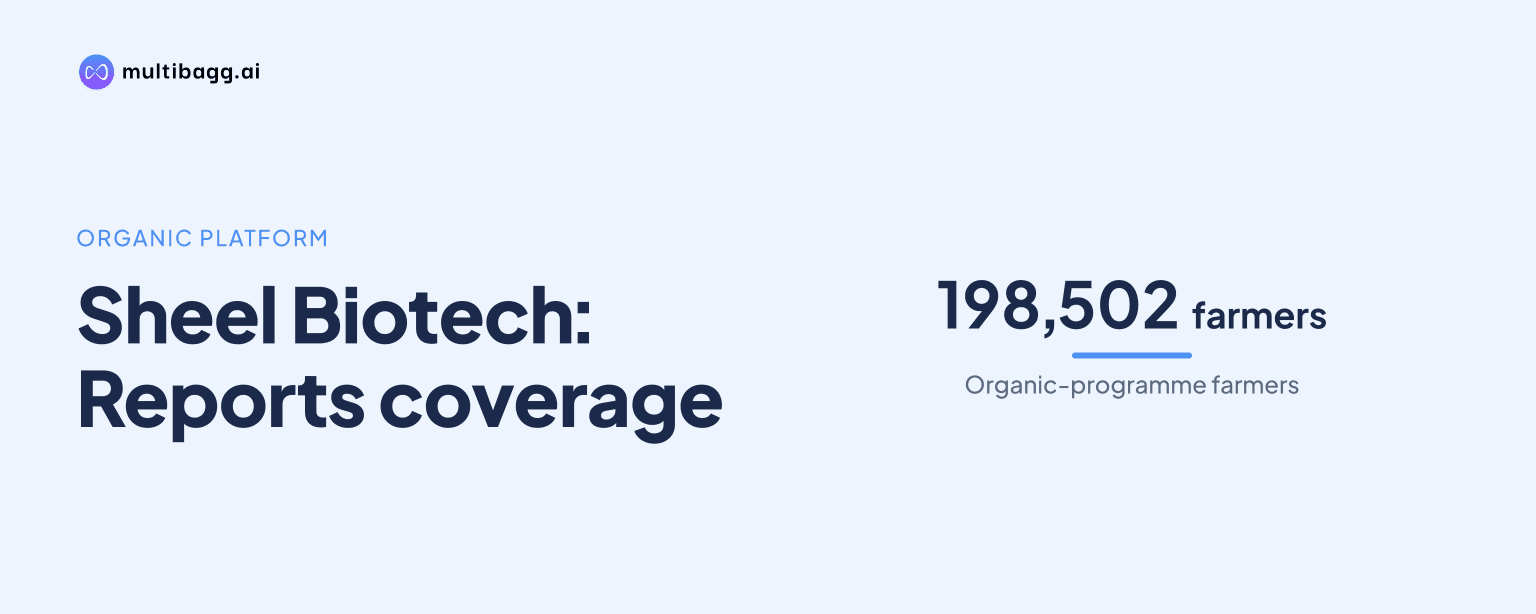
Sheel Biotech reports that its organic-adoption and certification programmes cover 198,502 farmers across 141,709 hectares in 15 states. The company says the platform uses the National Programme for Organic Production and Participatory Guarantee System frameworks, with a four-stage model of adoption, training, certification and marketing support.
Know Sheel Biotech inside out
Results, valuation, peers and who's buying, in one view.
What is the scale of Sheel Biotech’s organic programme coverage?
Sheel Biotech reports 198,502 farmers and 141,709 hectares under its organic-adoption and certification activities across 15 states. The presentation describes this 15-state presence as its largest footprint and says the company has spent more than nine years executing government organic programmes. These figures measure stated operating coverage, not sales of certified produce, revenue or farm output.
The reported land area equals about 0.71 hectare per covered farmer when the disclosed 141,709 hectares are divided by 198,502 farmers. That calculation describes the relationship between the two aggregate measures, not an average farm size or a certification outcome. Sheel Biotech does not disclose how farmers or hectares are distributed among the 15 states.
The presentation provides no earlier-period farmer, hectare or state figure. Therefore, it does not show whether coverage rose or fell from a prior year. What changes between the aggregate platform disclosure and scheme-level disclosure is the detail available: Sheel Biotech provides one combined farmer and hectare total, but no allocation by individual scheme, state or certification framework.
What does Sheel Biotech provide beyond certification?
Sheel Biotech says its full-service organic model has four stages: adoption, training, certification and marketing support. The model therefore includes farm-entry and training activity before certification, followed by marketing assistance for organic farmers. The source does not state how many of the 198,502 covered farmers received each of the four services.
On-farm input management is the specific operational mechanism listed within the platform. Sheel Biotech identifies NADEP compost, vermi compost, CPP compost and cow-pats pits as four input-management methods. The presentation does not quantify compost output, the number of pits or beds installed, or the share of the 141,709 hectares using any one method.
The four-stage service chain differs from the four named input methods. Adoption, training, certification and marketing support describe the delivery process, while compost and pit methods describe practices taught or managed at farm level. This distinction matters because the presentation reports the 198,502-farmer footprint for the combined platform rather than separately for certification, training or input management.
Sheel Biotech also identifies marketing assistance as part of its model, but supplies no volume, value or channel data for that activity. There is no disclosure of produce marketed, buyers served, prices realised or the number of farmers using marketing support. As a result, the stated service range is broader than the financial or commercial data provided for the organic segment.
Which organic frameworks and government programmes does Sheel Biotech use?
Sheel Biotech says its work covers the National Programme for Organic Production and the Participatory Guarantee System, two frameworks for organic adoption and certification. The company describes itself as certified under both frameworks and says its government-programme execution extends beyond nine years. It does not split the 198,502 farmers or 141,709 hectares between the two frameworks.
The presentation also lists five government schemes for which Sheel Biotech says it has multi-scheme capability. Those schemes are identified as MOVCD, MIDH, PKVY, Namami Gange and BPKP in the source. No scheme-level farmer count, land area, contract period or programme value is disclosed for any of the five names.
The comparison between the two certification frameworks and five government schemes shows two different layers of the platform. The frameworks relate to adoption and certification, while the schemes are presented as programme-delivery opportunities. Sheel Biotech does not say whether all five schemes operate in all 15 states or whether either framework is used under every scheme.
Sheel Biotech says accredited certification agencies provide export-ready standards. That statement concerns the standards route described in the presentation, rather than reported exports. The page gives no export revenue, shipment volume, destination country, number of export-certified farmers or number of certificates issued.
Got a follow-up? Ask IRIS
How does Sheel Biotech train farmers in organic practices?
Sheel Biotech lists four on-farm training modules: NADEP compost pit preparation, vermi compost beds, NADEP and CPP compost preparations, and cow-pats pits. These modules fit within the training stage of the company’s four-part delivery chain. The source does not state the number of training programmes, attendees, sessions or locations.
The disclosed modules focus on organic input preparation and structures used on farms. NADEP compost pit preparation and vermi compost beds are listed as separate modules, while NADEP and CPP compost preparations are grouped together in another module. The fourth module covers cow-pats pits, but the presentation provides no count of pits created across the 141,709 hectares.
Sheel Biotech does not report completion rates or certification outcomes for the 198,502 farmers. It also does not state which of the four training modules reached the most participants. That absence prevents a comparison of adoption rates between vermi compost beds, NADEP-related activities, CPP compost and cow-pats pits.
The presentation lists a Best Organic Award by the Agriculture Minister among its recognitions. It also names a Padma Shri recipient described as an FPO farmer and says the company has been acknowledged by four organisations. No date, selection criteria, project geography or financial effect is given for the award or acknowledgements.
What do the disclosures show about Sheel Biotech’s organic operating model?
Sheel Biotech presents an organic platform that combines two certification frameworks, five listed government schemes, four delivery stages and four training modules. The main numerical disclosure remains the combined footprint of 198,502 farmers, 141,709 hectares and 15 states. The source does not provide comparable operating metrics for its other activities, such as landscaping, hydroponics, packhouses or cold storage.
The platform’s stated sequence runs from adoption through training and certification to marketing support. Compost-related practices are the disclosed farm-level mechanism, while accredited certification agencies are the stated mechanism for export-ready standards. The presentation does not report the number of farmers progressing from one stage to the next.
No segment revenue, operating cost, profit, margin, order value or contract value is disclosed for the organic platform. This means the presentation supports an assessment of operating scale and stated service coverage, but not the segment’s financial contribution. It also does not identify the start year underlying the more-than-nine-year government-programme experience figure.
The available disclosure is therefore more detailed on delivery scope than on outcomes. Sheel Biotech gives a 15-state coverage figure and names four input-management methods, but does not disclose crop categories, certified-produce volumes, yield changes or farmer-income outcomes. Those omissions leave the economic results of the stated 141,709-hectare footprint unquantified.
Conclusion
Sheel Biotech reports a sizeable organic-adoption and certification platform covering 198,502 farmers across 141,709 hectares in 15 states. Its disclosed model combines the National Programme for Organic Production and Participatory Guarantee System frameworks with adoption, training, certification and marketing support, while its farm-level training centres on four compost and pit-related methods.
The next point to watch is whether Sheel Biotech discloses a breakdown of farmers and hectares by state, certification framework, government scheme or training module. The presentation sets no future coverage target, expansion schedule, export target or programme event, so the development of the platform beyond the current 15-state footprint remains unresolved.