










Sheela Foam uses Furlenco to launch furniture with low capex
Key highlights
- Sheela Foam has launched Sleepwell and Kurlon beds and recliners in the online segment.
- Furlenco makes about 20% to 30% of its furniture internally and outsources about 70% to 80%.
- Management put Furlenco’s return on assets and return on capital employed at around 25%.
- Management cited a Rs 600 crore pro forma EBITDA run rate, including about Rs 200 crore from Furlenco.
powered by IRIS
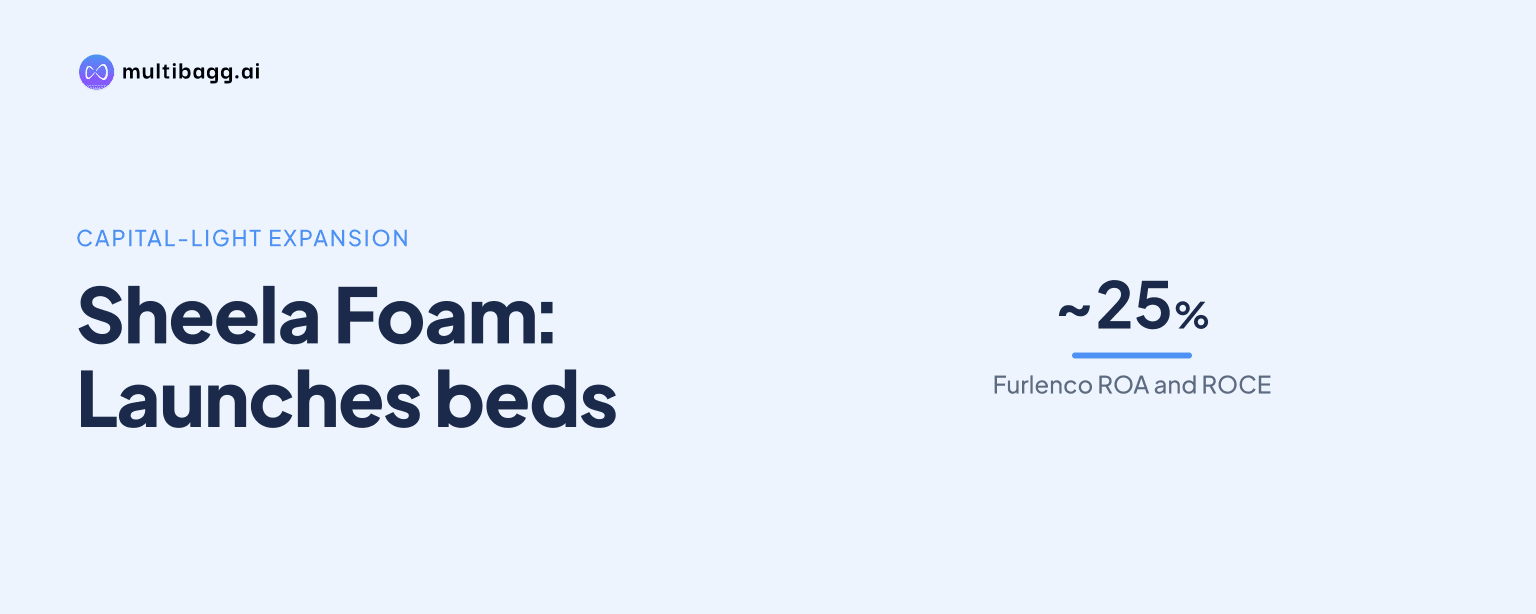
Sheela Foam has launched Sleepwell and Kurlon beds and recliners online using Furlenco for furniture design, manufacturing support and logistics, a model management said avoids substantial new capital expenditure; Furlenco currently makes about 20% to 30% of its furniture in-house and outsources the larger balance.
Know Sheela Foam inside out
Results, valuation, peers and who's buying, in one view.
What furniture has Sheela Foam launched?
Sheela Foam has launched Sleepwell and Kurlon beds and recliners in the online segment. Management said the products would also become available in some Sheela Foam stores very soon, followed by a gradual expansion of physical distribution rather than an immediate broad store rollout.
The launch is limited to beds and recliners in the disclosed product range. Management did not provide furniture revenue, unit sales, selling prices, store count, category margins or a timetable for the rollout beyond selected stores receiving the products shortly.
Sleepwell and Kurlon will be the consumer-facing brands for the furniture range, while Sheela Foam’s marketing and sales team will coordinate the commercial launch. Furlenco will provide the backend functions, separating brand marketing from design, production support and logistics.
How will Furlenco support Sheela Foam furniture?
Furlenco will design furniture, arrange manufacturing and provide logistics support for Sheela Foam’s branded furniture business. Management said Furlenco has capabilities across furniture design, supplier-side logistics control and consumer handling through its furniture-rental operations.
Sheela Foam’s team will handle marketing and sales for Sleepwell and Kurlon furniture, while Furlenco will manage the operational chain behind the products. This structure means Sheela Foam does not need to separately establish a furniture-design, manufacturing and delivery network before selling the new range.
Management said the arrangement should allow Sheela Foam to avoid investing heavily in capital expenditure, or capex, at the start of the business. Furlenco, in turn, can earn additional income from furniture sales conducted for Sheela Foam, although management did not disclose the commercial terms between the two businesses.
The arrangement uses Furlenco as a backend rather than combining the two businesses through a merger. Management said Furlenco would be consolidated but not merged, so its accumulated losses cannot offset Sheela Foam standalone profits for tax purposes, although Furlenco can continue to use benefits from its own past losses.
Got a follow-up? Ask IRIS
Why is Sheela Foam using outsourced furniture manufacturing?
Sheela Foam is using outsourced manufacturing because management said new production facilities would require substantial capex and could create idle capacity in weaker market periods. Furlenco makes about 20% to 30% of its furniture internally, while the remaining 70% to 80% is outsourced.
Management said outsourced production can be more efficient at volume after accounting for the cost of capital and depreciation. The supplier-led model therefore gives Sheela Foam access to production capacity for Sleepwell and Kurlon furniture without committing immediately to a large owned manufacturing base.
Furlenco may increase its internal manufacturing share over time, but management said outsourcing will remain a major part of its production capability. Its major investments during the past two to three years were directed toward rentable furniture because capital was limited and Sheela Foam was its only supplier of capital.
Furlenco’s rental model has also changed over roughly five years. Management said it previously leased furniture assets before renting them out, but it now buys the assets, records them as fixed assets and rents them to customers; that asset-owning rental model remains separate from the new branded furniture-sales arrangement.
How does the furniture launch fit Sheela Foam’s Furlenco plans?
The furniture launch is an operating linkage from bringing Furlenco into Sheela Foam’s fold, rather than a separately quantified investment programme. Management said Sheela Foam’s converted-equity ownership in Furlenco could range from 35% to 43%, with the remaining 57% to 65% treated as minority interest on consolidation.
Management described Furlenco as a furniture-rental company whose design, sourcing and logistics infrastructure can support retail furniture sales. It put Furlenco’s current return on assets and return on capital employed at about 25%, but declined to disclose furniture-level payback periods or internal rates of return because the sector is competition-sensitive.
Management gave a pro forma annual earnings before interest, taxes, depreciation and amortisation, or EBITDA, run rate of Rs 600 crore. It said Furlenco accounted for about Rs 200 crore of that run rate, compared with Rs 400 crore to Rs 450 crore from the existing Sheela Foam consolidated business.
The financing context remains relevant because management expects Furlenco to grow by more than 30%. Sheela Foam’s consolidated net debt was about Rs 600 crore at the time of the call and was expected to reach Rs 500 crore to Rs 550 crore by year-end before including Furlenco’s estimated Rs 250 crore net debt.
Conclusion
Sheela Foam’s furniture entry combines online Sleepwell and Kurlon beds and recliners with Furlenco’s design, supplier manufacturing and logistics network. The model leaves sales and marketing with Sheela Foam while relying on a production mix in which Furlenco makes 20% to 30% of furniture internally and outsources most of the rest.
The next disclosure to watch is the phased availability of beds and recliners in some stores, along with any future data on furniture sales or margins. Management also said a Furlenco listing may be proposed in the following year, while noting that such a step would be linked to private-equity holders’ exit rights rather than a settled requirement.