










Sheela Foam accepts lower margins after 25% mattress price rise
Key highlights
- Sheela Foam raised mattress prices by about 25% and foam prices by 35% to 40%.
- Sheela Foam said consolidated EBITDA margin was 9% to 10%, while gross margin was about 38% versus a historical 40% to 42%.
- Management estimated that full margin protection could have added Rs 15 crore to Rs 20 crore of EBITDA at 15% growth.
- Sheela Foam estimates that the sub-Rs 10,000 segment represents almost 40% of the mattress market.
powered by IRIS
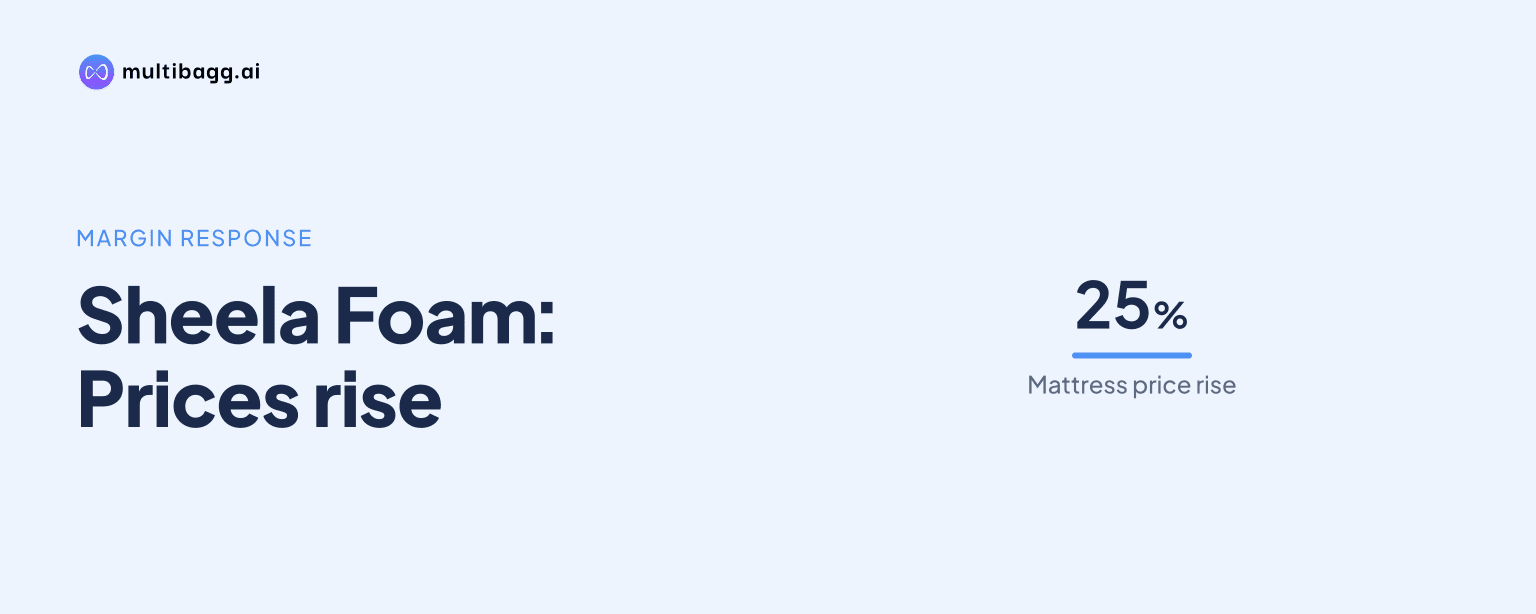
Sheela Foam accepted lower margins in the current quarter after raising mattress prices by about 25% and foam prices by 35% to 40%, judging that further increases could damage volumes. Consolidated earnings before interest, tax, depreciation and amortisation (EBITDA) margin was 9% to 10%, while gross margin was about 38% against a historical 40% to 42% range.
Know Sheela Foam inside out
Results, valuation, peers and who's buying, in one view.
What price increases did Sheela Foam take?
Sheela Foam raised foam prices by around 35% to 40% and mattress prices by about 25% following the Middle East disruption and higher raw-material costs. Management said it implemented multiple increases rather than a single revision because raw-material prices were moving by Rs 10 to Rs 20 every 15 days.
The increases enabled Sheela Foam to recover raw-material costs, but management said recovering the usual margin above those costs had become more difficult. Its gross margin was about 38%, compared with a historical 40% to 42%, because price increases are limited for institutional customers, including automotive customers, as well as mattress buyers.
Management said the intended unit-economics structure is for gross margin above 42%, with a greater business-to-consumer mix expected to help. However, it said a 50% increase in raw-material costs can become unaffordable for consumers, making complete pass-through impractical when input inflation is unusually high.
Why did Sheela Foam protect volumes over margins?
Sheela Foam accepted a lower margin because management believed additional price increases could reduce volumes and customer stability during what it considers a temporary disruption. Amit Kumar Gupta said the business could raise prices further to retain margins, but that approach would hurt overall volume.
Management instead focused on absolute profitability, compromising the margin percentage while seeking to maintain the profit pool and customer base. It said that, over a normal five-year period, about two-thirds to three-quarters of growth would generally come from volumes and one-quarter to one-third from value, whereas current growth has been tilted towards value by price increases.
Sheela Foam estimated that, at 15% growth, it might have earned an additional Rs 15 crore to Rs 20 crore of EBITDA if it had fully protected margins. Management nevertheless described retaining volumes as the preferable trade-off while raw-material costs, oil prices and global logistics conditions remain abnormal.
The margin decision coincided with higher advertising expenditure. Sheela Foam spent an additional Rs 15 crore to Rs 16 crore on advertising in the current quarter versus its earlier plan, while other expenses were about Rs 8 crore higher than the comparable quarter last year and Rs 15 crore above the first quarter, mainly because of advertising.
Got a follow-up? Ask IRIS
How far did profitability move from Sheela Foam's targets?
Sheela Foam's consolidated EBITDA margin was 9% to 10%, below the double-digit level management expects when conditions normalise. Management said a margin of about 12% would be reasonable for the business excluding Furlenco if conditions return to levels similar to those before February; including Furlenco would add 3 percentage points, according to management.
The gross-margin comparison shows the effect of the pricing choice: the current level of about 38% is 2 to 4 percentage points below the historical 40% to 42% range. Management said the gap reflects limits on passing through costs and said the business should recover margin if oil prices, logistics costs and goods movement normalise.
Sheela Foam reported operating EBITDA of Rs 83 crore and presented Rs 87 crore as the normalised level. Management said the Rs 4 crore difference was a one-time expense that would not recur in the next quarter; separately, it provided about Rs 7 crore across the first and second quarters after Australian customer A. H. Beard entered administration, resulting in a roughly 38% haircut on receivables.
Management had previously discussed a 13% to 15% EBITDA-margin objective for next year. It said the company had been on track to achieve that range under normal conditions, but now considers the outcome dependent on the duration of the disruption and the direction of raw-material prices.
How will Sheela Foam return to sub-Rs 10,000 mattresses?
Sheela Foam plans to use a new support-layer technology in a mattress positioned below Rs 10,000 while retaining a margin similar to its mid-segment products. Management said repeated price increases had shifted products that were previously below Rs 10,000 to around Rs 11,000 to Rs 12,000 or more.
Management estimated that the sub-Rs 10,000 category still represents almost 40% of the market. The proposed product is intended to recover that customer base without the margin dilution that could result from simply cutting prices, alongside the company's premiumisation efforts.
For U2O, management said price increases had also vacated earlier price points around Rs 8,000 and Rs 9,000. Its response is to increase distribution depth and introduce another product using the new technology, which management said should preserve margins while rebuilding volume at those price points.
Management did not give a timetable for the rollout or a volume target. In response to a question that described first-half mattress volumes as flat year on year, management said second-half volume growth would depend on whether Middle East disruption and raw-material costs stabilise, although it said the market had improved in October compared with September and the marriage season appeared better.
Conclusion
Sheela Foam's pricing strategy prioritises demand retention and absolute profitability over full margin recovery during a period of elevated input costs. The company has raised mattress prices by about 25% and foam prices by 35% to 40%, but gross margin remains about 38% versus the historical 40% to 42% range and consolidated EBITDA margin is 9% to 10%.
The next issue is whether raw-material, oil and logistics conditions normalise sufficiently for Sheela Foam to pursue its earlier 13% to 15% EBITDA-margin objective. Management's disclosed operating response is to deepen U2O distribution and introduce support-layer products below Rs 10,000, a market segment it estimates accounts for almost 40% of demand.